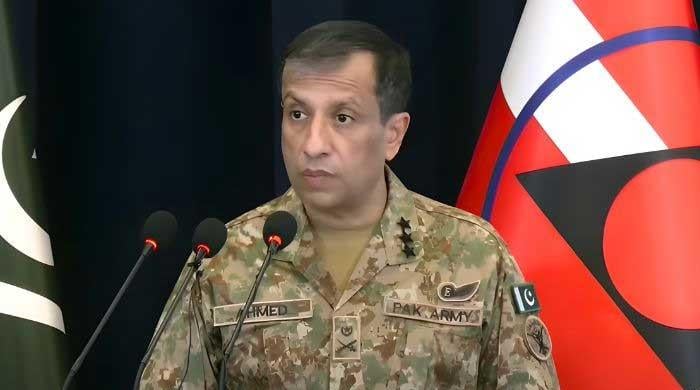
Inter-Services Public Relations (ISPR) Director General Lt Gen Ahmed Sharif Chaudhry said that Pakistan’s armed forces, with the support of the people, are fully committed to eradicating terrorism from the country, particularly from Khyber Pakhtunkhwa (KP).
Speaking at a news conference on Friday, the DG ISPR revealed that the number of terrorists killed this year is the highest in the past decade, reflecting the intensity and success of ongoing counterterrorism operations.
“Under the previous plan, terrorists and their facilitators were given space,” he said. “After every major incident of terrorism, their activities have increased, but the people of KP are bravely confronting this threat.”
Record counterterrorism operations in KP
Lt Gen Chaudhry disclosed that 917 terrorists were killed in Khyber Pakhtunkhwa this year alone, as of Sept 15, in 10,115 major operations. He further said that more than 14,500 operations were conducted in the province in 2024, resulting in 769 terrorists being neutralized.
Pakistan lost 577 innocent lives during the counter-terrorism operations in 2024, he stated, adding that these included 272 Pakistan Army personnel, 140 policemen and 165 civilians. He further stated that the operations in 2025 have so far led to the loss of 516 innocent lives, including 311 army soldiers, 73 policemen and 32 civilians.
“The Pakistani forces are determined to root out terrorism completely,” the DG ISPR emphasized. “With the courage and cooperation of the people, this scourge will be eliminated once and for all.”
Renewed commitment to national security
The DG stated that he had come to renew the resolve of Pakistan’s armed forces in the ongoing fight against terrorism, particularly among the resilient and patriotic people of Khyber Pakhtunkhwa.
“We must continue this war with unity and determination,” he said. “The enthusiasm of the people of KP strengthens our resolve to ensure lasting peace and stability.”
The DG ISPR reaffirmed that the Pakistan Army remains steadfast in its mission to eliminate terrorism and secure the country’s future through sacrifice, dedication, and cooperation with the nation’s citizens.
Political-criminal nexus
The spokesperson for the Pakistan Army claimed that a political and criminal nexus is operating behind terrorism in Khyber Pakhtunkhwa (KP). During the press briefing, he highlighted that politics and misleading narratives are being built around the issue of the repatriation of Afghans.
“Were those who created new narratives in 2014 and 2021 wrong?” the DG ISPR asked, adding that confusion and politicization have weakened national efforts against terrorism.
Failure to enforce justice and strengthen institutions
Lt Gen Chaudhry questioned why terrorists have not been punished by Khyber Pakhtunkhwa’s courts, stressing that the judicial system needed to be strengthened in both 2014 and 2021 to effectively eradicate terrorism.
“If every problem could be solved through talks, then there would be no wars or invasions,” he said. “Aren’t there voices today calling for negotiations with terrorists?”
He emphasized that misleading narratives had weakened counterterrorism operations, and the failure to fully implement the National Action Plan (NAP) was a major reason for the recent resurgence of terrorism.
Political and local support behind terrorism
The Army spokesperson revealed that the network behind terrorism in Pakistan has local and political backing. “Political parties themselves have said that for peace to prevail, the nexus between terrorism and crime must be dismantled,” he noted.
He further stated that India continues to use Afghanistan as a base to launch terrorist activities against Pakistan, adding to the country’s internal security challenges.
National Action Plan undermined
The DG ISPR criticized the previous government for deleting key points from the National Action Plan — a consensus-based counterterrorism framework agreed upon by all political parties.
“The reason for the increase in terrorism is the non-implementation of the National Action Plan,” he said. “Political parties had agreed to eliminate terrorism under this plan, but its implementation remained incomplete.”
Operational and security challenges in KP
Lt Gen Chaudhry acknowledged that fewer security personnel had been deployed for counterterrorism operations in Khyber Pakhtunkhwa, which affected the overall security response.
He praised the bravery of the KP Police, saying, “We salute the courageous personnel of the Khyber Pakhtunkhwa Police who have fought on the front lines against terrorism.”
The DG ISPR reiterated that it had been previously recommended that the counterterrorism department (CTD) of the police be strengthened to deal more effectively with evolving threats.
He said that the issue of terrorism was politicized, leading to public confusion and weakening of national resolve. “Today, we must ask ourselves — are we still standing by the same national narrative?” he said. “To defeat terrorism, we need unity, clarity, and unwavering commitment.”
Moreover, the spokesman claimed that the political leadership itself formulated the National Action Plan, yet it was not being implemented. “Pakistan will endure, Khyber Pakhtunkhwa will endure — no one can change this reality,” the ISPR DG.
Why only KP?
He emphasised that the military would not allow anyone to politicize the sacrifices of the martyrs. “If this is not done, then the facilitating forces should be ready to face Pakistan’s action,” the DG warned.
He questioned why no terrorist incidents occurred in Sindh and Punjab, saying that it was due to the absence of any political-terror nexus in those provinces. “Why have 70% of terrorist incidents in the last three months taken place in Khyber Pakhtunkhwa?” he asked, urging political leaders to reflect on their role.
“If politics continues to take precedence, how will we ever rid ourselves of the scourge of terrorism?” the Army spokesperson added.
He stressed that the martyrs were filling the governance vacuum in Khyber Pakhtunkhwa with their blood, highlighting the immense sacrifices made to ensure national security.
‘State must not become safe haven for terrorists’
The military spokesman further said that the state must not become a safe haven for terrorists. “We have clearly stated that our country should not serve as a haven for terrorists,” he stressed.
He added, “We have asked the Afghan government to ensure that its territory is not used for terrorism against Pakistan.” He emphasized that Pakistan has hosted millions of Afghans for decades, reflecting the nation’s long-standing commitment to humanitarian values.
“You prefer to talk about security issues rather than corruption and governance,” he noted, addressing ongoing debates in the public sphere. The DG also warned that continued smuggling poses a serious threat to national security.
“If smuggling continues unchecked, terrorists and explosive materials will inevitably find their way across the border,” he cautioned.
More details to follow…