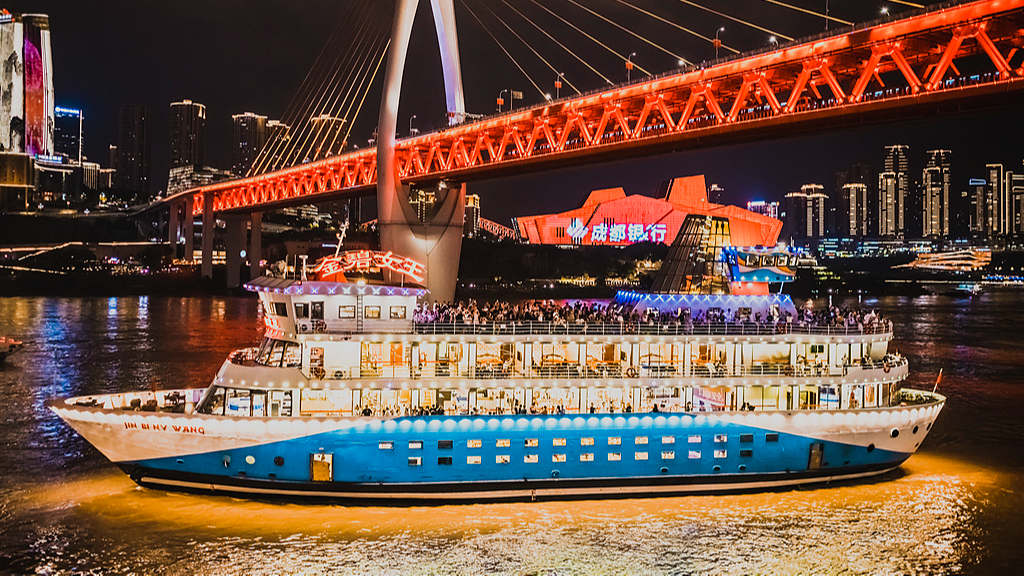
China’s “super golden week” – the eight-day National Day and Mid-Autumn Festival holiday – became more than a vacation this year. It turned into a nationwide celebration of consumption, creativity and culture, as cities across the country competed to attract visitors and boost local spending.
During the long holiday, different places rolled out distinctive cultural and tourism marketing strategies reflecting their unique characteristics to transform holiday excitement into lasting economic momentum.
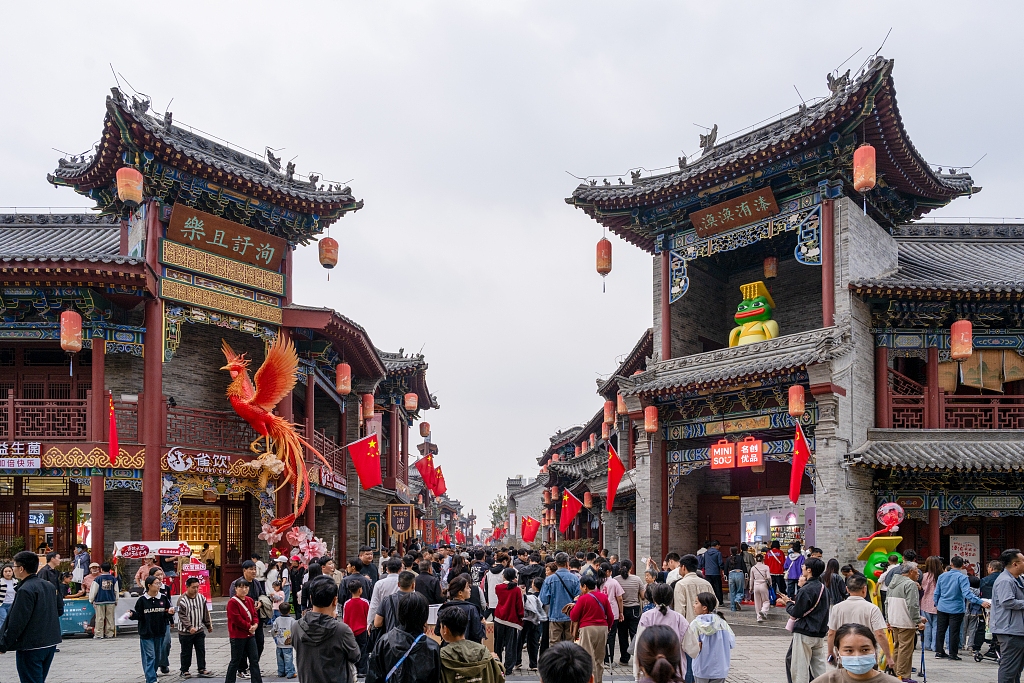
Crowds of tourists flock to Zhenwei Water City, Zhengzhou City, central China’s Henan Province, October 3, 2025. /VCG
For example, southwest China’s Sichuan Province highlighted its iconic pandas and spicy cuisine, central China’s Henan Province leveraged its rich historical heritage to offer immersive experiences of ancient culture, and the southeastern province of Fujian hosted various cultural events to exhibit the allure of its maritime culture.
Official data released on Wednesday shows that China saw steady growth in consumption during the holiday. Key retail and catering enterprises reported a year-on-year increase in sales of 2.7 percent during the holiday. From October 1 to 7, the passenger traffic of 78 major business districts monitored by the Ministry of Commerce rose 8.8 percent year on year, and their business revenues grew 6 percent.
In addition, a slate of high-quality domestic films premiering during the holiday spurred a movie-going frenzy, with China’s holiday box office exceeding 1.83 billion yuan ($258 million) as of Thursday. Various sports events also ignited spectator enthusiasm, boosting spending on catering services as well as related cultural and creative products.
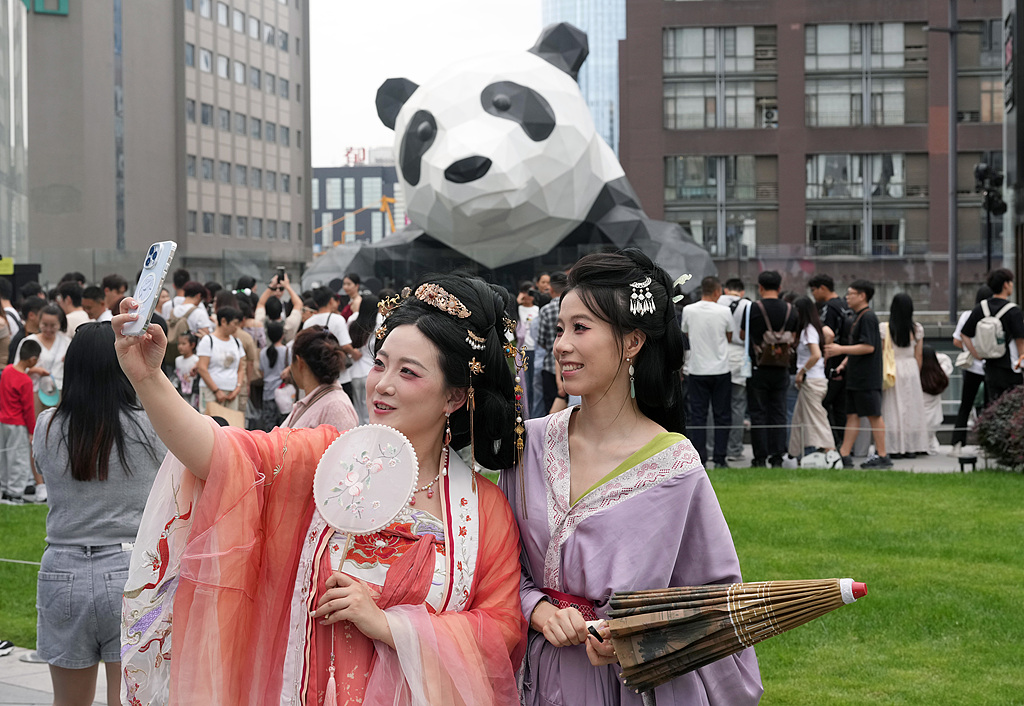
Visitors take photos at a giant panda sculpture on Chunxi Road, a pedestrianized shopping street in Chengdu, southwest China’s Sichuan Province, October 3, 2025. /VCG
In Chengdu, panda sculptures, creative shops and themed postboxes turned the bustling Kuanzhai Alley into an immersive “panda world.” Tapping into this internationally recognizable symbol, the Sichuan provincial government launched the fourth China (Sichuan) International Panda Consumption Festival, backed by 400 million yuan in vouchers for dining, tea, liquor and tourism.
“We aim to turn festive enthusiasm into lasting power through innovative experiences and cross-sector integration,” said an official from the Sichuan Commerce Department.
Elsewhere, Fujian tapped into its maritime roots and rich intangible cultural heritage to draw visitors. The province organized 185 heritage-themed events, ranging from exhibitions and folk experiences to craft fairs and hands-on workshops. In Fujian’s Xiamen, the lantern festival held in the city’s horticulture expo garden became a centerpiece, blending traditional craftsmanship with modern technology.
“We aim to invigorate the night economy while preserving culture and protecting the environment,” said Yu Hongping, general manager of Xiamen Cultural Tourism Investment Development Group Co., Ltd.
Central China’s Henan offered visitors a journey through history. In Zhengzhou, a new cultural block built around ancient Shang Dynasty (1600 BC-1046 BC) ruins blended archaeology with shopping, dining and light shows, attracting about 100,000 visitors daily. Visitors browsed trendy boutiques beside 3,600-year-old Shang Dynasty walls and an Eastern Han Dynasty (25-220) temple.
“This isn’t just a commercial project – it’s an open ‘urban living room’ where culture and business reinforce each other,” said project manager Liu Changhui.

Foreign tourists visit Qianmen Street, a historic and famous commercial pedestrian street in Beijing, capital of China, September 26, 2025. /VCG
During this year’s holiday, China’s inbound tourism also witnessed significant growth fueled by visa facilitation policies and a rich array of cultural and tourism activities.
Beijing welcomed 25 million visitors, generating 31.65 billion yuan ($4.45 billion) in tourism revenue, up 4.7 percent year on year. Notably, the capital hosted some 119,000 overseas arrivals – a 48-percent increase from the same period last year. Their spending totaled 1.23 billion yuan, up 54.1 percent year on year.
South China’s Guangdong Province also experienced a substantial rise in international travelers during the holiday. At Guangzhou Baiyun International Airport, cross-border traffic exceeded 350,000 by Wednesday noon, up 13 percent year on year. “It only took me about 20 minutes from getting off the plane to clearing immigration,” said Russian traveler Anna Ivanova.
According to previous estimates by the National Immigration Administration (NIA), an average of 2 million daily border crossings were expected to be recorded during the holiday.
Now, travelers from 76 countries can enjoy unilateral or mutual visa-free entry, with transit visa exemptions expanded to 55 nations. China is also working to remove payment barriers and rolling out AI-powered translation tools at airports and tourist attractions nationwide.