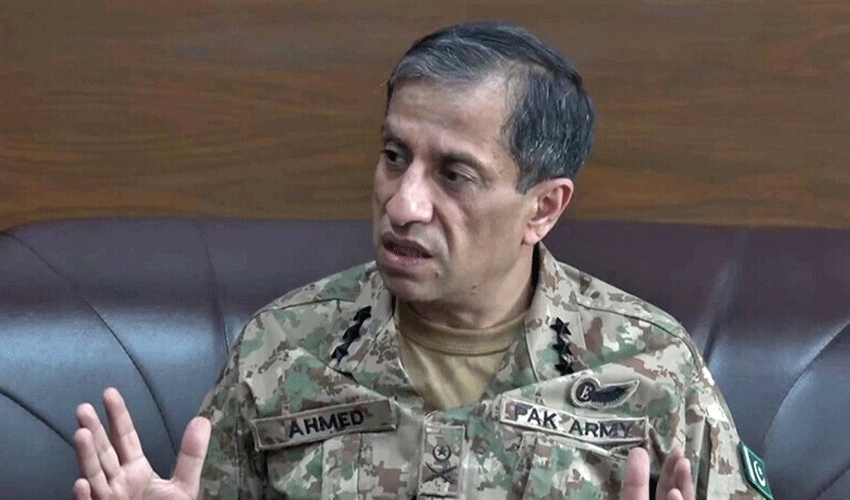
Pakistan’s military spokesperson has categorically rejected the notion of any separatist movement in the country, stressing that the unrest in Balochistan and Khyber Pakhtunkhwa is not political dissent but open terrorism.
In an interview with a German magazine, ISPR DG Lt Gen Ahmed Sharif Chaudhry blamed India for terrorist activities inside Pakistan using the Afghan soil as a base for operations.
‘No separatist movement, only terrorism’
Lt Gen Chaudhry clarified that Pakistan faces terrorism, not separatism. He described BLA as “Fitna-ul-Hindustan” and TTP as “Fitna-ul-Khawarij”, both of which he called Indian assets used to destabilize Pakistan. He further claimed that the gunned down members of Fitna-ul-Hindustan in Balochistan were on the missing persons list.
He stressed that aggression by these groups is fueled directly by India’s policies. “The West must recognize that India is a terrorist state that uses terrorism as a political tool,” he said.
Lt Gen Chaudhry remarked that the state of Pakistan rejected all non-state actors without distinction, adding that there was no place for any armed group in Pakistan. “No group or person other than the state has the authority to declare jihad,” he stressed.
India’s role in regional terrorism
The ISPR chief alleged that India not only sponsors terrorism in Pakistan but also manipulates narratives — presenting internal issues as external and external issues as internal. He said Indian state institutions, including the army, are increasingly influenced by extremist political ideologies.
“India commits acts of terrorism itself and then starts shouting against others,” he remarked, pointing out that Pakistan has presented evidence of Indian involvement to the world, including the United Nations, several times.
Afghanistan’s role and US weapons concern
General Chaudhry revealed that India exploits Afghan territory as an operational base for terrorism against Pakistan. He also voiced concern that American weapons left behind in Afghanistan after the US withdrawal are now being used in terrorist attacks.
The US itself, he added, has expressed concern over this issue. At the same time, he noted that Washington has declared the banned Majeed Brigade a global terrorist organization, validating Pakistan’s long-standing claims.
Pakistan’s Sacrifices in war on terror
Highlighting Islamabad’s role as a frontline state in the global war on terror, he said Pakistan has made immense sacrifices over the past two decades. He also credited US President Donald Trump’s leadership role during Marka-e-Haq against India, describing it as “strategic”.
On Kashmir and regional relations
General Chaudhry reiterated that the Kashmir issue remains unresolved, urging the international community to play its role. He added that a ceasefire agreement with India was signed on May 10, but the core disputes remain unchanged.
On the other hand, Pakistan continues to maintain constructive and strategic relations with China, describing it as a “brotherly country.”
Afghan refugees and terrorism links
The ISPR DG reminded that Pakistan has hosted millions of Afghan refugees for 40 years, repeatedly extending deadlines for their return on humanitarian grounds. He said systematic steps are being taken for their dignified repatriation.
However, he warned that there is credible evidence of illegal Afghan residents’ involvement in terrorism and serious crimes, emphasizing that the original reasons for their asylum — foreign intervention and civil war in Afghanistan — no longer exist.
Extremism in India
General Chaudhry also linked violence inside India to the extremist policies of Prime Minister Narendra Modi’s government, saying its growing radicalism fuels instability both domestically and regionally.