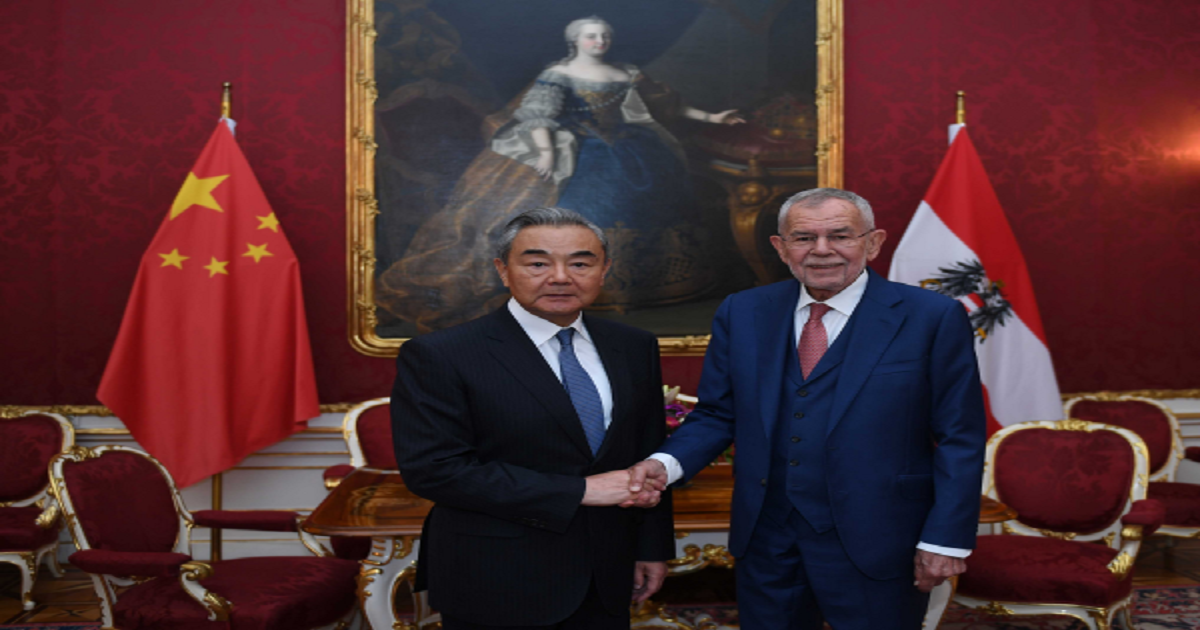
China is Austria’s important cooperation partner in Asia, and Austria is willing to work with China to jointly safeguard multilateralism and promote world peace and development, Austrian President Alexander Van der Bellen said on Friday.
Van der Bellen made the remarks while meeting with visiting Chinese Foreign Minister Wang Yi, a member of the Political Bureau of the Communist Party of China Central Committee, in Vienna.
Austria firmly adheres to the one-China policy and will not waver under any circumstances, the president stressed.
Noting that next year marks the 55th anniversary of diplomatic relations between the two countries, he said Austria is willing to celebrate the occasion with China and deepen exchanges and cooperation in areas such as economy and trade, investment, green development, tourism and culture.
Van der Bellen also praised China’s commitment to addressing climate change and advancing green development, saying Austria is willing to work with China to jointly safeguard multilateralism and promote world peace and development.
Practical cooperation, as well as people-to-people and cultural exchanges, have deepened over time, Wang said, emphasizing that both sides should build on these achievements and use the upcoming 55th anniversary as an opportunity to expand cooperation in areas such as the green economy and add new vitality to the China-Austria partnership.
Noting that this year marks the 80th anniversary of the victory in World War II as well as the founding of the United Nations, Wang said China’s grand commemorations aim to enhance the correct historical view of World War II, honor martyrs, cherish peace and create a better future. As the main battlefield in the East during World War II, China made tremendous national sacrifices and significant historic contributions to the victory of the World Anti-Fascist War.
The commemorations also seek to safeguard the outcome of the victory in World War II, Wang said, noting that Taiwan’s return to China is an important part of those outcomes and that any attempt to split the country is doomed to fail.
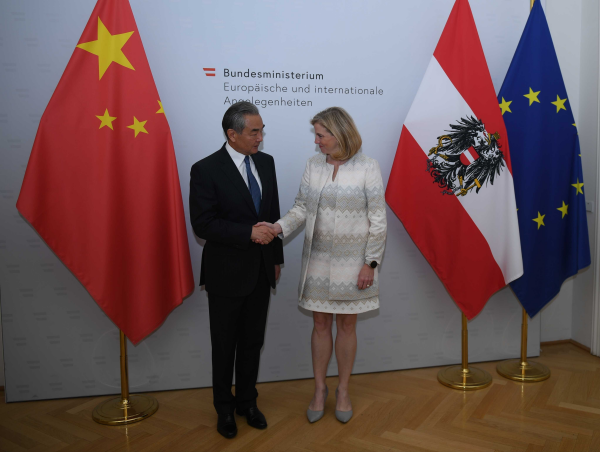
Chinese Foreign Minister Wang Yi shakes hands with Austrian counterpart Beate Meinl-Reisinger in Vienna, Austria, on September 12, 2025. /VCG
On the same day, the Chinese foreign minister held talks with his Austrian counterpart, Beate Meinl-Reisinger, with both sides vowing to lift bilateral relations to a new stage.
Wang said the long-term stability of China-Austria relations serves both sides’ interests and accords with the trend of history.
As China and Austria prepare to mark the 55th anniversary of their diplomatic relations, Wang said the China-Austria friendly strategic partnership is the most accurate positioning of bilateral ties and a true reflection of how China-Austria relations have withstood the tests of a changing international landscape.
China attaches great importance to its ties with Austria, appreciates the continuity of the new Austrian government’s China policy, and hopes Austria will work with China in the spirit of mutual respect, close communication, seeking common ground while reserving differences, and win-win cooperation. Wang added that Austria should seize the opportunities presented by China’s vast market and green industrial transformation, advancing bilateral relations to a new stage of higher quality.
Speaking on the Taiwan question, Wang said Taiwan’s return to China is an important part of the outcomes of the victory in World War II and the postwar international order. He expressed hope that Austria will faithfully adhere to the one-China principle and refrain from conducting any official interactions with the Taiwan region to safeguard the political foundation of China-Austria relations.
Noting the Global Governance Initiative proposed by Chinese President Xi Jinping during the Shanghai Cooperation Organization summit, Wang said these concepts meet the urgent needs of the international community and align with the purposes of the UN Charter, aiming to uphold multilateralism, safeguard the international system with the UN at its core, and maintain an international order underpinned by international law.
Sustaining healthy and stable China-EU relations is in the interests of both sides and their peoples, Wang noted, stressing that the current problems facing Europe do not come from China. He underscored that China supports Europe in seeking true strategic autonomy but opposes the mistaken idea of harming China’s interests in exchange for deals. China hopes Austria will play a constructive role in encouraging Europe to pursue a rational and pragmatic policy toward China, Wang added.
Meinl-Reisinger, for her part, said Austria attaches great importance to its relations with China and unswervingly adheres to the one-China policy.
Since establishing the friendly strategic partnership, Austria and China have maintained sound cooperation in both bilateral and multilateral fields, with common interests continuing to expand. Austria looks forward to strengthening exchanges at all levels with China, enhancing people-to-people ties, and deepening practical cooperation in areas such as the green economy, Meinl-Reisinger said.
She also expressed gratitude for China’s assistance to Austrian Jews during World War II, saying the two sides should jointly remember this valuable history.
The Austria-China panda cooperation project has become the latest symbol of friendship, and Austria welcomes more Chinese tourists to visit, she added.
Austria supports the Global Governance Initiative, advocates open, law-based and equal free trade, and opposes the dominance of the “law of the jungle,” she said, adding that the country upholds the authority of the United Nations and multilateralism.
Meinl-Reisinger also noted Austria’s willingness to actively promote constructive dialogue between Europe and China and facilitate the healthy development of relations between the two sides.
During their talks, the two ministers also exchanged views on issues of common concern, including Ukraine, the Middle East, and climate change.