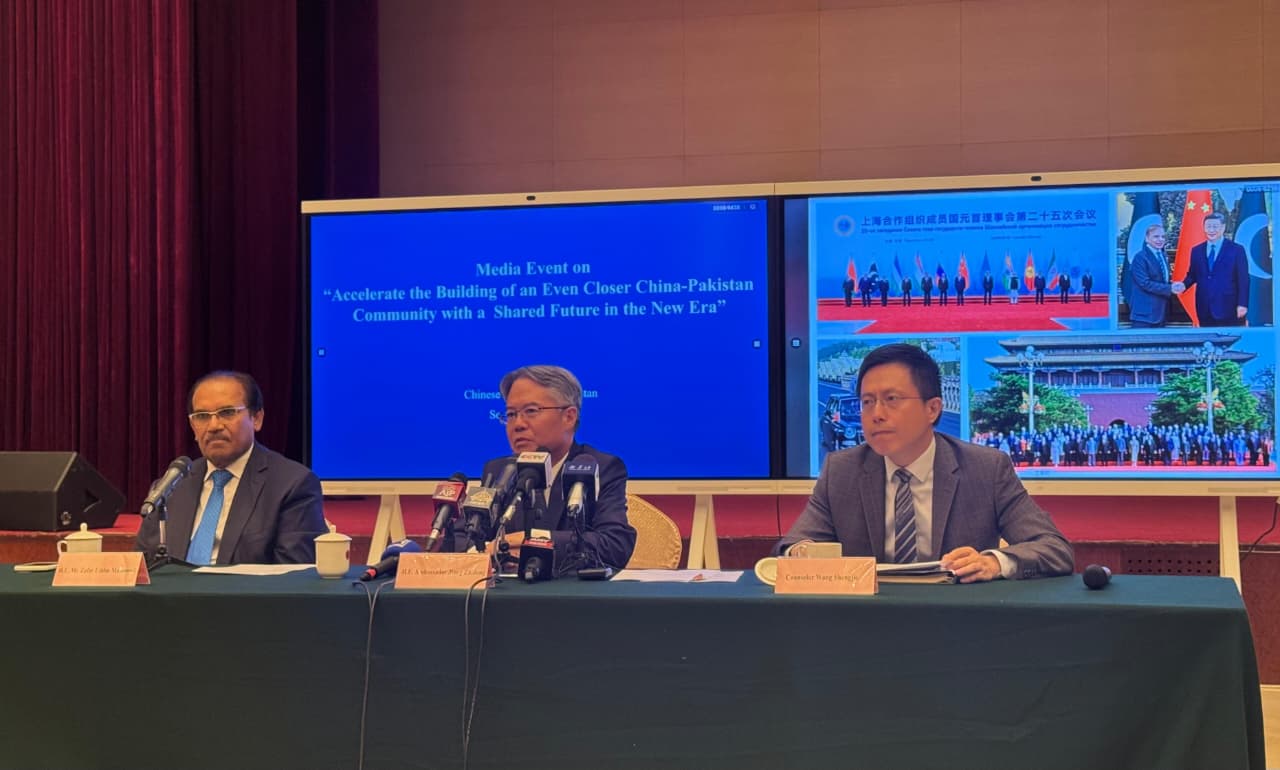
ISLAMABAD (DI NEWS) : In a detailed interaction, the Chinese Ambassador to Pakistan reflected on the recent Shanghai Cooperation Organization (SCO) Summit in Tianjin, President Xi Jinping’s Global Governance Initiative, and the grand commemoration of the 80th anniversary of the victory of the Chinese People’s War of Resistance Against Japanese Aggression and the World Anti-Fascist War. His remarks underlined China’s leadership role in regional and global affairs and reaffirmed the strength of Pakistan-China partnership.
Tianjin SCO Summit: Unity, Achievements, and Partnership
The Ambassador noted that the SCO Summit in Tianjin, held from August 31 to September 1, was the largest in the organization’s history and marked the successful conclusion of the “China Year” of the SCO. He highlighted three distinct features.
First, the summit brought together “old and new friends,” with over 20 heads of state and government and 10 heads of international organizations attending, including Prime Minister Shehbaz Sharif. Laos joined as a dialogue partner, expanding the SCO family to 27 members. President Xi Jinping engaged in nearly 20 bilateral and multilateral events, deepening consensus and opening a new stage of high-quality development for the SCO.
Second, the summit produced substantive outcomes. A 10-year development strategy was adopted, four new security centers were launched, an SCO development bank was approved, and six cooperation platforms along with six action plans for high-quality development were introduced. The multilateral trading system and the outcomes of World War II were reaffirmed.
Third, China’s leadership was again demonstrated through concrete initiatives. President Xi announced 100 livelihood projects for member states in need, 2 billion yuan in aid within this year, 10 billion yuan in additional loans through the SCO Interbank Consortium over three years, and 10,000 training opportunities in the next five years.
The Ambassador noted Pakistan’s strong role, recalling that President Asif Ali Zardari described the SCO as a “strong and tall tree,” while Prime Minister Shehbaz Sharif praised China’s visionary leadership of the SCO and pledged that Pakistan will continue to stand by China in pursuit of peace, progress, and prosperity.
Global Governance Initiative: A New Public Good
On President Xi’s proposal of the Global Governance Initiative at the “SCO Plus” meeting, the Ambassador said it has received wide acclaim in Pakistan. He described it as a new public good, following China’s earlier initiatives on global development, security, and civilization.
The Ambassador explained that the initiative rests on five pillars: sovereign equality, adherence to international law, multilateralism, people-centered values, and action-oriented implementation. These principles, he emphasized, reflect the UN Charter and are aimed at addressing today’s challenges such as hegemonism, unilateralism, and protectionism.
He recalled that Prime Minister Shehbaz Sharif termed the initiative “a historic step toward stronger multilateralism,” one that aligns with the aspirations of developing countries. “Pakistan fully supports it and will actively implement it,” the Ambassador stressed, adding that both countries will work together to promote multipolarity, inclusive globalization, and a shared future for humanity.
80th Anniversary Commemoration: Lessons of History and Message of Peace
Speaking on the 80th anniversary commemoration in Beijing on September 3, the Ambassador said he was deeply moved by the sight of China’s modernized forces, the release of 80,000 peace doves, and President Xi Jinping’s powerful speech.
He underlined that the event was meant to “remember history, honor fallen heroes, cherish peace, and create a better future.” The sacrifices of more than 35 million Chinese people during the war, he noted, earned global respect and underscored that aggression can only be countered through unity and resolve.
The Ambassador stressed that China remembers history not to perpetuate hatred but to uphold peace. He cautioned that militarism and hegemonism are still present in the world, pointing to ongoing unilateral practices and economic coercion. In this context, he called for global unity against hegemonic forces, affirming that “Chinese modernization is the modernization of peaceful development.”
He further noted the shared history of suffering under imperialism and colonialism between China and Pakistan, affirming that both nations look forward to peace and prosperity for humanity. “We stand ready to work with Pakistan to uphold international fairness and justice and promote the lofty cause of peace and progress,” he concluded.