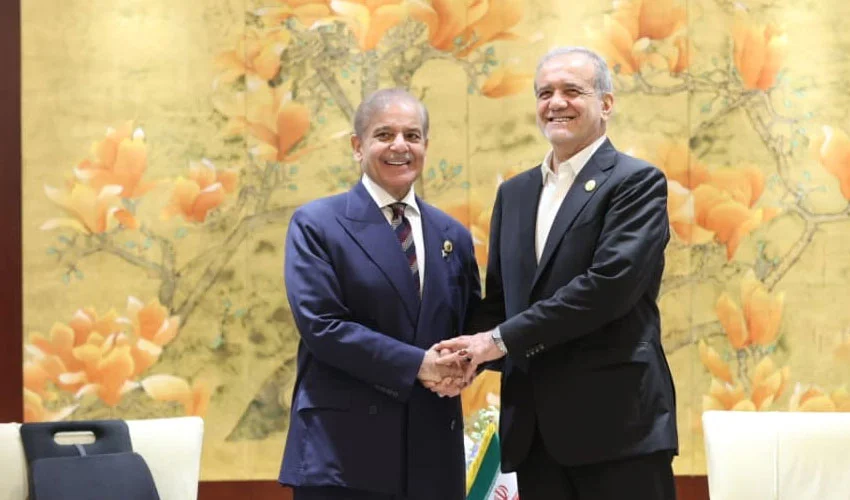
Prime Minister Mian Muhammad Shehbaz Sharif held a meeting with Iranian President Dr. Masoud Peshkeshian on the sidelines of the 25th Shanghai Cooperation Organization (SCO) Council of Heads of State meeting, reaffirming Pakistan’s commitment to closer ties with Iran.
Deputy Prime Minister Senator Ishaq Dar, Army Chief General Syed Asim Munir, and several federal ministers were also present during the talks.
Premier underscored the importance of enhancing political and economic cooperation, noting that ties between Pakistan and Iran are rooted in shared history, culture, and faith.
“Pakistan is committed to peace and stability in the region. Dialogue and diplomacy are the only way forward to reduce tensions and achieve lasting stability,” Shehbaz said while expressing solidarity with the Iranian people.
Both sides reviewed progress in bilateral cooperation and expressed satisfaction over the trajectory of relations.
Iran’s assurance of support
President Peshkeshian appreciated Pakistan’s longstanding support and vowed to strengthen cooperation in multiple fields. He also conveyed condolences over the loss of lives and property caused by recent floods in Pakistan, assuring that Iran stood by Pakistan in this hour of difficulty.
Shehbaz engages with world leaders
The Prime Minister’s visit to Tianjin has drawn notable attention. He was warmly welcomed by Chinese President Xi Jinping and First Lady Peng Liyuan, highlighting the close partnership between Pakistan and China.
On the sidelines of the summit, Shehbaz also met Russian President Vladimir Putin, Malaysian Prime Minister Anwar Ibrahim, Belarusian President Alexander Lukashenko, and Azerbaijani President Ilham Aliyev.
In addition, he held informal interactions with Turkish President Recep Tayyip Erdogan, Tajik President Emomali Rahmon, Turkmen President Serdar Berdimuhamedow, Kyrgyz President Sadyr Japarov, Maldives President Mohamed Muizzu, and UN Secretary-General António Guterres.
Officials noted that the warmth extended by world leaders reflects Pakistan’s strong bilateral ties within the SCO framework and beyond.