Ukraine has formally raised concerns with both the Indian government and the European Union about Indian-made or assembled electronic components found in Iranian-designed drones used by Russia against Ukraine, according to the Hindustan Times on August 5.
According to sources familiar with the situation and documents reviewed by the Hindustan Times, the Ukrainian government sent at least two official communications to India’s Ministry of External Affairs after discovering Indian components in Shahed-136 loitering munitions. These findings date back to 2023 and have persisted into this year.
Ukrainian diplomats raised the issue during EU sanctions envoy David O’Sullivan’s mid-July visit to New Delhi. According to the Hindustan Times, O’Sullivan’s trip was intended to brief Indian officials on the EU’s latest sanctions package, which included measures aimed at refined products made from Russian crude, such as those processed at Rosneft’s Vadinar refinery.
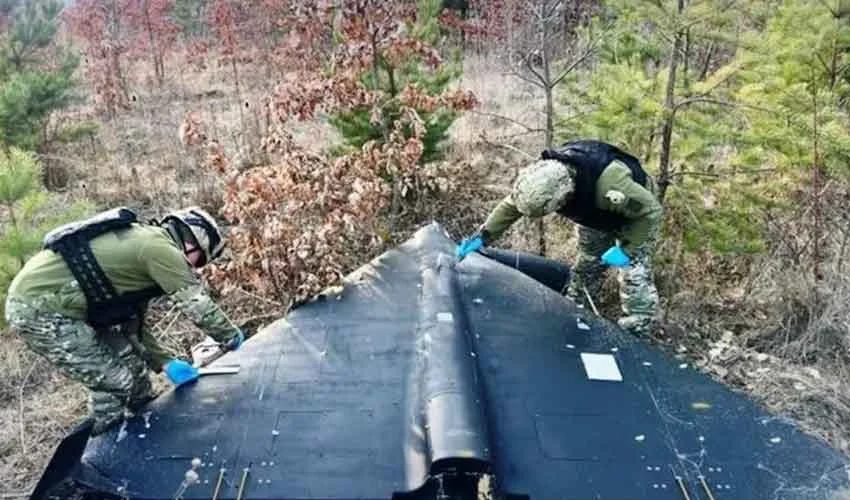
Ukrainian investigators discovered components produced or assembled in India by Vishay Intertechnology and Aura Semiconductor in the downed Shahed-136 drones. The drone’s voltage regulation unit contained a Vishay Intertechnology “bridge rectifier E300359” assembled in India. Meanwhile, Aura Semiconductor’s PLL-based AU5426A signal generator chip was used in a navigation system component designed to withstand GPS jamming.
While the companies involved did not violate Indian export laws on a technical level, the findings highlight gaps in the global supply chain for dual-use technologies.
“India’s exports of dual-use items are in keeping with its international obligations on non-proliferation, and based on its robust domestic legal and regulatory framework. Due diligence is conducted to ensure that such exports do not violate any of our laws,” Ministry of External Affairs spokesperson Randhir Jaiswal stated in response to the issue.
Although the Ukrainian Embassy in New Delhi did not issue an official statement, Ukraine’s Defense Intelligence Directorate reported the presence of Indian-origin components in Shahed drones on its official Facebook page and Telegram channel, according to Hindustan Times.
Vishay Intertechnology, based in the United States, has not responded to multiple requests for comment. However, Kishore Ganti, co-founder of Bengaluru-based Aura Semiconductor Pvt Ltd, stated that the company fully complies with national and international export controls and is “deeply disturbed” by the potential diversion of its products.
“We are deeply disturbed by the possibility that any of our components may have reached defense manufacturers through unauthorised third-party channels, in violation of our stated compliance framework and distribution agreements. We strongly oppose such activity and are committed to taking action wherever compliance gaps are identified,” Aura Semiconductor stated.
Ganti added that after learning of the problem, the company conducted a limited audit to determine the component’s end-use, but the results were inconclusive. The component in question, he explained, is a plug-and-play item that can function without manufacturer support, making traceability particularly difficult.
According to the Hindustan Times, several Indian-made components were legally exported to West Asian countries, possibly for re-export to Russia or Iran. Following Ukraine’s complaint, Indian security agencies made outreach visits to electronics manufacturers in Delhi, Bengaluru, and Mumbai to raise awareness of the restrictions on dual-use goods.
Since late 2022, Russia’s long-range strike capabilities have relied heavily on the Shahed-136, a relatively low-cost loitering munition.
Ukraine’s intelligence services have also discovered electronic components from American and Chinese companies in Russian drones and weapons.
Ajay Srivastava, founder of the Global Trade Research Initiative, highlighted the larger issue: “India strictly prohibits the export of dual-use items to sanctioned destinations. However, once such goods are exported to legitimate third countries, tracing their end use becomes nearly impossible – a challenge every open economy faces.”
Previously, a Chinese-made component was discovered in the wreckage of a Russian-Iranian Shahed-136 combat drone following a massive Russian airstrike on Kyiv on July 4.