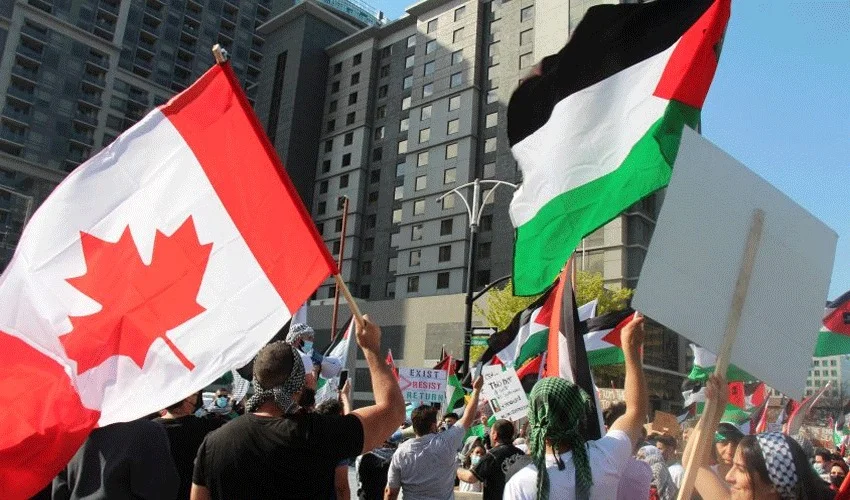
Canadian Prime Minister Mark Carney on Wednesday announced that Canada will formally recognise the State of Palestine in September, joining the United Kingdom and France in pushing for a two-state solution amid the ongoing war in Gaza.
Speaking at a news conference in Ottawa, Carney said the recognition would be conditional on democratic reforms by the Palestinian Authority, including the holding of national elections that exclude the participation of Hamas.
“The level of human suffering in Gaza is intolerable and it is rapidly deteriorating,” the Canadian premier said, referencing the ongoing humanitarian crisis in the besieged territory. “The prospect of a Palestinian state is being eroded before our eyes.”
Carney also cited the continued expansion of Israeli settlements in the occupied West Bank and the lack of a political horizon as factors behind the dramatic policy shift. He confirmed that Canada would announce its recognition of Palestine during the upcoming session of the United Nations General Assembly.
The decision places Canada alongside two other G7 nations — France and the UK — which recently made similar announcements. The British government had warned Israel it would recognise a Palestinian state in September unless significant diplomatic progress was made, including a ceasefire in Gaza. France also announced plans last week to move towards recognition.
The Israeli Ministry of Foreign Affairs swiftly condemned Canada’s move, calling it “a reward for Hamas”. In a post on X, the ministry said, “This decision harms the efforts to achieve a ceasefire in Gaza and a framework for the release of the hostages.”
Canada’s opposition Conservatives also criticised the move, stating that recognising a Palestinian state so soon after the October 7 attacks in Israel “sends the wrong message to the world”.
Despite the criticism, Carney defended the timing of the decision, insisting that Canada’s position was independent of foreign influence. “We make our own foreign policy decisions,” he said, when asked whether the UK and France’s decisions played a role or whether he had consulted with US President Donald Trump.
The US, Israel’s strongest ally, remains the only permanent member of the UN Security Council yet to support Palestinian statehood. Nearly 200 former Canadian diplomats and ambassadors had earlier signed an open letter urging Carney’s government to act, citing “the massive displacement, indiscriminate bombardment and starvation of Palestinian civilians in Gaza” and “violent attacks by extremist settlers in the West Bank”.
Carney said he had spoken with Palestinian Authority President Mahmoud Abbas on Wednesday before making the announcement. The Palestinian Authority, led by Abbas’ Fatah party, governs parts of the West Bank, while Hamas controls the Gaza Strip. National elections have not been held in either territory since 2006.
Carney made it clear that recognition would be contingent upon “fundamental reforms” by the Palestinian Authority, including a commitment to demilitarisation and good governance.
Canada has traditionally backed a negotiated two-state solution, but the prime minister acknowledged that the diplomatic approach was “no longer tenable” in light of Israel’s ongoing offensive and the deteriorating situation on the ground.
According to the Hamas-run health ministry in Gaza, more than 60,000 Palestinians have been killed since Israel launched its military campaign in response to the October 7 attacks, in which approximately 1,200 Israelis were killed and 251 others were taken hostage.
The Gaza health ministry also reports that 154 people — including 89 children — have died from malnutrition, amid widespread famine-like conditions exacerbated by limited humanitarian access and continuous bombardment.
The formal recognition of Palestine by Canada, the UK, and France could further isolate Israel diplomatically, while placing increased pressure on the United States to clarify its own position ahead of the UN General Assembly.
UN figures show that 147 of the 193 member states already recognise Palestine as an independent state.