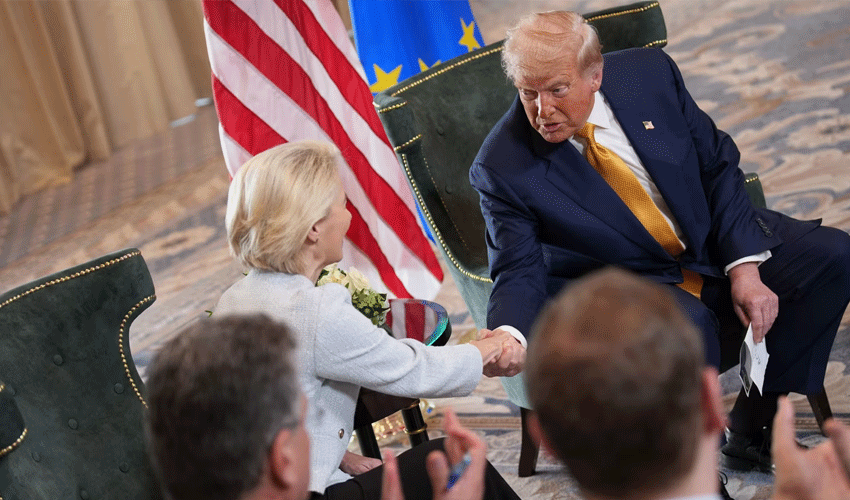
The United States and the European Union have reached a breakthrough trade agreement, bringing an end to months of escalating tensions between the two major economies.
Following high-stakes discussions at President Donald Trump’s Turnberry golf resort in Scotland, both sides confirmed a new framework under which a 15% tariff will be imposed on EU goods entering the American market. The move comes after President Trump had earlier threatened a more punitive 30% rate, set to come into effect later this week.
European Commission President Ursula von der Leyen, who met President Trump in a closed-door session on Sunday, described the agreement as a “stabilising step” for transatlantic trade. “This deal rebalances our relationship and ensures mutual benefits,” she said at a joint press briefing. “President Trump is a tough negotiator, but also a dealmaker.”
Mutual gains — But at what cost ?
The deal allows both parties to claim a measure of success. For the EU, the 15% rate, though higher than existing tariffs, is significantly less than what had been threatened. It matches the rate recently agreed between Washington and Tokyo but falls short of the 10% tariff negotiated by post-Brexit Britain.
For the United States, the agreement is expected to generate an estimated $90 billion in tariff revenue based on last year’s trade volumes. In addition, the EU committed to investing over $600 billion in the American economy over the next three years. This includes major purchases of US military equipment and energy resources, including liquified natural gas, oil, and nuclear fuels.
Von der Leyen said the move would reduce European dependence on Russian energy. “It’s a strategic shift, and it aligns with our energy security goals,” she added.
Products exempt from new tariffs
Several high-value items will remain exempt from the new tariff regime, including aircraft and their parts, select chemicals, and a number of agricultural products. A separate semiconductor agreement is reportedly under negotiation and could be announced in the coming weeks.
However, the 50% tariffs already imposed by the US on global steel and aluminium exports will remain unchanged. “We’re keeping the steel tariffs because they protect American jobs,” Trump stated.
Leaders react with caution
Reaction across European capitals was measured, with leaders acknowledging the deal’s importance while expressing concern over increased trade costs.
Irish Prime Minister Micheál Martin warned that the new tariffs, although lower than feared, would nonetheless complicate trade for Irish exporters. “This makes doing business more expensive and more challenging,” he said.
German Chancellor Friedrich Merz also weighed in, noting that Germany, a major exporter to the US, stood to lose in the event of a trade war. “Predictable and stable trade relations are in everyone’s interest,” he wrote on X.
Italian Prime Minister Giorgia Meloni welcomed the breakthrough but noted that full clarity would only emerge once the detailed terms are published. “We need to understand the fine print before celebrating,” she told Italy’s Ansa news agency.
Strategic victory for Trump
President Trump, who is in Scotland on a five-day visit, described the deal as the largest trade agreement in history and hailed it as a “win-win” for both sides.
“This is a good deal for everybody. It brings us closer together,” Trump said after completing a round of golf with his son Eric and several guests at Turnberry. The president is scheduled to meet UK Prime Minister Keir Starmer at the same venue on Monday.
Trade in goods between the EU and US stood at approximately $976 billion last year. The US imported $606 billion in goods from the EU, while exporting around $370 billion — a gap Trump has repeatedly criticised as evidence of an “unfair” trading relationship.
While the new tariff regime is expected to generate significant revenue for Washington, questions remain about the long-term impact on European exporters, particularly in sectors like pharmaceuticals, fashion, electronics, and dairy.
For now, however, both sides appear relieved to have avoided a full-blown trade conflict.
President Trump will head to Aberdeen on Tuesday, where he is expected to open a new golf course alongside his sons. A ribbon-cutting ceremony is planned, marking the expansion of the Trump family’s golf business in Scotland.