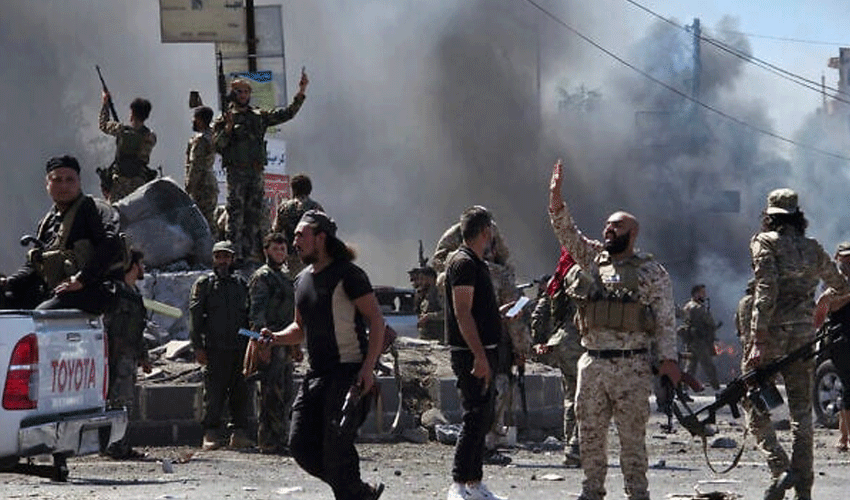
Syria and Israel have agreed to a US-brokered ceasefire following days of intense fighting in Syria’s southwestern Suwayda province, where clashes between Druze factions, Bedouin fighters, and government forces have left more than 300 people dead and hundreds wounded.
The truce, announced by U.S. Ambassador to Turkiye Tom Barrack in a post on social media platform X early Saturday, has been “supported” by Washington and “embraced” by Turkiye, Jordan, and Syria’s neighbouring countries. The ceasefire marks a temporary pause in escalating violence that saw Israeli airstrikes on Syrian targets and a growing humanitarian crisis in the conflict-hit province.
The violence was triggered by sectarian clashes in Suwayda, a region predominantly inhabited by Syria’s Druze minority. The fighting spiralled into broader confrontation after Israeli forces launched airstrikes on government positions in Suwayda and the Ministry of Defence in Damascus on Wednesday, citing protection of the Druze community as the reason.
Speaking from Damascus on Thursday, Syria’s interim President Ahmed al-Sharaa accused Israel of attempting to destabilise the country and pledged to defend Syria’s Druze population. “While Syria seeks peace, we are not afraid of war,” he said in a televised address, warning against efforts to fracture national unity.
The ceasefire came into effect after Druze leaders and the Syrian government reached an agreement on Wednesday with mediation from the U.S., Turkiye, and Arab partners. Despite the ceasefire deal, Israel proceeded with further airstrikes later the same day, reportedly killing at least three people and injuring 34 others.
Israeli Prime Minister Benjamin Netanyahu, speaking after the agreement, reiterated Israel’s commitment to safeguarding the Druze — a small but influential community with about one million members in Syria and some 150,000 in Israel. “They are our brothers,” Netanyahu said, amid growing calls from Israel’s own Druze citizens to intervene in Suwayda.
On Friday, an Israeli official, speaking on condition of anonymity, confirmed that Israel had agreed to allow limited entry of Syrian internal security forces into Suwayda district for a 48-hour period. The official said the move was aimed at calming the situation, though Israel remains wary of Syria’s new leadership, which it has described as “barely disguised jihadists.”
The situation on the ground remains precarious. Fighting continued in northern and western parts of Suwayda on Friday, according to local residents and media outlet Suwayda24. Thousands of Bedouin fighters reportedly continued to pour into the province, raising fears that the violence would persist despite the ceasefire.
“We’ve had no electricity, no food, no water — nothing at all for four days,” said Mudar, a 28-year-old resident who spoke to Reuters on condition of anonymity due to security concerns. “The clashes haven’t stopped. Even communication is hard, there’s barely any internet or phone coverage.”
The Syrian Network for Human Rights said it had documented 321 deaths since the start of the clashes, including women, children, and medical workers. The group reported incidents of field executions carried out by all sides. At least 13 civilians were allegedly killed on Tuesday when gunmen opened fire on a family gathering, while six men were summarily executed in separate incidents the same day.
Syria’s emergency ministry reported that more than 500 people had been treated for injuries, and hundreds of families had been evacuated from Suwayda. A convoy of interior ministry forces was seen waiting in nearby Daraa province, pending final approval to enter the conflict zone.
The United Nations has called for immediate humanitarian access to Suwayda, where the deteriorating security situation has blocked aid deliveries. The Office of the High Commissioner for Human Rights (OHCHR) urged Syria’s interim authorities to ensure accountability amid credible reports of widespread abuses, including arbitrary executions and kidnappings.
While the U.S. has played a key role in facilitating the ceasefire, it distanced itself from Israel’s recent military actions. A White House statement on Thursday said Washington had not supported the Israeli strikes on Syrian territory, highlighting a divergence in strategy between the two allies.
In a bid to promote reconciliation, Ambassador Barrack appealed to all sides in his post on X: “We call upon Druze, Bedouins, and Sunnis to put down their weapons and, together with other minorities, build a new and united Syrian identity — in peace and prosperity with its neighbours.”
Despite the ceasefire, analysts warn that the deep-rooted sectarian tensions and geopolitical rivalries make long-term stability in Suwayda uncertain. The region, long neglected by the central government, is now the flashpoint of a broader struggle over Syria’s future identity and alliances.