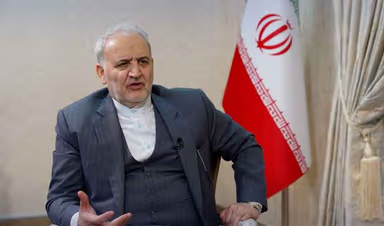
Iran has expressed willingness to negotiate with the United States as indirect diplomatic exchanges continue through Pakistan and Qatar, while warning that any renewed military aggression would trigger a firm response.
Iranian Ambassador to Pakistan Reza Amiri Moghaddam made the remarks in interviews with CNN, saying proposals and messages were being exchanged through the two countries as diplomatic efforts continued, albeit at a slower pace than previous rounds.
Reza Amiri Moghaddam said Iran and the United States were exchanging messages through intermediaries, including Pakistan and Qatar, with different proposals being circulated and discussed.
In an interview with CNN, the Iranian envoy confirmed that Tehran remained open to negotiations but would respond decisively if faced with renewed aggression.
In a separate interview with CNN Arabic, the ambassador said the indirect exchanges were continuing at a slower pace than before, with Qatar and Pakistan presenting ideas and proposals for discussion.
He said the proposals were being discussed with the participation of Iranian Foreign Minister Abbas Araghchi, adding that the “Islamabad Memorandum of Understanding” signed last June remained the basic framework for discussions with the US side.
Iran warns of decisive response if military operations resume
While reiterating Tehran’s readiness for negotiations, Amiri Moghaddam described the conflict involving Iran, the United States and Israel as an “existential battle,” warning that Iran was prepared to respond decisively if large-scale military operations against it resumed.
The ambassador said Iran had prepared itself for such a scenario and possessed “new surprises” in the event of renewed military action.
He stressed that Iran was willing to pursue diplomatic engagement, but would not remain passive in the face of aggression.
Iran’s position on Houthis, regional diplomacy
Asked about Chinese-led efforts to resolve the conflict involving Saudi Arabia and Yemen’s Iran-backed Houthis, Amiri Moghaddam said Tehran would welcome initiatives that recognised the Houthis as part of Yemen’s political and ground realities.
He argued that attempts by some Western and regional countries to designate the Houthis as terrorist entities had faced opposition at the United Nations Security Council from China and Russia.
The ambassador also pointed to the Houthis’ control of Yemen’s capital for more than a decade, arguing that their presence should be taken into account in efforts to resolve the conflict.
Amiri Moghaddam also reaffirmed Iran’s current commitment to the Treaty on the Non-Proliferation of Nuclear Weapons (NPT), saying Tehran had not made any decision to withdraw from the agreement.
However, he acknowledged growing public pressure inside Iran to leave the treaty, arguing that it had imposed restrictions on the country without delivering the benefits Tehran had expected.
Araghchi outlines conditions for negotiations
The ambassador’s remarks come as Iranian Foreign Minister Abbas Araghchi has reaffirmed Tehran’s commitment to seven conditions for moving towards broader negotiations and normalising navigation through the Strait of Hormuz.
The conditions reportedly include lifting the US naval blockade on Iranian ports, a ceasefire across all fronts and easing sanctions.
Iran has maintained that these conditions must be addressed before it agrees to reopen the Strait of Hormuz to normal traffic or enters comprehensive negotiations with Washington.
Meanwhile, the United States has called for guarantees to ensure the safety of maritime navigation and has insisted that Iran’s nuclear programme be included in preliminary negotiations.
The differing positions underline the challenges facing diplomatic efforts, even as Pakistan and Qatar continue to facilitate indirect exchanges between Tehran and Washington.