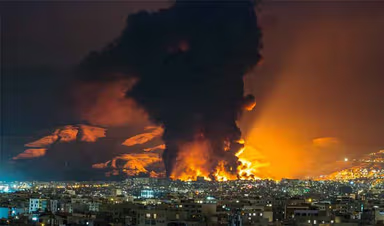
The United States and Israel are continuing consultations over possible joint military strikes against Iran, with suspected nuclear facilities, strategic infrastructure and senior military and civilian leaders reportedly among the potential targets, according to Axios.
The White House has asked Pentagon and intelligence experts to assess how Tehran might retaliate against different strike scenarios, particularly whether any military option could avoid triggering attacks on oil and gas facilities across Gulf countries.
Although Trump recently described another major round of strikes on Iran as “quite unlikely,” he continues to weigh military options, with a final decision dependent on intelligence assessments and the evolving regional situation.
According to Axios, US military planning for a potential operation involving Israel could include strikes on suspected Iranian nuclear facilities, including the underground nuclear site known as Pickaxe Mountain.
The reported list of potential targets also includes key bridges, power plants and senior Iranian military and civilian leadership. Targeting senior officials could be aimed at disrupting Iran’s command-and-control system, according to the report.
The potential strike plans are still under consideration, with intelligence assessments expected to play a central role in determining whether military action is pursued.
Trump indicated that a strike was not imminent, telling Fox News on Wednesday: “We’ll see, we are gonna have a new year coming up and we will see what happens after January 1. They have been nasty, these are nasty people.”
Netanyahu presses Trump for renewed military action
Israeli Prime Minister Benjamin Netanyahu has reportedly been lobbying Trump to resume broader military operations against Iran as soon as possible, amid his own political challenges.
Netanyahu is said to be pushing for renewed strikes, while leaders of Gulf countries have urged the US president to avoid a return to full-scale fighting. Gulf leaders are concerned that Iranian retaliation could target critical oil and gas infrastructure across the region.
Instead, Gulf states have reportedly encouraged Washington to continue tightening economic pressure on Tehran rather than pursue another major military campaign.
Trump’s national security team is also divided over the potential course of action, with some officials, including Defense Secretary Pete Hegseth, reportedly favouring more aggressive military measures.
US officials have said that Washington is taking the advice of Gulf countries into account, although Trump continues to consider military options.
A US official said the economic pressure campaign against Iran was already having a significant impact.
“As President Trump and Secretary [of State Marco] Rubio have stated, our economic pressure campaign is devastating Iran to such an extent that the President does not have any need to conduct major combat operations,” the official said.
“However, President Trump has all options at his disposal to ensure that Iran can never have a nuclear weapon,” the official added.
White House assesses potential Iranian retaliation
Behind the scenes, the White House has asked the Pentagon and intelligence experts to assess how Iran could respond to different strike scenarios prepared by the US military, according to two sources cited by Axios.
Officials have specifically sought to determine whether any of the proposed options could avoid triggering a devastating Iranian retaliation against oil and gas facilities in Gulf countries.
The concerns reflect the potential consequences of renewed military confrontation, particularly for regional energy infrastructure, shipping and broader economic stability.
Mossad chief reportedly pushes for strikes
Mossad Director Roman Gofman reportedly travelled to Washington and Miami last week for meetings with CIA Director John Ratcliffe and White House envoy Steve Witkoff.
According to an Israeli source, Gofman, one of Netanyahu’s close confidants, was sent by the Israeli prime minister to press the Trump administration to resume military action against Iran.
During his meetings, Gofman reportedly conveyed Israeli concerns about Iran’s activities related to chemical weapons development. US and Israeli sources said Israel claims to have intelligence indicating that Iran has increased its research and development of chemical weapons and conducted tests.
Trump was reportedly briefed on the intelligence. Speaking to Fox News, he also raised concerns about Iran potentially exploring chemical and biological weapons.
“There is indication that Iran is looking at gases, looking at bio, because we’ve shut them out with the nuclear. Nuclear is much harder. And they’re looking at gas and biological weapons. Not nice,” Trump said.
However, there is disagreement within the US and Israeli governments over how imminent the alleged chemical weapons threat is.
US and Israeli officials reportedly assess that although Iran has increased its work on chemical weapons, it does not currently have the capability to carry out such attacks.
A source briefed on the matter said Gofman argued that if the US and Israel did not act now, they could be forced to undertake military action later under more difficult conditions.
Some senior US officials, however, reportedly viewed Gofman’s claims with scepticism, with one official describing the argument as appearing “driven by an agenda.”
CENTCOM chief holds meetings in Israel, Saudi Arabia
US Central Command (CENTCOM) commander Admiral Brad Cooper visited Israel on Wednesday and met with Israel Defense Forces Chief of Staff General Eyal Zamir and Mossad Director Roman Gofman.
The discussions focused on Iran and strengthening coordination and joint readiness for various scenarios, according to the Israeli military.
Cooper also travelled to Saudi Arabia, where he met Crown Prince Mohammed bin Salman and military officials to discuss Iran and the war in Yemen.
The meetings come as US and Israeli military coordination continues amid growing concerns over the possibility of renewed confrontation with Tehran.
Tensions rise in Strait of Hormuz
Regional tensions have also intensified in the Strait of Hormuz, where Iran has reportedly increased attacks on ships while the United States has conducted additional self-defence strikes that have not been publicly announced.
Iran has also resumed drone attacks on US bases in Kuwait and Bahrain. Most of the drones were intercepted, and no casualties were reported.
A US official described the exchanges as limited confrontations that have so far remained below the threshold of a full-scale conflict.
“We have been poking each other below the threshold of all-out escalation,” the official said.
Previous phases of the conflict reportedly involved Iranian missile and drone attacks that damaged energy infrastructure and US military sites across the region, contributing to disruptions in global energy markets.
Qatar, Pakistan continue mediation efforts
Meanwhile, Qatar and Pakistan are continuing efforts to break the deadlock in indirect negotiations between Washington and Tehran.
Qatari officials met Iranian Foreign Minister Abbas Araghchi in Oman on Tuesday as part of the diplomatic efforts, although the talks reportedly failed to achieve significant progress.
The mediation efforts continue as the United States weighs military options, Gulf countries call for restraint and regional tensions remain elevated.