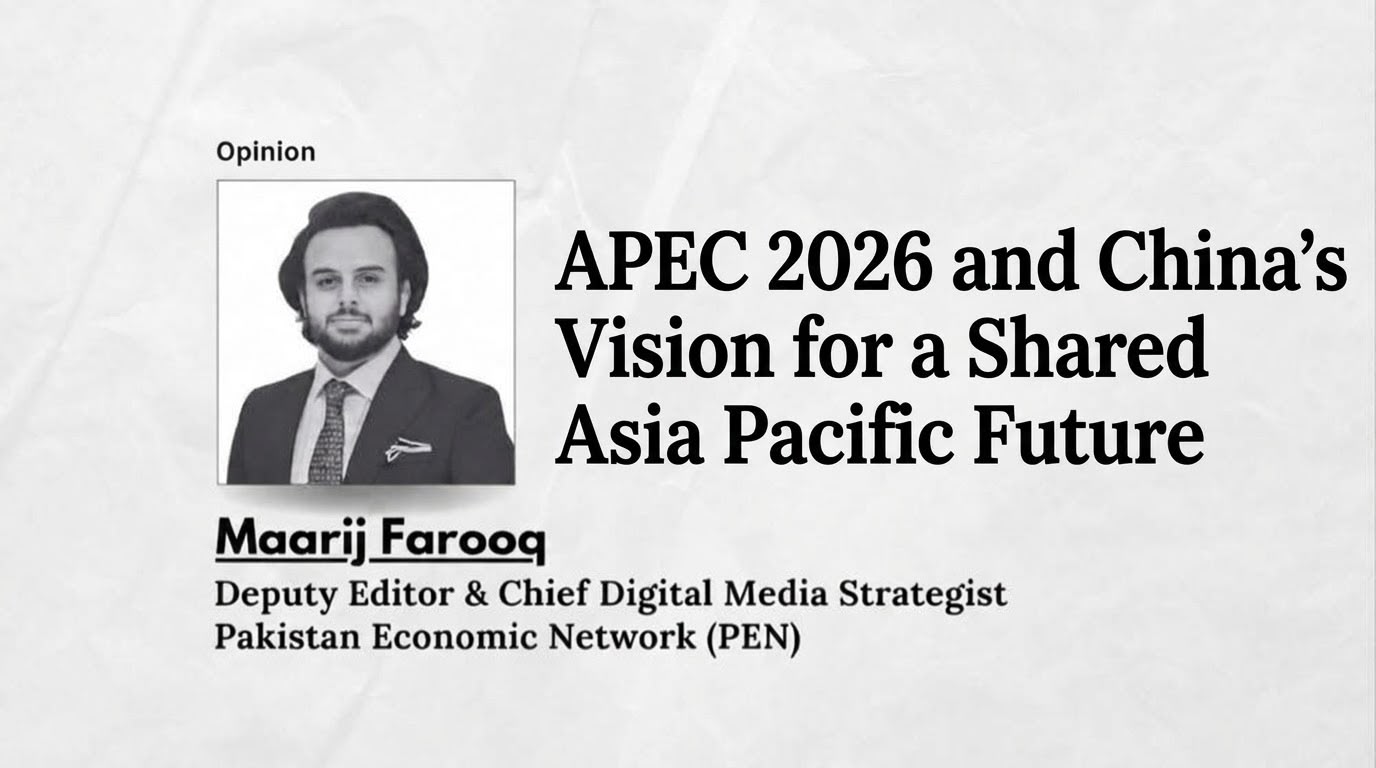
By: Maarij Farooq
As the world grapples with geopolitical uncertainty, economic fragmentation and an increasingly contested international order, China is preparing to host the Asia Pacific Economic Cooperation (APEC) Economic Leaders’ Meeting in Shenzhen. The gathering comes at a defining moment for the region and the wider world. More than a diplomatic occasion, it presents an opportunity to reaffirm the importance of economic cooperation, multilateralism and shared prosperity at a time when these principles face growing challenges.
Being in Shenzhen to attend the APEC related activities has provided me with an opportunity to witness firsthand the extraordinary transformation of one of China’s most technologically advanced cities. Shenzhen is not merely a showcase of modern infrastructure, innovation and economic dynamism. It represents the remarkable possibilities that emerge when long term vision, policy continuity and technological ambition converge.
Once a modest coastal settlement, Shenzhen has emerged as a global centre of innovation, manufacturing and technological advancement. Its transformation reflects China’s wider development trajectory, one that has lifted hundreds of millions out of poverty, strengthened industrial capabilities and established the country as a central pillar of the international economic system.
The choice of Shenzhen as the host city is therefore significant. It sends a message about the future China envisages for the Asia Pacific, a future driven by innovation, connectivity and economic opportunity rather than confrontation and division.
China’s role in shaping the economic destiny of the Asia Pacific cannot be overstated. Over the past several decades, its expanding manufacturing capacity, infrastructure development, technological progress and trade relationships have contributed substantially to regional economic integration. China has become an indispensable economic partner for numerous countries, providing markets, investment, technology and development opportunities.
At a time when protectionist tendencies are resurfacing and geopolitical rivalries threaten to disrupt established economic relationships, Beijing’s emphasis on openness and cooperation offers an important alternative to fragmentation.
The theme of APEC 2026, “Building an Asia Pacific Community to Prosper Together,” reflects this broader approach. With openness, innovation and cooperation identified as central priorities, China is seeking to reinforce the foundations of regional economic integration while preparing member economies for emerging technological and developmental challenges.
President Xi Jinping’s vision of building a community with a shared future has particular relevance in this context. It underscores the argument that prosperity cannot be sustained through isolation, nor can regional stability be achieved through economic exclusion. In an interconnected world, development increasingly depends upon cooperation across national boundaries.
The forthcoming summit should consequently be viewed through a wider strategic lens. Its importance extends beyond trade negotiations and economic declarations. It concerns the direction of the international economic order and whether the Asia Pacific can preserve its position as a centre of global growth despite intensifying strategic competition.
Artificial intelligence, digital transformation, sustainable development and resilient supply chains are among the issues likely to shape the regional economic agenda. These are precisely the areas in which China’s technological capabilities and industrial experience can make meaningful contributions to regional development.
For developing economies, China’s experience offers valuable lessons. Its success demonstrates the importance of infrastructure investment, human capital development, industrial modernization and sustained policy implementation. The challenge for the wider region is to translate these lessons into cooperation that produces tangible benefits for ordinary citizens.
Yet expectations must remain grounded in political realities. Differences among major economies continue to complicate collective decision making. The success of the Shenzhen summit will therefore depend not simply on ambitious declarations but on practical commitments that strengthen connectivity, facilitate trade and expand technological opportunities.
For countries such as Pakistan, although not an APEC member, the implications are equally important. Greater economic integration across the Asia Pacific can generate opportunities for investment, connectivity and industrial cooperation. China’s expanding technological capabilities and commitment to regional connectivity also provide avenues through which Pakistan can deepen its economic partnership with Beijing.
What should the world expect from Shenzhen? Above all, a renewed assertion of China’s commitment to multilateral cooperation and its willingness to assume greater responsibility in shaping regional economic development.
The summit also offers Beijing an opportunity to demonstrate that its rise need not be understood through the narrow framework of geopolitical rivalry. China’s development can instead serve as an important source of economic opportunity, technological advancement and shared progress.
Standing in Shenzhen, one is reminded that development is ultimately the product of vision translated into action. The city’s extraordinary journey provides a compelling illustration of what determined leadership and sustained economic transformation can accomplish.
As world leaders prepare to gather here, the central question is whether the Asia Pacific will choose cooperation over confrontation and collective prosperity over division.
China has articulated its vision. Shenzhen demonstrates its possibilities. The forthcoming APEC summit offers an opportunity to turn that vision into a stronger foundation for the region’s shared future.
The writer is the Deputy Editor in Chief at Daily ITTEHAD and Pakistan Economic Network.