


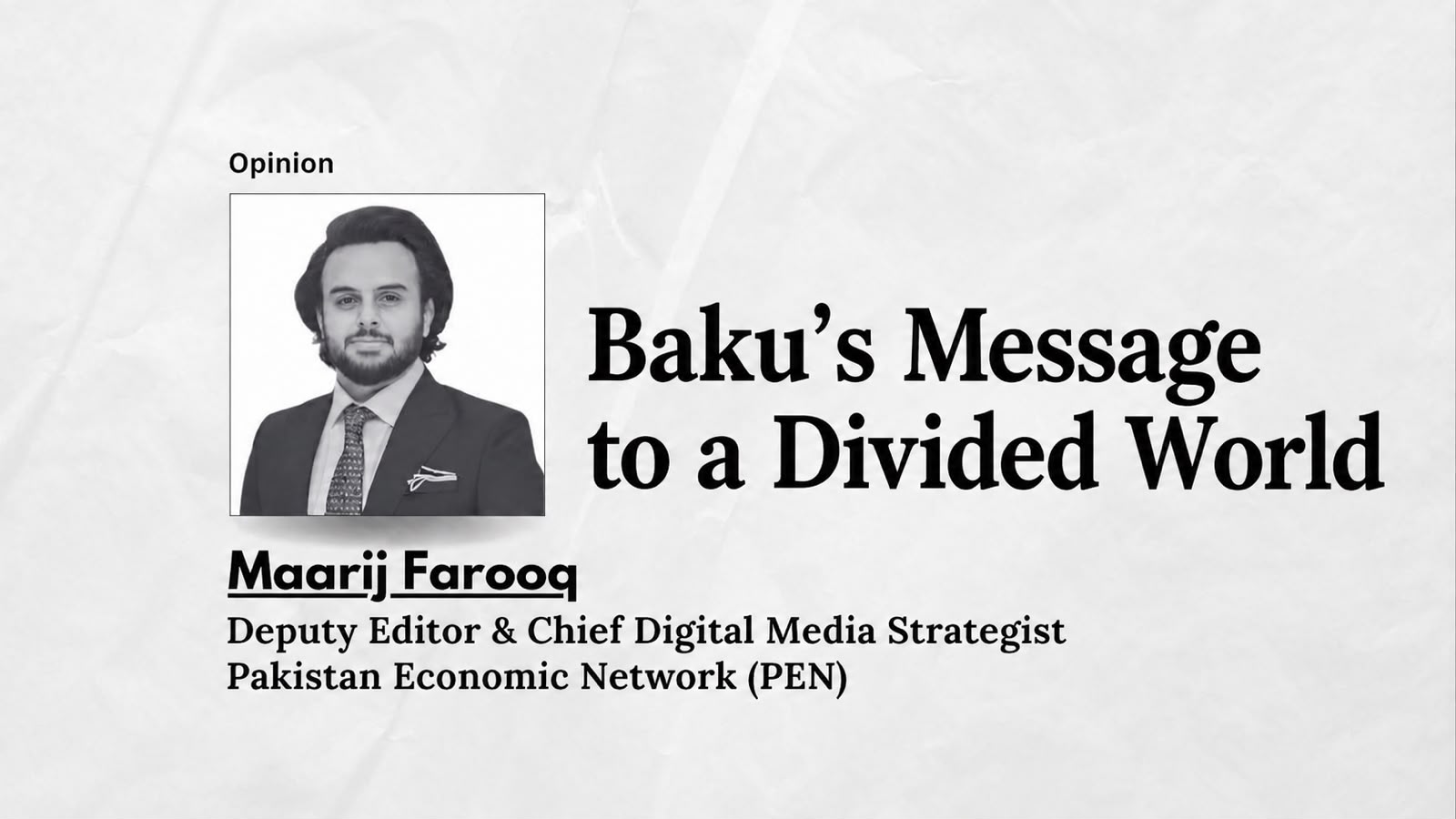
By: Maarij FarooqThe world is witnessing a troubling paradox. Never before have societies been so closely connected through technology, commerce and communication, yet rarely has the international environment appeared so divided. Geopolitical rivalries are intensifying, conflicts continue to destabilise regions, and the institutions established to promote international cooperation are struggling to respond effectively. Against this backdrop, the 7th World Forum on Intercultural Dialogue, held in Baku from October 27 to 29, carried significance extending well beyond cultural exchange.Organised under the theme “Dialogue for a Shared Future: Building Bridges in a Fractured World,” the gathering brought together representatives of governments, international organisations, religious communities and civil society. Its importance lay not simply in the participation it attracted, but in the larger question it sought to address: how can nations preserve cooperation when political differences, competing interests and cultural misunderstandings increasingly shape international relations?
The question is particularly relevant at a time when the international system is undergoing profound transformation. The expectation that economic integration would gradually produce political convergence has proved misplaced. Instead, the world is moving towards a more fragmented order, characterised by competing centres of power, strategic uncertainty and declining confidence in multilateral institutions. In such circumstances, intercultural dialogue should no longer be regarded as a ceremonial exercise or an exclusively cultural undertaking. It has become an important dimension of contemporary diplomacy.Azerbaijan’s decision to continue investing in this platform reflects an understanding of this changing international environment. Situated at the crossroads of Europe and Asia, the country occupies a geographical and strategic position that has historically connected different civilisations, trading networks and political traditions. Rather than treating this diversity merely as a historical inheritance, Baku has increasingly sought to translate it into a diplomatic asset.The Baku Process, launched in 2008, represents an important part of this approach. Over the years, it has developed into a platform bringing together countries and institutions from different cultural and political backgrounds. The World Forum on Intercultural Dialogue, first convened in 2011, has provided continuity to this initiative and helped establish Azerbaijan as a regular meeting place for discussions on coexistence and international understanding. The participation of institutions including UNESCO, the United Nations Alliance of Civilizations, ICESCO and UN Tourism further demonstrates how the initiative has acquired an international institutional character.President Ilham Aliyev, addressing the opening ceremony, emphasised Azerbaijan’s historical traditions of multiculturalism and its role in connecting Europe and Asia. He also drew attention to the country’s expanding diplomatic engagement, economic development and growing importance in international transport and energy connectivity. According to the Azerbaijani President, the forum attracted more than 2,000 registered participants, including over 500 foreign guests from more than 100 countries. These figures illustrate the reach the initiative has developed since its inception. Yet the larger significance of the Baku Forum lies in what it tells us about the changing nature of international influence.For much of modern history, power was understood principally in military and economic terms. Although these remain central to international relations, a country’s ability to convene discussions, build relationships and encourage cooperation across political and cultural divisions has acquired increasing importance. This is particularly true for countries that seek to exercise diplomatic influence beyond their geographical size.Azerbaijan’s approach offers an example of how strategic location, cultural identity and sustained diplomatic engagement can be brought together to strengthen international standing. By hosting forums that attract diverse participants, Baku is positioning itself as a venue where different perspectives can meet, even when political agreement remains difficult. This matters because one of the greatest weaknesses of contemporary international diplomacy is the shrinking space for meaningful engagement. Countries increasingly communicate through competing narratives, public accusations and political pressure rather than sustained negotiation. International disagreements are often framed in absolute terms, leaving little room for compromise.Dialogue cannot by itself resolve territorial disputes, eliminate economic inequalities or end geopolitical competition. But it can create conditions in which disagreements become more manageable and cooperation remains possible. This distinction is essential. The value of intercultural diplomacy should not be measured by whether every gathering produces a major agreement. Its contribution also lies in maintaining communication, encouraging mutual understanding and preventing political differences from developing into permanent hostility.Another important dimension of the Baku Forum was its recognition that the challenges facing international society now extend beyond traditional diplomacy. Discussions addressed artificial intelligence, digital transformation, youth participation, migration, cultural heritage, peacebuilding and the role of media in shaping public perceptions. These subjects reflect the changing sources of division within and between societies.
Technology, for example, has created unprecedented opportunities for communication, but it has also accelerated misinformation, reinforced social polarisation and enabled competing narratives to spread with extraordinary speed. Digital platforms can connect societies, yet they can equally deepen misunderstanding.The challenge is therefore not simply to increase communication, but to improve its quality.
Similarly, the participation of young people in intercultural initiatives is becoming increasingly important. A generation growing up amid geopolitical uncertainty, economic pressures and rapid technological change will inherit the consequences of decisions being taken today. Providing young people with opportunities to engage across national and cultural boundaries is an investment in future international stability. For the developing world, these discussions carry particular relevance. Countries across Asia, Africa and other regions face common challenges involving economic development, educational opportunity, technological inequality and social cohesion. Their experiences often differ from those of the major powers that dominate international decision making.
Platforms such as the Baku Forum can help bring these perspectives into broader international discussions.There is also a compelling economic argument for greater intercultural cooperation. Trade, investment, tourism and regional connectivity depend not only on infrastructure and financial arrangements, but also on political confidence and social understanding. Countries may construct transport corridors and commercial networks, but their long term success requires trust between the societies they connect.
This is where Azerbaijan’s emphasis on connectivity and cultural diplomacy becomes particularly relevant. Its position between Europe and Asia gives it an opportunity to contribute to both physical connectivity and the wider relationships needed to sustain it.For Pakistan, the experience offers useful lessons. Pakistan and Azerbaijan enjoy close political relations and share an interest in strengthening cooperation across trade, education, tourism and regional connectivity. These relations can acquire greater depth through expanded academic exchanges, media cooperation, cultural engagement and stronger links between younger generations.
Pakistan itself occupies a strategically important position connecting South Asia with Central Asia and beyond. It has much to gain from approaches that combine economic diplomacy with sustained engagement between societies. The wider lesson is that cultural diplomacy should not be treated as secondary to foreign policy. In a world where perceptions influence political choices and public opinion increasingly shapes international relations, cultural understanding can become an important source of diplomatic strength.There is, however, a broader challenge for all international dialogue initiatives. Their lasting relevance depends on the ability to translate discussions into practical cooperation. Conferences can establish relationships and identify common priorities, but sustained engagement between governments, universities, civil society organisations and international institutions is needed to carry those commitments forward.The Baku Process has the advantage of continuity. Its development over nearly two decades provides a foundation upon which more practical partnerships can be built. The next stage should place greater emphasis on measurable cooperation, particularly in education, youth engagement, digital literacy and initiatives that promote mutual understanding.
This would reinforce Azerbaijan’s contribution to an area of international diplomacy that is likely to become more important in the years ahead.The world does not suffer from a shortage of international meetings. What it increasingly lacks is the political willingness to listen, accommodate differences and recognise that cooperation does not require uniformity. The 7th World Forum on Intercultural Dialogue offered a reminder that diversity need not become a source of confrontation. It can also provide the foundation for cooperation, provided countries are prepared to invest in understanding rather than division.For Azerbaijan, the continued success of the Baku Process strengthens its role as a convening power and demonstrates how diplomacy can extend beyond traditional political and economic engagement.
For the international community, the message is equally important. At a time when global politics is increasingly defined by rivalry and mistrust, the capacity to build bridges may prove as valuable as the power to defend interests.The real significance of Baku’s initiative lies in its recognition that a divided world cannot be made more stable through competition alone. It also requires dialogue, mutual respect and the willingness to find common ground. And in an international environment where these qualities are becoming increasingly scarce, that is a message worth taking seriously.The writer is the deputy editor-in-chief at Daily ITTEHAD Media Group & Pakistan Economic Network




© 2024 – Daily Ittehad. All Rights Reserved.
Developed by Optimaxor