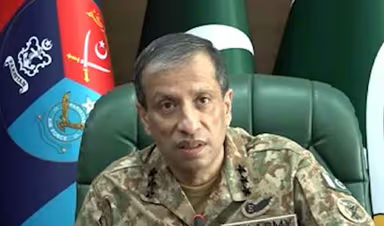
Pakistan has warned that any aggression against Saudi Arabia or another member of the Makkah Joint Defence Agreement could trigger a collective response, with the country prepared to take all necessary measures to protect the Kingdom’s sovereignty and territorial integrity.
In an interview with Independent Arabia, Inter-Services Public Relations (ISPR) Director General Lieutenant General Ahmed Sharif Chaudhry reaffirmed Pakistan’s defence commitments to Saudi Arabia, called for negotiations to prevent further escalation and urged Muslim countries to unite rather than fight among themselves.
Chaudhry said Saudi Arabia’s sovereignty, territorial integrity and the security of Makkah and Madinah were matters that could not be compromised.
“The sovereignty of Saudi Arabia, its territorial integrity, and the security of the Two Holy Mosques are matters that are neither negotiable nor open to compromise,” he told Independent Arabia.
He added that Pakistan was already providing the necessary support to achieve these objectives and would continue to do so. However, he said operational security prevented the disclosure of specific details about the military assistance being provided.
The military spokesperson reiterated that Pakistan was prepared to use all available means to deter attacks against the Kingdom and safeguard its sacred sites.
He also stressed that any threat to Saudi Arabia’s security would receive significant support from Pakistan, adding that the protection of the Two Holy Mosques remained a top priority for the country.
Makkah Joint Defence Agreement
Chaudhry described the Makkah Joint Defence Agreement’s development as extraordinary, dismissing criticism of the arrangement.
“Those who are troubled by the Makkah Joint Agreement are the ones criticising it,” he said, adding that the true value of any initiative was determined by its outcomes rather than the criticism it attracted.
He maintained that sceptics would continue to question the alliance, but the three countries would remain focused on fulfilling their commitments.
The DG ISPR said the Makkah pact was the culmination of a shared vision among Saudi Arabia, Pakistan and Türkiye, rooted in their longstanding historical ties. He explained that relations between the three countries were based on mutual respect, trust and a common commitment to regional security, stability and collective deterrence.
According to Chaudhry, military cooperation between Pakistan and Saudi Arabia dates back decades and covers multiple areas. Such coordination existed long before the establishment of the alliance and would continue in the future.
He pointed to the rapid establishment of the alliance’s General Secretariat and the formation of a political-strategic and defence committee as evidence of progress.
The committee brings together the foreign ministers, defence ministers and armed forces chiefs of the three member states, providing a framework for political coordination and military cooperation.
Aggression against a member can prompt collective action
Chaudhry said the alliance was based on the right to self-defence guaranteed under Article 51 of the United Nations Charter. He explained that its collective deterrence mechanism was intended to send a clear message to any party seeking to destabilise the region.
“Should any party launch a war — directly or indirectly — against any of the three member states, the response will be collective,” he said.
The military spokesperson added that if deterrence failed to achieve its objectives, the three countries would need to re-establish it using all means available to them.
Chaudhry also maintained that the agreement was defensive in nature and had no aggressive intentions. He stressed that the three member states shared a clear understanding of the alliance’s commitments and objectives.
Outrage over threats to holy sites
Addressing the Houthi attacks and threats involving Saudi Arabia’s sacred sites, Chaudhry said the incidents had triggered widespread anger across Pakistan. He said the outrage extended from ordinary citizens, including children and young people, to the country’s political and military leadership.
“We wondered: how could any rational person attack Saudi Arabia, threaten its holy sites, or even give the impression that they intend to do so?” he said.
Chaudhry emphasised that the security of Islamic holy sites was not open to compromise or reservation and that Pakistan’s military position stemmed directly from this commitment.
He added that Pakistan’s message to Saudi Arabia, its own people and Muslims angered by the attacks combined two principles: the need for unity among Muslim countries and readiness to defend the security of alliance members.
Negotiations to prevent wider conflict
Despite the firm warning, Chaudhry stressed that escalating or expanding military conflicts would serve no country’s interests. He said Pakistan, Saudi Arabia and Türkiye believed in peace and stability across the region and that reaching a negotiated settlement was imperative.
The military spokesperson urged the parties concerned to pursue diplomacy rather than allow tensions to develop into a wider confrontation.
However, he warned that if negotiations failed and military conflict erupted, the Makkah Defence Alliance’s collective deterrence mechanism would come into effect.
Chaudhry also reiterated that the agreement was not directed against any specific country and that its objective was to promote regional peace, stability and security.
“Muslims need to unite rather than fight among themselves,” he said.
Pakistan to consider request to support Yemen
Chaudhry also addressed the possibility of Pakistan providing direct military assistance to Yemen’s internationally recognised government.
He said he was unaware whether Islamabad had received a formal request for such support. However, he confirmed that Pakistan would examine any formal request and make an appropriate decision.
The interview followed remarks by Saudi Foreign Ministry official Raed Qarmali, who said during a press briefing that Iran had encouraged the Houthis to escalate their actions against the Kingdom.
Chaudhry said Pakistan was communicating the seriousness of its defence commitments through its armed forces, official statements and operational deployments.
“We will take all necessary measures to support the security of Saudi Arabia and its territorial integrity, as well as the security of the Two Holy Mosques and other sacred sites,” he said.
He added that the message was directed at everyone involved, including those carrying out attacks and those standing behind them.
The DG ISPR said Pakistan’s position had already been conveyed through the country’s political leadership and the Field Marshal, reaffirming that Islamabad’s commitment to Saudi Arabia’s security remained clear and unequivocal.