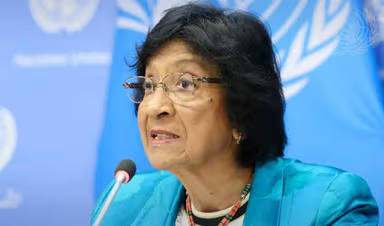
Navanethem “Navi” Pillay has been announced as the winner of the 2026 Nobel Peace Prize for her efforts to promote peace and international law, according to the announcement provided.
The Norwegian Nobel Committee, chaired by Jørgen Watne Frydnes, praised Pillay’s commitment to universal legal principles, personal integrity and courage throughout a distinguished career spanning South Africa’s anti-apartheid struggle and some of the most significant international legal proceedings of recent decades.
Pillay has played a significant role in advancing international law and strengthening accountability for war crimes, crimes against humanity and genocide.
The Nobel Committee’s stated rationale highlights her efforts to hold states and national leaders accountable while bringing hope to victims of violence and conflict. Her career reflects a consistent emphasis on the responsibility of individuals and governments to uphold the rule of law. Through her work as a lawyer, judge and United Nations official, she has helped establish legal mechanisms for addressing serious human rights violations.
The recognition also highlights the importance of resolving conflicts through diplomacy, treaties and legal institutions rather than threats, violence and warfare.
Defending anti-apartheid activists to international justice
Born into a family of Indian Tamil descent in Durban, South Africa, Pillay grew up under apartheid, a system of racial segregation and discrimination.
She pursued a legal career and began defending activists who challenged apartheid, including Nelson Mandela and others who stood up against the system. In 1967, she established her own law firm in Durban.
Pillay later continued her legal education at Harvard University in the United States, earning a Doctor of Juridical Science degree in 1988.
Her early work confronting structural discrimination, segregation and exclusion helped establish the foundations of a career dedicated to legal accountability and human dignity.
Distinguished career in international courts
Pillay was appointed to South Africa’s High Court in 1995. Four years later, she became a judge and president of the International Criminal Tribunal for Rwanda (ICTR).
During her time at the tribunal, she gained recognition for her role in establishing important legal precedents concerning sexual violence, rape and propaganda in cases involving crimes against humanity and genocide.
Her work helped demonstrate how sexual violence could constitute an instrument of genocide and how the deliberate use of propaganda could contribute to the commission of serious international crimes.
Pillay subsequently served as a judge at the International Criminal Court (ICC), further expanding her involvement in international criminal justice.
UN human rights chief, Palestinian territory inquiry
From 2008 to 2014, Pillay served as the United Nations High Commissioner for Human Rights, leading the UN human rights office during a period marked by significant international crises and human rights challenges. She also chaired the UN Independent International Commission of Inquiry on the Occupied Palestinian Territory from 2021 to 2025.
In 2019, Pillay became an ad hoc judge at the International Court of Justice (ICJ) in the case in which Myanmar stands accused of genocide.
Her involvement in these institutions has placed her at the centre of efforts to strengthen international legal standards and ensure that allegations of serious abuses are addressed through judicial processes.
Rule of law amid rising conflicts
The Nobel Committee’s stated reasoning emphasises the importance of international law at a time when wars and conflicts are increasing and judicial institutions face political pressure.
Pillay’s career demonstrates how legal mechanisms can help prevent violence, establish accountability and provide victims with avenues to seek justice.
The committee also highlights the importance of independent judges and strong international institutions in ensuring that those responsible for war crimes, crimes against humanity and genocide can be prosecuted.
An effective international legal order, the announcement argues, is essential to a peaceful world because it provides mechanisms for resolving disputes and holding perpetrators accountable without resorting to force.
Career centred on justice and human dignity
Pillay’s legal career has extended from defending activists under apartheid to serving in some of the world’s most prominent international judicial and human rights institutions. Her work has focused on universal legal principles, the protection of human dignity and the responsibility of governments and individuals to comply with international law.
The 2026 Nobel Peace Prize recognition underscores the role of international justice in addressing conflict and protecting victims, while highlighting the importance of supporting and strengthening the institutions responsible for upholding the global rule of law.