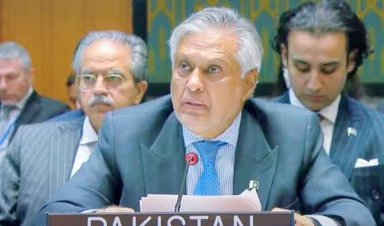
Deputy Prime Minister and Foreign Minister Ishaq Dar has called for stronger global measures to address the risks posed by artificial intelligence, stressing that humans must retain control over AI systems and that no small group should be allowed to monopolise the technology.
Speaking at a UN Security Council briefing on ‘Artificial Intelligence and International Security’ in New York, Dar said global cooperation was urgently needed to ensure AI serves humanity while addressing threats including fake news, cyberattacks and the potential militarisation of the technology. The meeting was convened by France, which holds the Security Council presidency for September.
Dar underscored the need for further measures on artificial intelligence, saying it was essential to counter the threats AI poses to humanity.
He stressed that human judgment and control must be retained at every stage of AI design, development and integration, while calling for a comprehensive framework to govern the technology.
The deputy prime minister also warned against allowing AI to become another facet of the global arms race. He called for restraint and confidence-building measures to reduce the risks of miscalculation and increasingly compressed decision-making in the military domain.
No monopoly over artificial intelligence
Dar cautioned that efforts to regulate the pace of AI development should not become a new form of gatekeeping.
He said measures introduced in the name of AI safety should not be turned into instruments of technology denial, stressing the importance of equitable access to the benefits of artificial intelligence.
The deputy prime minister called for AI governance to be discussed through representative and inclusive forums with universal participation under the auspices of the United Nations.
Pakistan backs global cooperation on AI
Dar reaffirmed Pakistan’s commitment to advancing international cooperation on artificial intelligence and bridging the global AI divide.
He said equitable access to AI should be promoted so that the technology can contribute to peace and development for all, rather than becoming concentrated in the hands of a few countries or entities.
He also welcomed the first UN Global Dialogue on AI Governance in Geneva and highlighted Pakistan’s founding membership of the World Artificial Intelligence Cooperation Organization (WAICO).
Dar described Pakistan’s participation in WAICO as a concrete step towards promoting the development of AI “for good and for all.”
Fake news and cyberattacks among key concerns
The deputy prime minister also highlighted the challenges posed by fake news and cyberattacks, calling for efforts to curb the harmful use of artificial intelligence in spreading misinformation and facilitating cyber threats.
His remarks come as the Security Council examines the implications of rapidly advancing AI for international peace and security. The UN said the September 23 briefing brought together senior political leaders and leading figures from the global AI industry to discuss both the opportunities and risks associated with frontier AI.
Dar delivered Pakistan’s statement at the high-level Security Council briefing, which was chaired by France’s foreign minister.
The meeting featured senior participation from Security Council members, including the foreign ministers of Denmark and the Democratic Republic of the Congo, the UK secretary of state for foreign, Commonwealth and development affairs, and the assistant to the US president and director of the White House Office of Science and Technology Policy.
Senior representatives from Panama, Greece, Somalia, Bahrain, Latvia, Colombia, China, Russia and Liberia also participated.
The Council was briefed by Professor Yoshua Bengio, co-chair of the UN International Independent Panel on AI, OpenAI CEO Sam Altman, Anthropic CEO Dario Amodei and Hugging Face CEO Clément Delangue.
Pakistan stresses inclusive AI governance
Dar’s participation was part of his wider programme during the high-level week of the 81st session of the UN General Assembly in New York. Pakistan’s Foreign Office had earlier confirmed that he would deliver a statement at the Security Council briefing on artificial intelligence and international security.
In his address, Dar linked Pakistan’s position on AI governance to the broader need for international cooperation, arguing that the development and deployment of advanced technology should remain guided by human judgment, inclusivity and shared international responsibility.
He reaffirmed Islamabad’s commitment to working internationally to bridge disparities in access to AI and promote its use for peaceful development.