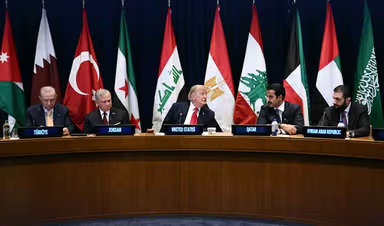
US President Donald Trump met senior officials from across the Middle East on the sidelines of the 81st United Nations General Assembly in New York on Tuesday, as the Iran war and attacks by Iran-backed forces continued to unsettle the region.
The meeting, initially planned with Gulf Cooperation Council representatives, expanded into a wider gathering involving officials from 12 Middle Eastern countries, including Türkiye, Syria and Jordan.
Before the closed-door meeting, Trump said Washington would continue applying financial and military pressure on Iran while leaving open the possibility of further strikes.
“We’re completely isolating Iran financially, and we’re just putting the pressure on because hopefully they’ll do the right thing fast before it’s too late,” Trump told reporters.
He warned that there could eventually be a point at which Washington would no longer be willing to allow Iran to “survive as a nation.”
Earlier at the UN General Assembly, Trump had said he faced a choice between reaching a deal with Iran and taking further military action, including what he described as annihilating the country.
Wider Middle East summit in New York
The White House had initially described the gathering as a meeting between Trump and leaders from the Gulf Cooperation Council, which comprises Saudi Arabia, the United Arab Emirates, Qatar, Bahrain, Kuwait and Oman.
However, the roundtable also included senior representatives from Jordan, Egypt, Türkiye, Iraq, Lebanon and Syria. Israel and Iran were among the only Middle Eastern countries not represented at the meeting.
Among the participants was Turkish President Recep Tayyip Erdogan, Syrian President Ahmed al-Sharaa and Jordan’s King Abdullah II.
The talks came as Gulf Arab governments have grown increasingly concerned about the expanding regional conflicts and questions surrounding Washington’s long-term commitment to their collective security.
Trump says Iran deal could be reached
At the beginning of the meeting, Trump repeated his view that the United States could reach an agreement with Iran by the November midterm elections, if not sooner.
He also referred to the earlier meeting between US envoys Steve Witkoff and Jared Kushner and Iranian representatives, describing those discussions as “very productive.”
“We will see what happens with that. I think there’s a lot of momentum for them to make a deal. That’s what we are hearing from everybody,” Trump said.
Trump also thanked the officials around the table for their cooperation with Washington, including efforts that helped secure a ceasefire and hostage-release agreement between Israel and Hamas last year.
However, progress on that agreement has since largely stalled.
Gulf states face growing security concerns
The meeting took place against the backdrop of increasing attacks involving Iran and its regional allies.
Gulf governments are concerned that any further US military escalation against Iran could trigger additional retaliation against their territory and energy infrastructure.
Saudi Arabia faces attacks from multiple directions, while Qatar, Bahrain and Kuwait continue to experience major trade disruptions linked to the closure of the Strait of Hormuz.
The UAE, meanwhile, has increased diplomatic engagement with Iran. UAE presidential diplomatic adviser Anwar Gargash said the two sides had agreed on the need to “turn the page,” while warning that rebuilding trust could take decades.
Gargash has also argued that dialogue must be accompanied by deterrence.
Gulf leaders previously urged Trump to hold fire
Trump’s meeting with Gulf leaders comes more than a month after regional governments helped persuade him to call off a major attack against Iran.
In early August, Trump said he had cancelled a planned escalation after Saudi Arabia, the UAE and Qatar urged restraint, believing at the time that a diplomatic agreement with Tehran was within reach.
More than a month later, no agreement has emerged, oil prices remain elevated and the US midterm elections are approaching.
Trump told Axios that he faced a “big decision” over the war and wanted to hear directly from Gulf leaders.
The challenge for Gulf governments is to seek protection from further Iranian retaliation while avoiding deeper involvement in the conflict.
Iranian-backed forces have continued targeting Saudi energy infrastructure from Yemen and Iraq, raising concerns about a broader disruption to global energy supplies.
Saudi Arabia faces major security test
Saudi Arabia is confronting what has been described as one of its most significant security challenges since the 1991 Gulf War.
The situation is also testing the longstanding US-led security arrangement in the Gulf, under which regional countries host American forces and purchase US weapons while relying on Washington to help deter external threats.
At the same time, Washington has been discussing a possible longer-term reduction in its military presence in the Gulf.
Whether Trump will act on his threat to launch further attacks against Iran remains uncertain. US missile stockpiles have reportedly been significantly depleted, while another escalation in a war that has already generated domestic opposition could create additional political pressure ahead of the November midterm elections.
Gulf states wary of US military drawdown
Gulf governments are also concerned about reports that the United States may reduce its military footprint in the region.
Senior Pentagon officials have privately indicated that Washington wants to scale back troop deployments in several Gulf countries as part of a broader effort to shift more responsibility for regional defence onto local partners.
For Gulf governments, discussing a US military drawdown while attacks are spreading across the region could increase their vulnerability to Iran.
An official familiar with Saudi thinking said the timing was particularly sensitive and that the Gulf Cooperation Council was working to present a united position toward Iran.
During the early stages of the Iran war, Trump questioned why the United States should continue shouldering such a large share of the burden of protecting Gulf energy routes as Iranian attacks against Gulf states intensified.
“You could make the case that maybe we shouldn’t even be there at all,” Trump said in March while discussing the US military presence in the Gulf.
Iran has long opposed US bases in the Gulf
Iran has historically described US military bases in the Gulf as a security threat.
Throughout the war, Tehran has repeatedly demanded the closure of those bases, while Iranian Supreme Leader Mojtaba Khamenei has argued that the US military presence has made Gulf states targets without providing the security Washington promised.
“By now they must have realized that the United States’ claims of providing security and peace have been nothing more than a lie,” he said in a March statement.
Iranian officials have continued to make the US military presence in the region a central part of their criticism of Washington’s Gulf policy.
Trump again threatens strike on Pickaxe Mountain
During the meeting with Gulf leaders, Trump again threatened possible military action against the suspected Iranian nuclear facility known as Pickaxe Mountain.
“We may have to blow up another one, Pickaxe Mountain,” Trump said, adding that if the United States detected activity at the site, “we’ll blow it up immediately.”
Trump simultaneously said that Washington was not currently seeing significant activity there.
His remarks came shortly after he said he believed Iran was no longer pursuing a nuclear weapon.
“We’re not going to let that happen. It’s already ended. That aspect of it, in my opinion, has already ended,” Trump said.
US intelligence assessments have previously said Iran ended a nascent nuclear weapons program around 2003 and was not pursuing a nuclear bomb under former Supreme Leader Ali Khamenei, who was killed in an airstrike in February.
Regional economic corridor also discussed
Trump reiterated his administration’s support for the India–Middle East–Europe Economic Corridor, a major connectivity initiative linking South Asia, the Middle East and Europe.
The corridor incorporates Israel, although Saudi Arabia and Türkiye have been advancing an alternative approach that would connect the corridor through Syria and Lebanon instead.
Trump did not mention the Abraham Accords during the meeting. Several countries have become increasingly reluctant to join the framework amid concerns over what they view as Israel’s expansionist policies in the region.
Oman stresses diplomacy and regional stability
Oman also participated in the multilateral meeting convened by Trump alongside Gulf and Arab countries and Türkiye.
Oman was represented by Ambassador Talal Al Rahbi, the country’s accredited ambassador to the United States, accompanied by several officials.
According to Oman, the meeting addressed developments in the Middle East, regional challenges and efforts to reduce escalation while strengthening security and stability.
Discussions also covered diplomatic efforts and peaceful approaches to resolving regional crises.
Oman stressed the importance of continuing dialogue and diplomacy and intensifying regional and international efforts to contain tensions.
Muscat said such efforts should help create conditions for peaceful and sustainable solutions that protect regional security and stability while meeting the aspirations of people across the region for peace and development.
UN General Assembly provides diplomatic backdrop
The meeting formed part of a series of high-level diplomatic engagements taking place in New York during the 81st session of the UN General Assembly.
The high-level general debate is being held from September 22 to 26, bringing together world leaders and senior officials to discuss international conflicts, security concerns and regional crises.
The latest Middle East meeting comes as Washington weighs its next steps in the Iran war, Gulf countries seek greater clarity over US security commitments and regional governments push for diplomatic channels to remain open.
For the Gulf states, the immediate concerns include Iranian retaliation, energy infrastructure attacks, disruption to shipping through the Strait of Hormuz and the potential consequences of a further US military escalation.
At the same time, the longer-term question remains how the regional security framework will evolve if Washington reduces its military presence while conflicts involving Iran and its regional allies continue.