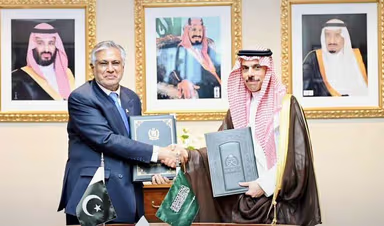
Pakistan and Saudi Arabia have signed an agreement to abolish visa requirements for holders of diplomatic, official and special passports, further strengthening institutional and high-level engagement between the two countries.
Deputy Prime Minister and Foreign Minister Ishaq Dar and Saudi Foreign Minister Prince Faisal bin Farhan signed the agreement on the sidelines of the United Nations General Assembly in New York on Tuesday.
The agreement, formally titled the “Agreement between Islamic Republic of Pakistan and Kingdom of Saudi Arabia on the abolition of visa requirements for holders of Diplomatic and Official/Special Passports,” provides a framework for visa-free travel for eligible passport holders.
Dar highlights impact on bilateral ties
Announcing the development, Ishaq Dar said the agreement would further facilitate high-level engagement and institutional exchanges between Pakistan and Saudi Arabia.
He said the move would also contribute to advancing the countries’ enduring and brotherly strategic partnership across areas of mutual interest.
Dar described Saudi Foreign Minister Faisal bin Farhan as his “brother” in announcing the signing, underscoring the close relationship between Islamabad and Riyadh.
Agreement to facilitate official exchanges
The visa waiver arrangement is expected to make official travel easier for eligible diplomatic, official and special passport holders from both countries.
The agreement comes as Pakistan and Saudi Arabia continue to maintain close bilateral engagement through regular high-level contacts and consultations on matters of mutual interest.
The signing in New York adds another institutional mechanism to the longstanding relationship between Pakistan and Saudi Arabia, with both sides continuing to emphasize closer cooperation and coordination.
Strategic partnership remains key focus
Pakistan and Saudi Arabia have repeatedly reaffirmed their commitment to strengthening bilateral ties and cooperation. Recent high-level engagements between the two countries have covered bilateral relations as well as regional and international developments.