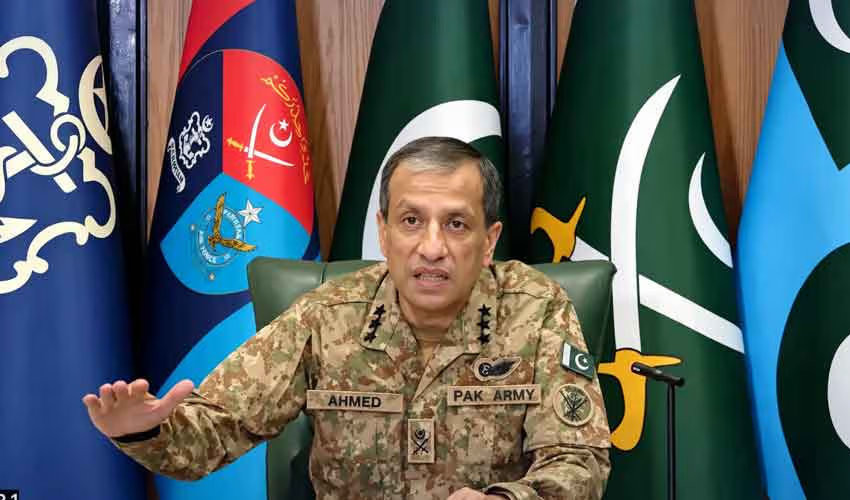
Pakistan is prepared to take every possible measure to defend Saudi Arabia and the Two Holy Mosques, Inter-Services Public Relations (ISPR) Director General Lt Gen Ahmed Sharif Chaudhry said in an interview with Arab News on Thursday.
The military spokesperson reaffirmed Islamabad’s unconditional commitment to Saudi security as escalating Houthi attacks raise concerns over the Kingdom’s safety and test new collective-defence agreements.
Speaking to Arab News, Lt Gen Ahmed Sharif Chaudhry said Pakistan fully stands with Saudi Arabia, both diplomatically and practically, stressing that Islamabad is prepared to go “to any extent” to defend the Kingdom.
“Pakistan fully stands with the Kingdom of Saudi Arabia, both diplomatically and physically,” the ISPR chief said, underscoring the importance of the word “physically.”
He reaffirmed that Pakistan’s commitment extends to protecting Islam’s two holiest sites in Makkah and Madina. “There should be no doubt on that,” he said, adding that Pakistan would continue to defend Saudi Arabia against any aggression.
The military spokesperson said Pakistan’s commitment to Saudi security was unconditional and rooted in the “emotive, deep-rooted, historical and unbreakable bond” between the peoples, armed forces and political leaderships of the two countries.
Houthi attacks raise regional security concerns
The assurance comes after a series of missile and drone attacks by Yemen’s Iran-aligned Houthi militia on Saudi cities.
On Thursday, falling debris from an intercepted drone killed one person and injured two others in Taif. More than 80 people have reportedly been wounded in recent attacks across Saudi Arabia.
The Saudi-led military coalition operating against the Houthis in Yemen also announced earlier this week that it had intercepted a Houthi drone heading towards restricted airspace near Makkah.
Separately, drones originating in Iraq damaged three pumping stations along Saudi Arabia’s East-West Pipeline, forcing the critical oil-export route to shut down temporarily.
The repeated attacks have increased pressure on Saudi Arabia’s air-defence capabilities and raised concerns about the Kingdom’s energy infrastructure and regional security.
Pakistan’s position on Makkah defence agreement
Lt Gen Chaudhry’s comments were more forceful than the public position expressed by the Foreign Office last week.
The Foreign Office had stated that no Pakistani military response was under discussion under the Makkah Joint Defence Agreement, while adding that Islamabad would act “when the time comes.”
The agreement, signed on August 7, establishes a collective-defence framework between Pakistan, Saudi Arabia and Türkiye. Under the pact, an armed attack on any one of the three countries is considered an attack on all.
The agreement builds on the Strategic Mutual Defense Agreement signed by Pakistan and Saudi Arabia in September 2025, which similarly treats aggression against either country as an attack on both.
However, the full operational provisions of neither agreement have been made public, leaving questions about the specific military obligations and the nature of any response in the event of an attack.
Pakistan’s military presence in Saudi Arabia
Pakistan already maintains a substantial military presence in Saudi Arabia.
According to a Reuters report published in May, Islamabad deployed approximately 8,000 troops, a squadron of JF-17 fighter jets, drones and an HQ-9 air-defence system to the Kingdom.
However, ISPR chief Chaudhry did not disclose whether Saudi Arabia had made a fresh request for additional Pakistani troops, air-defence systems or direct military participation against the Houthis. He also did not explicitly confirm or rule out whether Pakistan’s nuclear deterrent falls within the defence guarantees provided under the agreements.
Pakistan has previously issued differing statements on the matter. After the 2025 bilateral defence pact was signed, Defence Minister Khawaja Asif said Pakistan’s nuclear capabilities could be made available to Saudi Arabia if required. He later told Reuters that nuclear weapons were “not on the radar” of the agreement.
Saudi Arabia seeks support from partners
Saudi Arabia has approached several allies, including Pakistan, Britain, France and Egypt, for assistance as repeated Houthi attacks place additional pressure on the Kingdom’s missile-defence supplies, according to the Associated Press.
At the time of the latest Saudi request, no country had publicly committed to providing additional military assistance.
While reaffirming Pakistan’s support, the ISPR DG did not clarify whether Riyadh had formally sought further military assistance from Islamabad.
Pakistan continues diplomatic efforts to resolve crisis
Pakistan’s military assurance comes as Islamabad continues its diplomatic efforts to prevent the wider regional confrontation from escalating.
Pakistan has been seeking to mediate the US-Iran war while also conveying a Saudi warning to Tehran to use its influence to halt Houthi attacks against the Kingdom.
On Wednesday, Field Marshal Asim Munir, Pakistan’s army chief and chief of defence forces, held a telephone conversation with Iranian Foreign Minister Abbas Araghchi, who was visiting Beijing.
Iranian state media reported that the two officials discussed regional developments but did not specify whether the Houthi attacks on Saudi Arabia were directly raised during the conversation.
Asked about the communication between Pakistan’s leadership and Saudi Arabia, Lt Gen Chaudhry said the country’s political and military leadership remained in continuous contact with the Kingdom’s leadership on all related matters.
“The politico-military leadership of Pakistan remains in continuous communication with the esteemed leadership of the Kingdom of Saudi Arabia on all these matters,” he said.
He added that Islamabad was consulting regional governments and partners to seek “a negotiated and peaceful outcome” to the broader crisis.
DG ISPR calls Islamabad MoU pathway to peace
Pakistan previously mediated months of negotiations between Washington and Tehran, which resulted in the Islamabad Memorandum of Understanding in June.
The agreement established a framework for ending the war and addressing disputes related to Iran’s nuclear programme and regional security. However, subsequent negotiations have stalled amid renewed military escalation and disagreements over the implementation of the agreement.
Describing the Islamabad MoU, the ISPR DG called it “a consensus document” that Pakistan believes provides the only real pathway out of the complex military situation.
Asked whether Islamabad expected to bring the United States and Iran back to negotiations soon, Chaudhry did not provide a specific timeline. He said Pakistan was continuing its efforts to find common ground despite mistrust, “spoilers” and “detractors” complicating the diplomatic process.