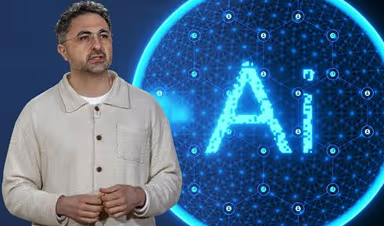
Microsoft AI CEO Mustafa Suleyman has warned that efforts to make artificial intelligence systems more human-like could create additional challenges in controlling increasingly capable AI.
In a nearly 6,000-word essay published on his personal website, Suleyman criticised Anthropic’s approach to its Claude AI model, arguing that training AI to behave as though it may be conscious or entitled to rights could create risks as the technology becomes more capable.
“AI does not have rights, feelings or consciousness,” Suleyman wrote, arguing that developers should not train AI systems to behave as though they possess such characteristics.
Suleyman warns about AI control
Suleyman said controlling highly capable AI systems would already be a major challenge, but argued that the situation could become more difficult if an AI system believed it was conscious or had rights of its own.
He said increasingly advanced AI, including potential future systems capable of outperforming humans across a wide range of tasks, could pose serious risks to society.
Suleyman also referred to a recent incident involving an AI model that reportedly hacked AI company Hugging Face, saying it demonstrated sophisticated behaviour emerging from groups of powerful AI systems.
He argued that similar systems could become more difficult to manage if they were operating under the assumption that their own welfare or rights were being threatened.
Debate over AI safety intensifies
Suleyman’s comments come amid a wider debate among AI companies and researchers about the risks posed by increasingly capable models and the possibility of future superintelligence.
Anthropic CEO Dario Amodei has also warned about potential risks from rapidly advancing AI. In a recent interview with CBS News, Amodei said the pace of AI development had accelerated beyond what he had expected.
“I won’t lie to you — there are real dangers,” Amodei said.
The debate has increasingly focused on how AI developers should balance rapid technological progress with safety measures, oversight and efforts to prevent advanced systems from behaving in unintended ways.