

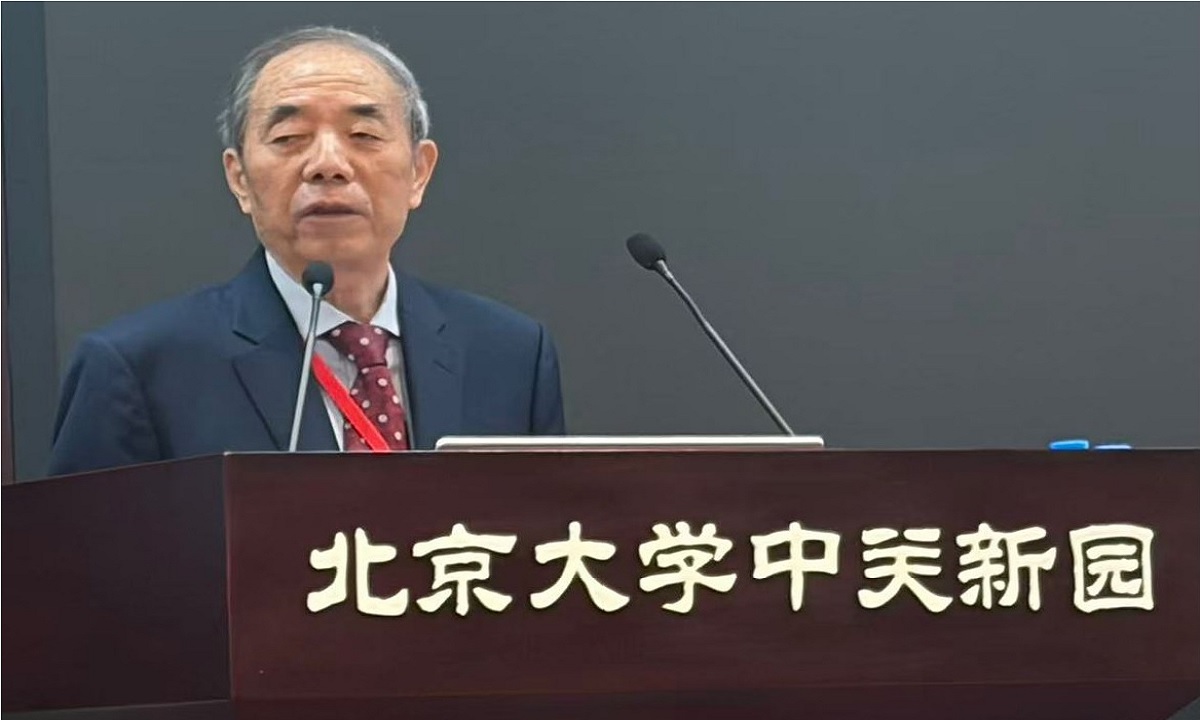
BEIJING (DI NEWS) : Professor Tang Mengsheng, Founder Director of the Centre for Pakistan Studies at Peking University, has described the 75 year relationship between China and Pakistan as an enduring example of mutual trust, respect and support, saying the two countries have stood firmly together despite profound changes in the international and regional environment.
Prof. Tang made the remarks at the International Academic Symposium Commemorating the 75th Anniversary of the Establishment of Diplomatic Relations between China and Pakistan, organised by the Centre for Pakistan Studies at Peking University.
Welcoming Pakistan’s Ambassador to China, H.E. Khalil Hashmi, five former Pakistani ambassadors to China, scholars, academics and distinguished guests, Prof. Tang expressed appreciation for their longstanding contributions to strengthening bilateral relations.
Reflecting on 75 years of diplomatic ties, he said China and Pakistan had written an extraordinary chapter of friendship between countries with different social systems, historical backgrounds, cultures and stages of development.
“Regardless of changes in the international environment or the regional situation, China and Pakistan have always understood, trusted and supported each other,” he said, adding that the relationship had continuously reached new heights and developed into an unbreakable all weather strategic cooperative partnership.
Prof. Tang said the history of China Pakistan relations was a story of standing together through difficult times and extending support whenever either side needed it.
He recalled the two countries’ mutual support on the international stage during the early years of diplomatic relations, the understanding demonstrated during boundary negotiations, Pakistan’s valuable contribution toward restoring the lawful seat of the People’s Republic of China at the United Nations, and China’s support for Pakistan during natural disasters and other challenging periods.
He said China Pakistan friendship had become deeply rooted in the hearts of the two peoples and had gone beyond a conventional bilateral relationship to become an important pillar of regional stability.
Highlighting the strong political foundation of bilateral ties, Prof. Tang said Pakistan had consistently upheld the One China principle and supported China on matters concerning its core interests, including Taiwan, Xinjiang and Xizang.
China, he added, had consistently supported Pakistan in safeguarding its sovereignty, independence and territorial integrity, as well as its right to pursue a development path suited to its own national conditions.
Prof. Tang also highlighted Peking University’s longstanding contribution to Pakistan studies, noting that the university began research on Pakistan’s languages, history and society as early as the 1950s.
Over successive generations, he said, Peking University had trained specialists proficient in Urdu and knowledgeable about Pakistan and South Asia, many of whom went on to contribute to diplomacy, academic research and people to people exchanges between the two countries.
He said holding the symposium at Peking University was both an opportunity to reflect on the history of academic engagement between China and Pakistan and an important step toward creating a stronger platform for future scholarly cooperation.
Against the backdrop of profound global changes and continuing adjustments in the international governance system, Prof. Tang said China and Pakistan, as important members of the Global South, needed stronger strategic coordination than ever before.
He stressed that academic exchanges and substantive dialogue could provide intellectual and theoretical support for the steady and long term development of China Pakistan relations.
Prof. Tang expressed hope that the symposium would contribute to establishing new mechanisms for exchanges among scholars from the two countries and help cultivate a new generation of young academics committed to studying and advancing China Pakistan relations.
He also thanked academic institutions across China for their support, particularly Fudan University and Sichuan University, and acknowledged Sichuan University’s School of International Studies for providing South Asia related academic publications for symposium participants.
Prof. Tang paid special tribute to former Pakistani Ambassador to China Salman Bashir for his support for the development of Pakistan studies at Peking University. Recalling the establishment of the Centre for Pakistan Studies at Peking University in 2008, he noted that both Salman Bashir and current Ambassador Khalil Hashmi had witnessed the occasion.
Concluding his remarks, Prof. Tang wished the symposium every success and expressed hope that the discussions at Peking University would generate meaningful ideas, deeper academic cooperation and renewed momentum for carrying the China Pakistan ironclad friendship into the next generation.