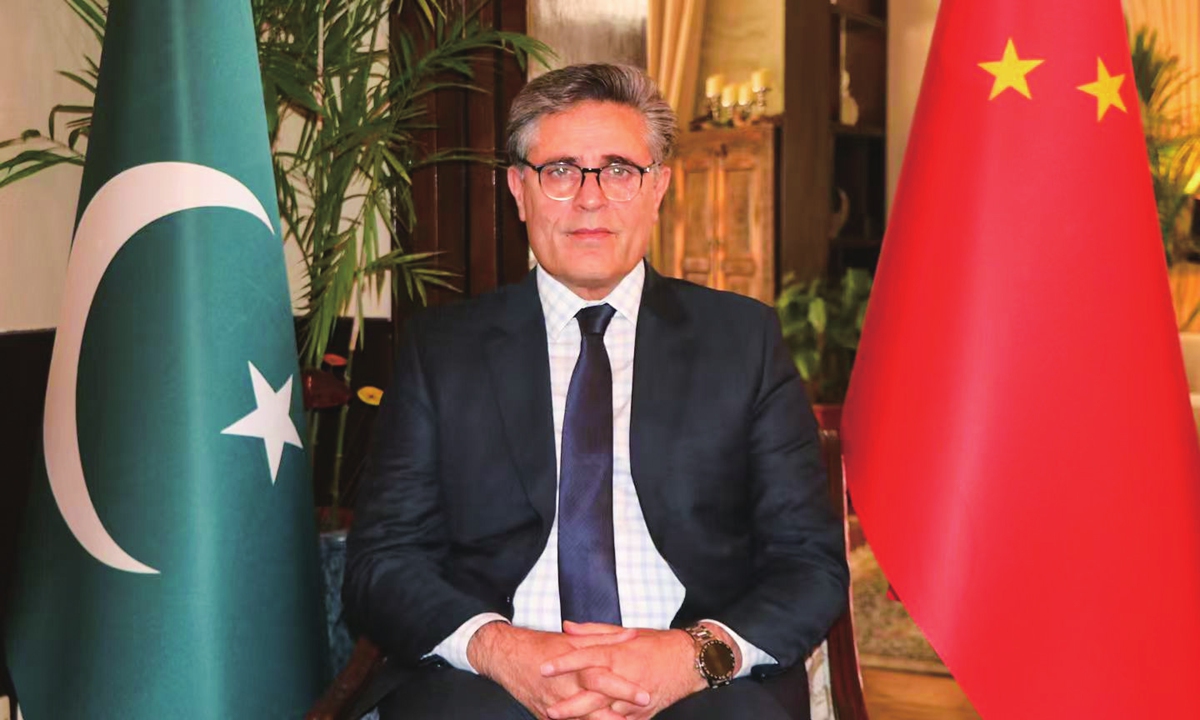
Pakistan seeks greater Chinese FDI, enhanced market access and faster implementation of CPEC 2.0
BEIJING (DI NEWS) : Pakistan’s Ambassador to China, H.E. Khalil Hashmi, has said that Pakistan China business engagement has resulted in the signing of more than 650 MoUs and agreements worth over US$42 billion, as Islamabad seeks to attract greater Chinese investment and accelerate implementation of CPEC 2.0.
Ambassador Hashmi made these remarks while addressing the International Academic Symposium Commemorating the 75th Anniversary of the Establishment of Diplomatic Relations between China and Pakistan, organised by the Pakistan Study Center at Peking University.
Highlighting growing economic engagement between the two countries, Ambassador Hashmi said the Pakistan Embassy and its four consulates in China have undertaken extensive efforts during the past two and a half years to mobilize Chinese investment in 21 priority sectors, particularly through joint ventures between Pakistani and Chinese enterprises.
He said six business to business investment conferences had been organised across several priority sectors, resulting in more than 650 MoUs and agreements valued at over US$42 billion.
According to Ambassador Hashmi, the conversion rate from MoUs to agreements and contracts stands at nearly 30 percent, representing approximately US$7 billion in two years.
He said Pakistan’s economy had reached a stage where it required enhanced Chinese foreign direct investment, greater access to the Chinese market through further improvement of the bilateral Free Trade Agreement and closer coordination to mobilize mutually agreed third party investment.
Ambassador Hashmi said the business to business investment drive could gain further momentum through Chinese official encouragement for enterprises seeking to expand or relocate overseas under the Go Global strategy.
Referring to CPEC, the Ambassador said both countries remain focused on fast tracking CPEC 2.0 through collaborative and innovative approaches, including new mechanisms for existing and future capital intensive infrastructure and public projects.
He also underlined the potential for third party participation in CPEC, noting that Pakistan and China have already discussed and agreed on modalities for such cooperation. Operationalizing this framework, he said, could help mobilize financing for CPEC projects while producing mutually beneficial outcomes.
On bilateral trade, Ambassador Hashmi said Pakistan and China have twice upgraded their Free Trade Agreement, reaching around 75 percent zero rated tariffs. The two sides are now engaged in discussions aimed at further improving market access for Pakistani products.
He expressed hope that a creative formula could be reached to provide Pakistan with a much needed export boost to China and help address the country’s trade imbalance.
Speaking about the broader economic situation, Ambassador Hashmi said Pakistan had succeeded in stabilizing its economy despite domestic and external challenges. He pointed to improvements in the country’s credit rating, stronger foreign exchange reserves, increased revenue generation and rising investor confidence.
He acknowledged that security, energy and economic challenges remain and require prudent management. He stressed that continued Pakistan China coordination on safety and security must go hand in hand with facilitating Chinese investment, particularly in designated and secured Special Economic Zones.
Highlighting the strength of bilateral relations, Ambassador Hashmi said Pakistan and China have exchanged more than seven leadership visits over the past two years. The two countries have also issued several joint statements, agreed on a five year action plan and signed more than six dozen MoUs.
He said China has continued to extend generous political, diplomatic and security support to Pakistan, while Islamabad has maintained close consultation and coordination with Beijing on bilateral, regional and international issues of common concern.
Looking towards the future, Ambassador Hashmi identified artificial intelligence, digital infrastructure, telecommunications, cybersecurity and satellite technology as important areas for expanded Pakistan China cooperation.
He also called for greater academic and research collaboration, faculty and student exchanges, particularly at the undergraduate level in STEM education, alongside stronger cooperation in tourism, youth engagement, language learning and cultural exchanges.
Ambassador Hashmi praised the role of Pakistan Study Centers in China, particularly the Pakistan Study Center at Peking University, in promoting greater understanding and strengthening people to people relations.
He said four new Pakistan Study Centers had been established in China during the past two years, with greater specialization in emerging fields including technology and artificial intelligence.
Ambassador Hashmi also expressed Pakistan’s desire for the establishment of a Pakistan Chair at Peking University, while calling for deeper institutional linkages between Pakistani and Chinese universities.
As Pakistan and China commemorate the 75th anniversary of the establishment of diplomatic relations, Ambassador Hashmi said academic institutions and people to people exchanges would remain crucial in taking the longstanding friendship forward into new areas of economic, technological and educational cooperation.