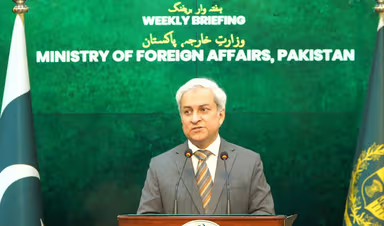
Pakistan on Thursday rejected recent remarks by Indian officials regarding an alleged strike on Kirana Hills, saying the country’s strategic assets remain completely safe and there can be no compromise on their security.
Foreign Office spokesperson Tahir Hussain Andrabi, speaking at his weekly briefing, dismissed the statements concerning Kirana Hills and questioned why such claims were being made 16 to 18 months after the events in question.
He described the remarks as “Bollywood-style statements” and said they had no significance.
“Pakistan’s strategic assets are completely safe and there can be no compromise on them,” Andrabi said.
The remarks come amid renewed debate over claims surrounding Kirana Hills following last year’s Operation Sindoor. Various claims have circulated over whether the area was targeted, while Indian military officials have previously made conflicting or disputed statements regarding the operation.
Andrabi reiterated that Pakistan would not compromise on the security and safety of its strategic assets.
Pakistan to host next year’s SCO summit
The spokesperson also announced that Pakistan will host next year’s summit of the Shanghai Cooperation Organization (SCO) and will assume the organization’s presidency for one year.
He said Pakistan’s presidency will formally begin at the upcoming SCO Heads of State meeting.
Prime Minister Shehbaz Sharif is scheduled to travel to Bishkek to attend the SCO Heads of State Conference.
The SCO presidency will give Pakistan an opportunity to play a more active role in discussions involving regional cooperation, security, connectivity and economic engagement.
Pakistan says Iran trade subject to international laws
On trade with Iran, Foreign Office spokesperson Tahir Hussain Andrabi said Pakistan-Iran trade was continuing and Islamabad remained keen to promote bilateral economic ties.
He said Pakistan’s trade with Iran was subject to applicable international trade laws, adding that Pakistan was not bound to implement unilateral sanctions imposed against Iran by individual countries.
“If UN sanctions are imposed against Iran, the matter will be different,” the spokesperson said.
Andrabi said Pakistan had consistently opposed unilateral sanctions that go beyond measures imposed by the United Nations.
He reiterated that Pakistan wanted to strengthen trade and economic relations with Iran while ensuring that bilateral commerce remained consistent with applicable international obligations.
Pakistan continues efforts to ease US-Iran tensions
Turning to tensions between the United States and Iran, Andrabi said Pakistan was continuing diplomatic efforts aimed at reducing tensions and ending the military stalemate in the region.
He said Field Marshal Syed Asim Munir’s recent visit to Iran was part of Pakistan’s peace efforts and rejected the impression that the visit was undertaken as an envoy of US President Donald Trump.
According to the spokesperson, Pakistan has been pursuing coordinated diplomatic efforts with friendly and brotherly countries to promote peace and stability through negotiations and dialogue.
Deputy Prime Minister and Foreign Minister Ishaq Dar visited Tehran on August 14, where discussions focused on reducing regional tensions, ending the military stalemate and finding a negotiated solution to the conflict.
Andrabi said Dar also held telephone conversations with the Turkish foreign minister on August 17, 19 and 25 to discuss the regional situation and the need to advance negotiations and diplomacy.
The deputy prime minister has also been in contact with his Kuwaiti counterpart.
Dar is currently visiting London, where he met the head of the International Maritime Security Agency and the head of the Commonwealth, according to the spokesperson.
The Foreign Office maintained that dialogue and diplomacy remained the only sustainable means of resolving the region’s current challenges.
Pakistan ready for talks with Afghanistan
On relations with Afghanistan, Andrabi said Pakistan remained ready for state-level talks with the Afghan interim government.
However, he said Kabul would first have to provide concrete evidence that it was taking effective measures against terrorism.
“Pakistan does not want to close the path of talks with Afghanistan,” the spokesperson said, adding that mere assurances regarding terrorism were not sufficient.
He said Afghan authorities would need to demonstrate practical steps and provide evidence of action against militant groups.
The statement comes amid continued tensions between Islamabad and Kabul over allegations concerning militant activity originating from Afghan territory.
Pakistan has repeatedly urged the Afghan interim government to prevent its territory from being used for attacks against Pakistan.
Pakistan stresses dialogue and diplomacy
Andrabi said Pakistan would continue its diplomatic engagement with countries in the region to reduce tensions and prevent further escalation.
He reiterated Islamabad’s position that lasting solutions to regional conflicts could only be achieved through negotiations and diplomacy.
The spokesperson also highlighted Foreign Minister Ishaq Dar’s recent diplomatic contacts with regional counterparts as part of those efforts.