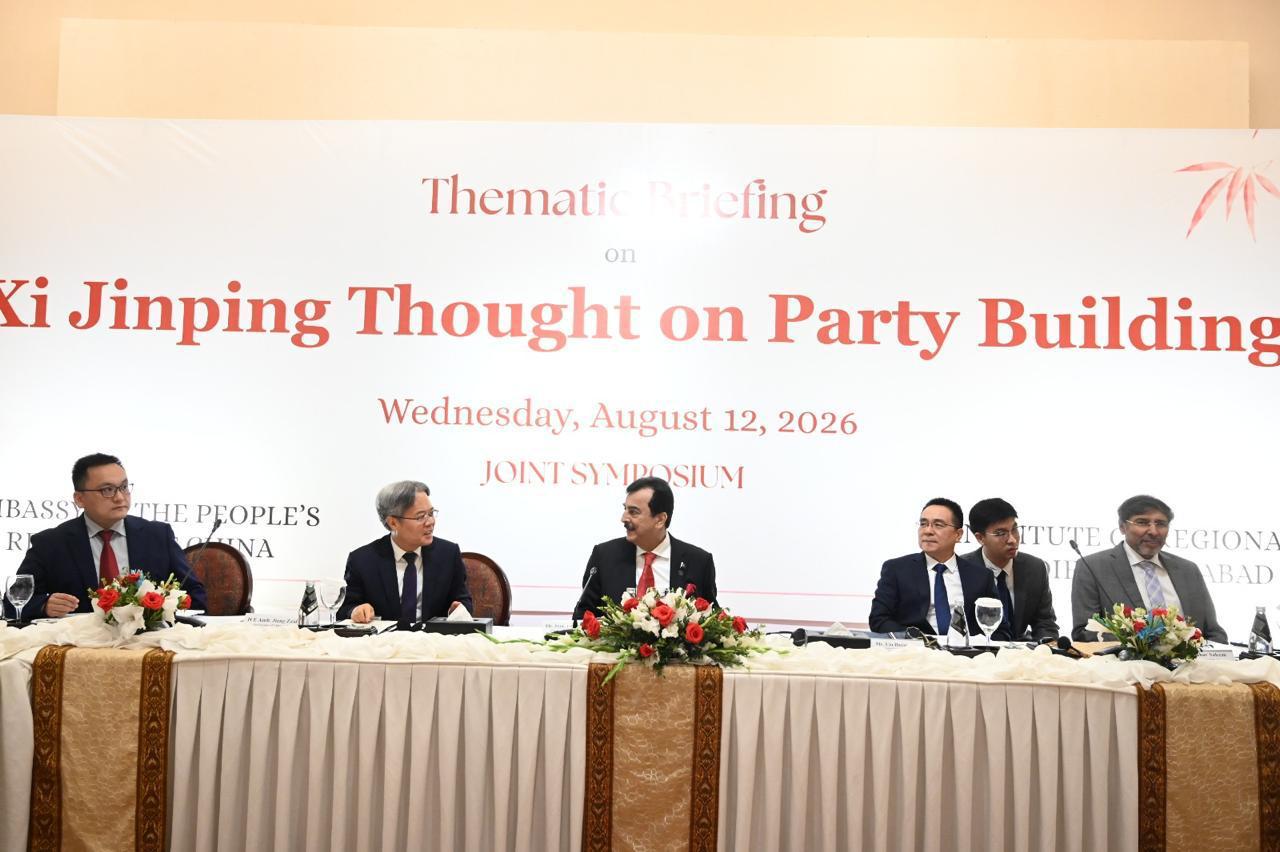
ISLAMABAD (DI NEWS) : A Joint Symposium, “Thematic Briefing on Xi Jinping Thought on Party Building,” was held in Islamabad, bringing together Chinese officials, senators, political representatives, senior ambassadors, members of academia, think-tanks and media representatives, focusing on the theory’s main tenets and China’s approach to political organization, governance, and institutional development. The Symposium was organized by the Embassy of the People’s Republic of China and the Institute of Regional Studies (IRS).The Chairman of the Senate, Syed Yousuf Raza Gillani, graced the occasion as the Chief Guest. Ambassador of the People’s Republic of China to Pakistan Jiang Zaidong delivered special remarks. The Chinese delegation included Liu Daxiu, Head of the delegation, First-Class Inspector at the Party Building Research Institute of the Organization Department of the Communist Party of China (CPC) Central Committee, and Zheng Huan, Professor of Party Building at the Central Party School of the CPC Central Committee. Ambassador Jauhar Saleem, President IRS, also addressed the gathering and shared his perspective on the subject.Chairman Gillani conveyed a message from President Asif Ali Zardari. China’s transformation, he said, demonstrated what vision and steady implementation could achieve, and he called strategic planning, institutional continuity and good governance universal needs. He welcomed President Xi’s four global initiatives and recalled his own family’s long ties with China, calling the friendship “a living, breathing legacy” passed from one generation to the next.Ambassador Jiang Zaidong called the Xi Jinping Thought on Party Building a vivid lesson for political parties on building internal mechanisms of self-reform and discipline. Drawing lessons from the theory, the Ambassador stated that the common goal of all parties is to seek a better life for the people, and this theory emphasizes remaining true to the founding principle of the CPC, which is serving the common people. He pointed to China’s eradication of poverty as proof of what development on scientific principles could deliver. He stressed that Xi Jinping Thought on Party Building is not limited to the CPC only; it envisions prosperity for the whole of humanity. That people-first outlook, he added, carries into a wider global vision. The theory reveals noble values and provides examples of developing countries, he further added. The ambassador noted that the same spirit of prosperity drives the Pakistan-China relationship in the New Era and the China-Pakistan Economic Corridor.Presenting his expert insights, Mr. Liu Daxiu described this theory as an integral part of Xi Jinping Thought on Socialism with Chinese Characteristics for a New Era. Under this guidance, the whole Party achieves ironclad solidarity, solving problems one by one and advancing step by step, he deliberated. Further explaining, he said, the thought is rich in meaning, sound in logic and deep in insight, and its core is summed up in “Fourteen Upholds”, which contain both ideological content and specific requirements. He highlighted that the fundamental logic of party politics is rooted in the “aspiration of the people”, positioning the people-centered development philosophy as the most important idea in Xi Jinping Thought. Additionally, he highlighted that the theory underscores the significance of discipline, accountability, and Party conduct for national rejuvenation. Mr. Liu further accentuated the theory’s promulgation as the new strategy and ‘opening up’ of the system for the New Era.Professor Zheng Huan set out five key ways in which Xi Jinping Thought on Party Building matters for political parties globally, noting that it offers a fresh choice of development path, rebuilds public trust through a people-centered approach, strengthens party organization, combats corruption so officials “dare not, cannot, and will not” be corrupt, and encourages a new paradigm for interparty relations. Expanding on organizational capacity, Professor Huan argued that Xi Jinping Thought provides a clear solution to the global challenges of organizational weakness and inadequate leadership in modern political parties. He noted that in many countries, loosely structured party organizations, underdeveloped primary-level units, and internal factionalism impede political leadership from mobilizing social forces or driving national development. Presenting the CPC’s institutional framework as a contrasting model, he cited data showing that by late 2025, total Party membership reached 101.29 million across 5.43 million grassroots organizations, backed by an annual net growth of 1.015 million members and 181,000 units. This coordinated network, he explained, enabled large-scale national execution, including the deployment of 255,000 village work teams and over three million first secretaries and cadres during China’s poverty alleviation campaign.Ambassador Jauhar Saleem aptly noted the importance of ‘party building’ in governance and state building. He stated that a party that wants to reform the state “must first possess the courage and capacity to examine and reform itself.” He stressed that the Chinese experience of party building does not have to be copied; rather, it inspires a serious argument about why political parties must reform themselves if they hope to govern well, quoting President Xi’s remark that “only the wearer knows whether the shoes fit.” Ambassador Saleem underscored ‘meritocracy’ as the single most important reason for the success of the CPC. He welcomed the Chinese guests to a dialogue built on mutual respect and learning from one another.An open discussion followed, with participants weighing what Pakistan could take from the Chinese experience. Rana Ihsaan Afzal Khan, Special Assistant to the Prime Minister on Commerce, called China’s visible achievements “lagging indicators” and said the real lesson lay in its governance and delivery structure, which Pakistan should adapt in its own way. Syed Sardar Ali of the Crescent Foundation said the CPC was organized to build a modern state, whereas parties in the Western tradition were organized to form the next government. Ambassador Ashraf Jehangir Qazi said good governance everywhere rested on a state that saw itself as a servant of the people, not their master. Salman Sheikh of Jamaat-e-Islami said China’s rise was the work of decades of party building, and that a party was only as strong as its internal discipline. Xu Hangtian, Minister Counsellor at the Chinese Embassy, appreciated the participation of Pakistan’s major parties and said every nation must find its own path.This year marks seventy-five years of diplomatic relations between Pakistan and China. Speakers said exchanges between political parties and institutions had become a growing part of that all-weather friendship. The symposium was moderated by Ms. Nabila Jaffer, Senior Research Analyst and Head of the China Program at IRS.
Daily Ittehad is your go-to source for timely and reliable news. Covering a diverse range of categories, we bring you the latest updates on National and International affairs, CPEC developments, Business trends, Sports highlights, Entertainment, and much more.