China’s housing market has expanded alongside the country’s urban population, with the urbanization rate rising from less than 20% in the late 1970s to nearly 68% in 2025.
After decades of rapid urbanization and property-led growth, China is now shifting its focus from large-scale construction to the renewal of existing urban areas.
Against this backdrop, China unveiled on May 28 an urban renewal plan for the 15th Five-Year Plan period (2026-2030), a move expected to improve living standards while creating new opportunities for investment and economic activity. What’s new in this urban renewal plan?
Renewing aging homes
Upgrades to aging residential communities are expected to significantly improve living conditions and help stimulate housing demand.
Under the plan, residential compounds that are 20 years old or older will undergo special inspections. Elevators will be installed where conditions permit, while water and power pipelines will be upgraded, roads repaired, and parking, landscaping and security facilities improved.
About 115,000 old urban residential communities and around 4,000 urban villages are expected to undergo renovation, making older homes more comfortable and livable.
In Shanghai’s Xuhui District, old housing renovation has been combined with second-hand home acquisitions. In February, Shanghai launched a pilot program to purchase existing homes for conversion into affordable rental housing. As of May 20, Xuhui District had acquired 458 units, more than 300 of which were aging homes that were difficult to renovate despite poor living conditions, according to China’s Jiemian News.
The acquired units will be converted into affordable rental housing for workers, providing a new approach to revitalizing aging housing stock while addressing housing needs.
Enhancing urban livability
Improving urban safety and living quality is another key focus. The plan calls for eliminating risks posed by unsafe housing, reinforcing aging buildings, and enhancing resilience against earthquakes and structural deterioration. Around 500,000 units of dilapidated urban housing are set to be renovated while 365,000 kilometers of underground utility pipelines will be upgraded to help reduce water outages, gas leaks and urban flooding.
To make cities more livable, the plan aims to improve 20,000 hectares of parks and green spaces, giving residents greater access to outdoor public spaces.
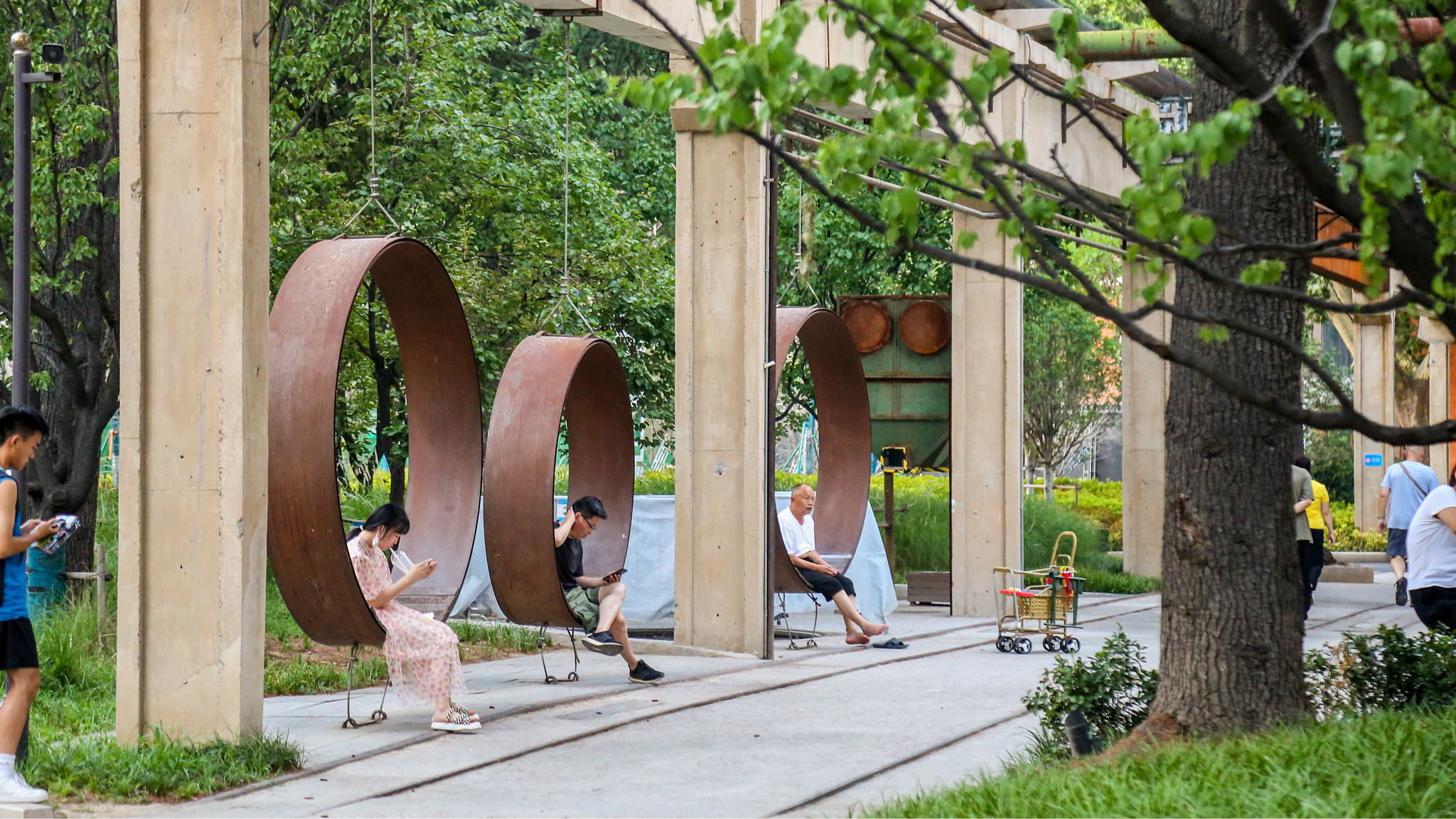
In Zhengzhou, the capital of central China’s Henan Province, the former Second Grinding Wheel Factory has been transformed into the Ersha Cultural and Creative Park. The redevelopment preserved key elements of the site’s industrial heritage while opening the area to public use.
Former factory grounds have been converted into open spaces for recreation and exercise, turning the park into a popular cultural and tourism destination for both local residents and visitors.
The plan also seeks to make everyday life more convenient through “15-minute community life circles,” giving residents easier access to services such as grocery stores, convenience stores, childcare and elderly care facilities, and fitness venues.
It targets the construction or renovation of sports facilities covering 128,000 hectares and calls for more age-friendly, child-friendly and barrier-free communities.
Boosting investment
Beyond improving living conditions, the urban renewal drive is expected to provide new growth opportunities for a wide range of industries. The plan is likely to boost demand for steel and construction materials while encouraging spending on household goods.
According to Pengyuan Credit Rating, a major Chinese credit rating agency, the urban renewal market is expected to reach 20 trillion yuan (about $2.8 trillion) during the 15th Five-Year Plan period. Investment in renovating old residential communities alone is estimated to exceed 8 trillion yuan.
Upgrades to underground pipeline networks are expected to cost around 4 trillion yuan, with smart pipeline systems accounting for 30% of the upgraded network.