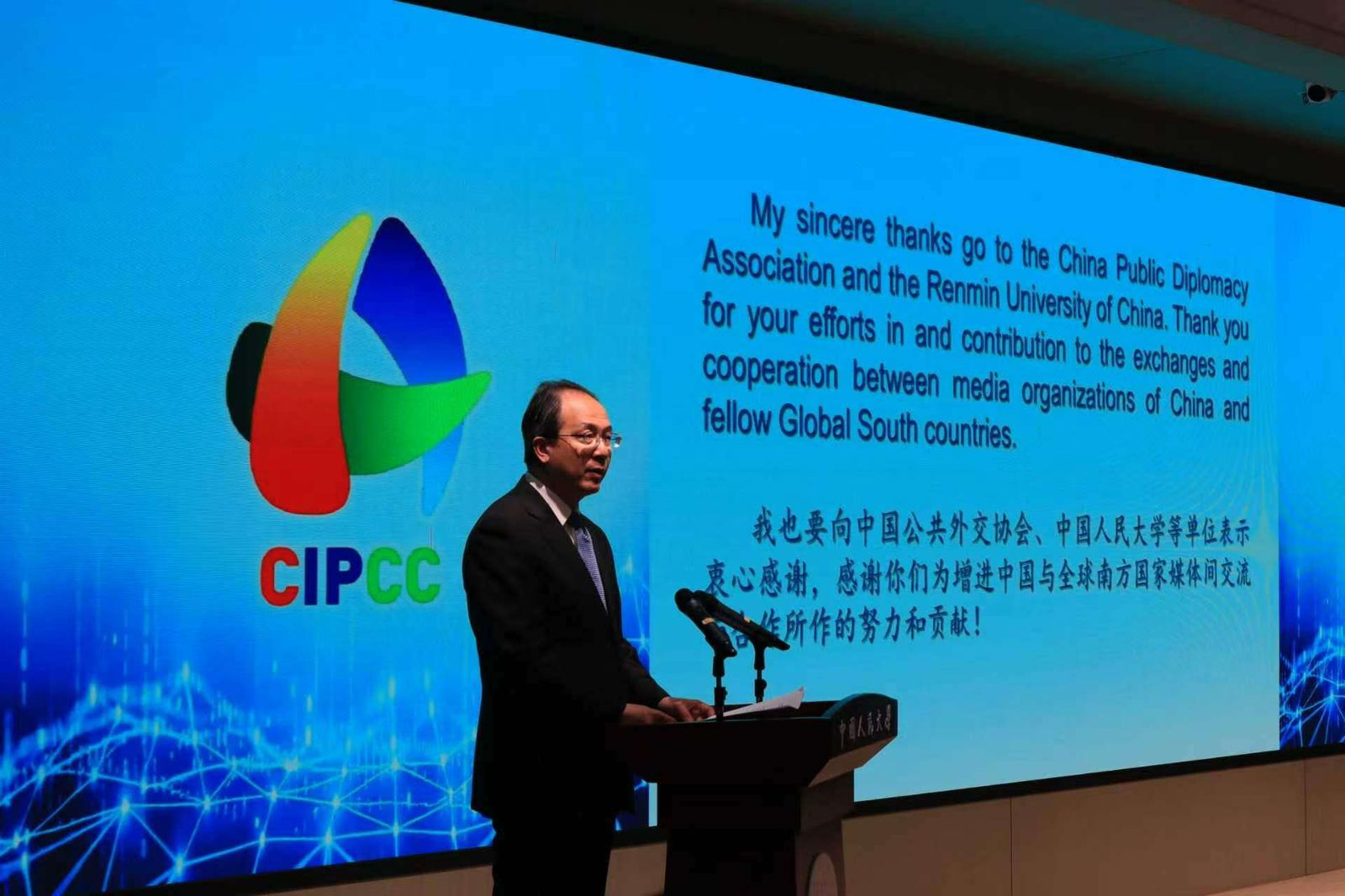
The Opening Ceremony of the China International Press Communication Center (CIPCC) 2026 was held in Beijing with journalists and media professionals from around 90 countries participating in what emerged as one of China’s most significant international media exchange initiatives. The ceremony reflected China’s growing emphasis on international communication, people to people connectivity, and cooperation among Global South countries through media diplomacy and cultural dialogue.
The event brought together senior Chinese officials, diplomats, academics, and journalists from Asia Pacific, Africa, Europe, Eurasia, Latin America, the Caribbean, and Arab countries. Throughout the ceremony, speakers emphasized the importance of responsible journalism, cultural understanding, balanced reporting, and international cooperation in an increasingly polarized and rapidly changing world.
In her remarks, Ambassador Tong Xiaoling of the China Public Diplomacy Association highlighted the growing importance of exchanges and mutual learning among civilizations at a time when the world is facing increasing turbulence and uncertainty. She stated that media serves as a bridge across borders and an important link connecting the hearts of people. According to her, journalists play an irreplaceable role in conveying authentic voices, reducing misunderstandings, and advancing international understanding.

She noted that over the last 12 years, CIPCC has gradually expanded from a regional media exchange initiative into a global platform involving journalists from more than 140 developing and emerging countries. Nearly one thousand journalists have participated in the program, traveling across China and reporting on the country’s transformation and modernization. She emphasized that these reports have enabled the world to witness a more genuine and diverse China beyond conventional Western narratives.
Assistant Foreign Minister of China Hong Lei, while addressing the participants, warmly welcomed 98 journalists from 90 countries and described the gathering as a vivid reflection of solidarity and cooperation among Global South nations. He thanked the China Public Diplomacy Association and Renmin University of China for their efforts in strengthening media exchanges and communication partnerships.
Hong Lei stated that Chinese modernization has increasingly attracted the interest of developing countries seeking to understand China’s development model, governance system, and modernization philosophy. He explained that CIPCC was established to provide international journalists with a direct window into China and to build a bridge connecting media professionals from different regions of the world.
Highlighting China’s achievements, he noted that the Chinese economy had crossed the 140 trillion RMB threshold and has consistently contributed nearly 30 percent to global economic growth. He also referred to China’s progress in high technology manufacturing, artificial intelligence, renewable energy, industrial robotics, poverty alleviation, and ecological development. According to him, China’s modernization and technological rise continue to provide new opportunities for global growth and development.

Speaking about global affairs, Hong Lei stressed that the world is witnessing geopolitical conflicts, protectionism, and economic uncertainty. Referring to President Xi Jinping’s vision of building a community with a shared future for mankind and the Global Initiatives proposed by China, he said China remains committed to promoting peace, global development, and international stability. He further highlighted China’s role in advocating political solutions to international crises and promoting multilateral cooperation.
He also informed participants that over the next three months, journalists would travel across China, witness regional development projects, visit high technology companies, interact directly with Chinese communities, and experience the country’s modernization process firsthand. He encouraged participants to become objective recorders, promoters of friendship, and advocates of mutual understanding between China and the Global South.
President of Renmin University of China, Ma Huaide, emphasized the growing importance of journalism and communication in the modern world. He stated that journalists serve as the eyes and ears of the world, conveying truth through words and images while acting as bridges between civilizations and nations.
He observed that despite technological connectivity, the world continues to witness cognitive divisions caused by geopolitical conflicts and information bubbles. According to him, this makes truthful, responsible, and in depth journalism more important than ever before.
Ma Huaide also highlighted Renmin University’s efforts in international communication, artificial intelligence integration in journalism, and cross cultural dialogue. He noted that the university has developed advanced communication platforms and research centers aimed at enhancing China’s global communication capabilities. He further stated that, for the first time, CIPCC participants would reside on a Chinese university campus, enabling them to directly observe Chinese youth, society, and the country’s evolving spirit.
Addressing the gathering on behalf of Asia Pacific, Moiz Farooq of Daily Ittehad Media Group delivered a speech. He stated that attending the program was not merely a professional opportunity for him, but also a deeply emotional and historic moment connected to his family’s longstanding friendship with China.

Moiz Farooq shared that he proudly represents the third generation of a family dedicated to strengthening Pakistan China friendship and people to people ties. He recalled that his late grandfather, Sharif Farooq, visited China twice, first in 1972 alongside former Prime Minister Zulfikar Ali Bhutto where he met Premier Zhou Enlai, and later in 1980 with former President Zia ul Haq where he met Deng Xiaoping.
He further noted that his grandfather later authored one of the earliest Urdu book on China, published in 1980, during a period when very few Pakistanis had firsthand understanding of China. According to him, journalism and writing became important tools for strengthening friendship and awareness between the people of both countries.
Moiz Farooq also highlighted that his father had the honor of meeting President Xi Jinping during the 70th anniversary celebrations of the Chinese People’s Association for Friendship with Foreign Countries in 2024. He described these moments as symbols of decades of mutual trust, respect, and friendship between Pakistan and China.
Speaking about his own role in media, he introduced himself as Executive Editor of Pakistan Economic Network and Daily Ittehad Media Group, while also discussing his work in digital media and podcasting focused on regional connectivity, diplomacy, youth engagement, and international affairs. He stressed that in today’s world of misinformation and division, media must become a bridge of understanding rather than conflict.
He praised the organizers for bringing together journalists from across the world on one platform and stated that such programs create understanding among nations, friendships among people, and cooperation among future media leaders. He expressed confidence that the professional and personal relationships developed during the program would continue long after its conclusion.
Representing Burkina Faso, journalist Nadege Yameogo described CIPCC as far more than a professional training initiative. As a former participant of the 2023 program, she said the experience had significantly influenced her work and deepened her understanding of China’s culture, economy, and society. She emphasized that the platform promotes intercultural dialogue and enables journalists to tell China’s story with authenticity and balance.

Ashley Martínez from the Dominican Republic highlighted the responsibility journalists carry in promoting mutual understanding, countering misinformation, and presenting balanced narratives about different societies. She described the program as a valuable opportunity to explore China’s culture, development, and daily life while strengthening ties between China and Latin America and the Caribbean.
Ali Ibrahim Aati from Saudi Arabia emphasized the deep historical ties between China and Arab countries and praised the program for creating opportunities for dialogue, media cooperation, and cultural exchange. He expressed hope that participants would develop lasting professional and personal friendships through the initiative.
Representing Eurasia, Russian journalist Ekaterina Veka described the gathering as a model of the future world where borders disappear and understanding prevails. She highlighted the importance of education, journalism, and direct human communication in building trust between nations and praised China for creating a platform based on mutual exchange, knowledge sharing, and cooperation.
The ceremony concluded with optimism and enthusiasm as participants prepared to begin their three month journey across China. Beyond being a media exchange initiative, the opening ceremony of CIPCC 2026 reflected China’s broader vision of strengthening international dialogue, promoting cultural understanding, and building lasting partnerships among journalists and media professionals from across the Global South and beyond.
Report by: Moiz farooq
Executive Editor, Pakistan Economic Network and Daily Ittehad Media Group