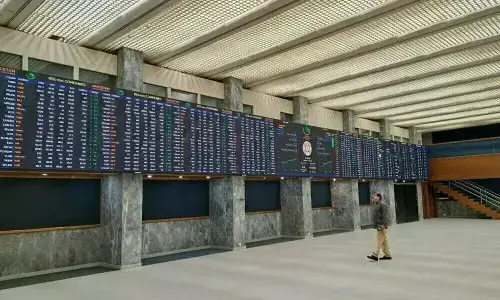
Selling pressure was observed at the Pakistan Stock Exchange (PSX) as tensions in the Middle East escalated, with the benchmark KSE-100 Index shedding over 1,200 points during the opening minutes of trading on Monday.
At 9:34am, the benchmark index was hovering at 164,366.67, down by 1,229.40 points or 0.74%.
Selling was observed in key sectors, including automobile assemblers, cement, commercial banks, fertiliser, oil and gas exploration companies, OMCs, power generation and refinery. Index-heavy stocks, including ARL, HUBCO, MARI, OGDC, PPL, POL, HBL, MEBL and UBL, traded in the red.
Oil prices have surged past $110/bbl after a drone attack targeted the UAE’s Barakah nuclear site.
“The UAE has called it a ‘dangerous escalation,’ and the sudden return of the war premium is hammering energy-importing markets like Pakistan,” said Behtari Capital on Monday.
During the previous week, Pakistan’s stock market remained under pressure with the benchmark KSE-100 Index declining 3.2%, or 5,519.75 points, to close at 165,596.06 points as continued uncertainty surrounding geopolitical tensions in the Middle East kept investor sentiment subdued despite improving domestic macroeconomic indicators.
Internationally, Asian share markets were on the skids on Monday as fresh drone attacks in the Gulf shoved oil prices and bond yields higher, while the AI boom is set to be tested by earnings from Nvidia this week.
A drone strike caused a fire at a nuclear power plant in the United Arab Emirates, while Saudi Arabia reported intercepting three drones, as US President Donald Trump warned that Iran must act “fast” to reach a deal.
Meanwhile, the vital Strait of Hormuz remains closed to all but a trickle of shipping as Tehran tries to formalise its control of the waterway that during normal times carries 20% of the world’s oil trade.
G7 finance ministers are scheduled to gather in Paris on Monday to discuss the Strait of Hormuz and critical raw material supplies, even as geopolitical differences threaten to test the group’s cohesion.
Minutes of the Fed’s last meeting are out on Wednesday and should show how much pressure there was on the committee for a shift to a neutral stance and away from an easing bias.
Japan’s Nikkei eased 1.1%, having fallen 2% last week from record highs. South Korean stocks fell 0.1%, as the red-hot market cooled just a little after demand for semiconductors drove it to all-time peaks.
MSCI’s broadest index of Asia-Pacific shares outside Japan lost 0.9%.