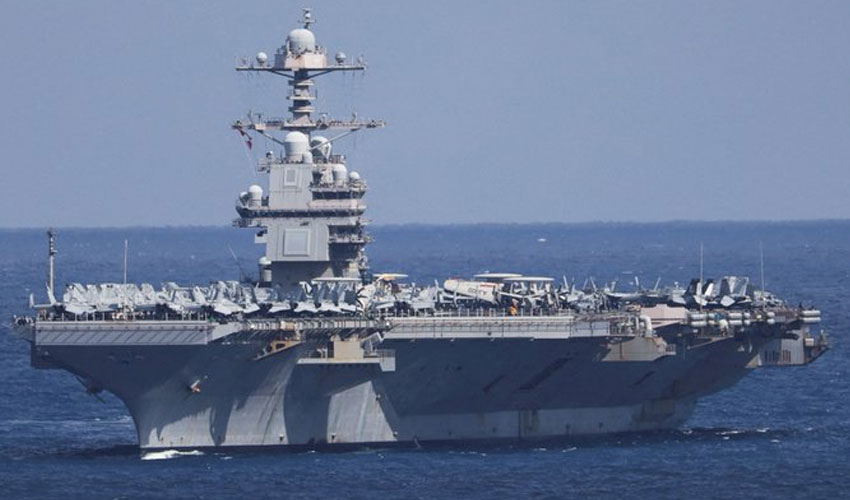
The USS Gerald R. Ford is set to return to the United States after more than 300 days at sea, ending a record-setting deployment that stretched across the Mediterranean, Caribbean and Middle East.
The aircraft carrier’s departure will reduce US naval firepower in the region at a sensitive moment, as Washington maintains a fragile ceasefire with Iran and continues a naval blockade of Iranian ports.
The USS Gerald R. Ford will leave the Middle East in the coming days and return to its home port in Virginia by mid-May, two US officials said Wednesday.
The officials spoke on condition of anonymity because they were discussing sensitive military movements. The Washington Post first reported the development.
Multiple US officials also told the newspaper that the Ford would begin its homebound voyage soon after spending around 10 months at sea.
Reduces US carrier presence near Iran
The Ford is one of three US aircraft carriers that have been deployed to the Middle East during the Iran war ceasefire. The USS George H.W. Bush arrived in the region last week, joining the Ford and the USS Abraham Lincoln. The Lincoln has been in the region since January as tensions with Tehran increased.
The presence of three American aircraft carriers in the Middle East was a level of deployment not seen since 2003.
The Ford’s return will therefore mark a significant decrease in US firepower at a time when the ceasefire with Iran remains fragile and the United States is maintaining a blockade of Iranian ports.
The USS Gerald R. Ford broke the US record this month for the longest post-Vietnam War aircraft carrier deployment. The carrier left Naval Station Norfolk in June and has now spent more than 300 days deployed. One report said the ship has been deployed for 309 days, the longest deployment for any modern US carrier.
According to data compiled by US Naval Institute News, the Ford’s 295th day at sea surpassed the previous modern record.
That earlier record was held by the USS Abraham Lincoln, which was deployed for 294 days in 2020 during the Covid-19 pandemic.
The Ford’s deployment still falls short of the Cold War-era record held by the now-decommissioned USS Midway, which was deployed for 332 days in 1972 and 1973.
Concerns for sailors and equipment
The Ford’s extended deployment has raised questions about the impact on service members who have spent long periods away from home.
It has also increased concerns about strain on the ship and its equipment.
The aircraft carrier has already faced operational issues, including a fire that forced it to undergo lengthy repairs. Reports said the carrier will likely need extensive maintenance after returning home because of repeated issues and damage connected to a laundry room fire.
The Ford carries around 4,500 sailors.
The Ford began its deployment by heading to the Mediterranean Sea. It was later rerouted to the Caribbean Sea in October as part of the largest US naval buildup in the region in generations.
The carrier participated in the military operation to capture Venezuelan leader Nicolás Maduro before later moving toward the Middle East as tensions with Iran escalated.
The Ford took part in the opening days of the Iran war from the Mediterranean Sea. It then passed through the Suez Canal and entered the Red Sea in early March.
However, a fire in one of its laundry spaces forced the carrier to turn around and return to the Mediterranean for repairs. The incident left hundreds of sailors without places to sleep.
One report said the Ford is currently in the Red Sea and is not taking part in the US blockade of Iranian ports.
Operational needs forced extension
Defense Secretary Pete Hegseth was questioned about the Ford’s long deployment during a Wednesday hearing before the House Armed Services Committee.
Lawmakers raised concerns about the trade-offs involved in keeping the carrier deployed for so long.
Representative Gil Cisneros asked Hegseth about the risks and sacrifices being made by extending the Ford’s mission.
Hegseth said he had consulted with the Navy and acknowledged that officials had mentioned readiness and maintenance tradeoffs.
“Multiple times the operational requirements — whether it was down in Southcom or up to Centcom — demanded additional assets in real time, which through a tough decision-making process led to an extension,” Hegseth said.
Southcom refers to US Southern Command, which oversees Latin America. Centcom refers to US Central Command, which is responsible for the Middle East.
Mission stretched across three regions
The USS Gerald R. Ford was deployed on June 24 last year, leaving Naval Station Norfolk for Europe. Its mission later shifted to the Caribbean, where it became part of a major regional naval buildup.
After participating in the operation involving Maduro, the carrier was sent toward the Middle East as the situation with Iran deteriorated.
Its long deployment has now become one of the most closely watched US naval missions in recent years, combining combat operations, crisis deployments and questions about military readiness.
The Ford is expected to arrive back in Virginia around mid-May, according to officials cited in the reports. Its departure from the Middle East will leave the United States with fewer carrier assets in the region, although the USS George H.W. Bush and USS Abraham Lincoln remain deployed there.