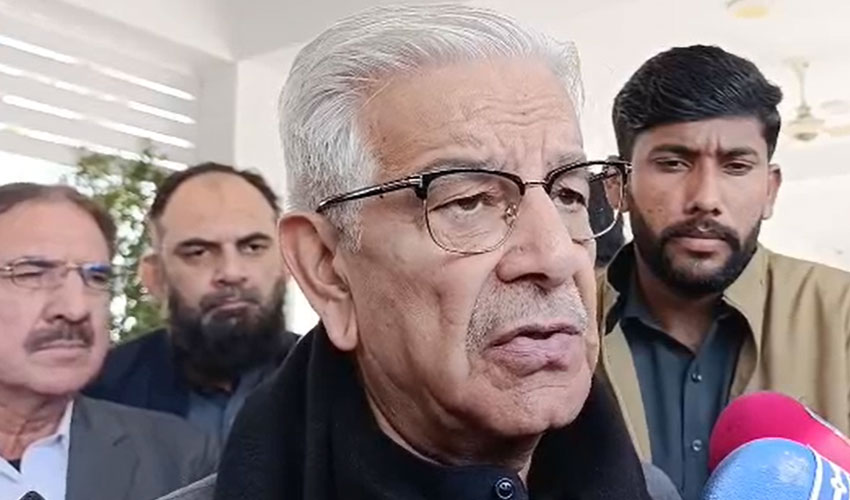
Defense Minister Khawaja Asif on Tuesday said that terrorist elements operating in Balochistan with backing from across the Afghan border would be defeated with the support of the Baloch people, stressing that the state and local communities stand united against terrorism.
Speaking to reporters outside Parliament House, the defense minister said Pakistan was facing externally sponsored terrorism but remained confident that peace would prevail through collective efforts.
Khawaja Asif said hostile elements were using Afghan-sponsored forces to destabilise Balochistan. “If terrorists become agents of our enemies, who will negotiate with them?” he asked, rejecting any dialogue with armed groups involved in attacks on civilians.
He said stopping trains, blocking highways and killing innocent people could not be justified under any circumstances, adding that talking to such groups would amount to protecting inhumane and illegal acts.
Baloch people stand with state
The defense minister emphasised that the Baloch people were not aligned with terrorists and would play a key role in defeating them. “This is a matter of Pakistan’s unity. They want to blackmail the state, but the Baloch people are with Pakistan,” he said.
Asif said peace in Balochistan was inevitable, noting that development and democracy were essential to countering extremism. “Local resources belong to the Baloch people, and democracy is also their right,” he added.
Security operations and strong response
Referring to recent security operations, Khawaja Asif said forces had taken full action in Balochistan two days ago. “Enemies of peace fled, leaving behind 170 bodies. We will give a befitting reply in the future as well,” he said.
He warned that India and Afghanistan were actively trying to destabilise Balochistan through proxies, claiming India was seeking to avenge its defeat by supporting militant groups.
Highlighting progress in the province, the defense minister said Balochistan had seen significant development in recent years. “Hospitals have been built, and road infrastructure has expanded from 500 kilometres to 26,000 kilometres,” he said.
He added that addressing the concerns of tribal elders and elected representatives was essential and assured that the federation would play its role in supporting local leadership.