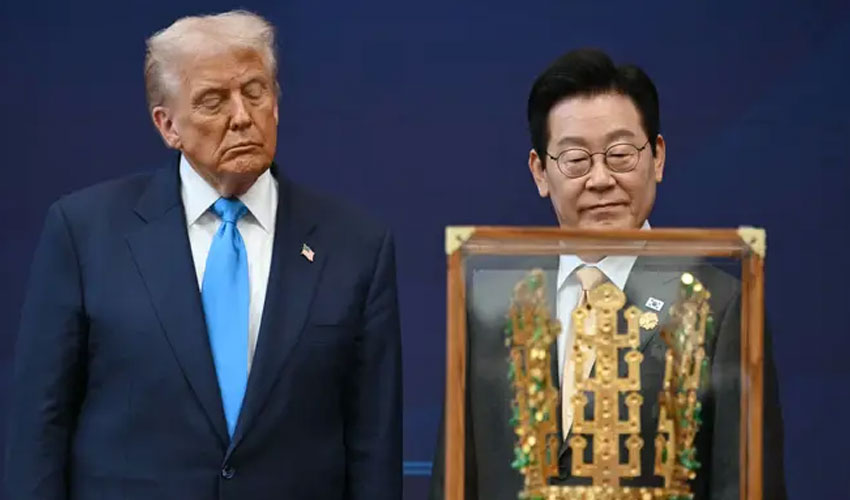
South Korea moved swiftly on Tuesday to reassure the United States of its commitment to a major trade and investment deal after President Donald Trump threatened to sharply raise tariffs, accusing Seoul of delaying implementation.
US President Donald Trump said he would raise tariffs on South Korean autos and other imports. The proposed increase would push tariffs to 25% from the current 15%, without offering a timeline.
Trump accused South Korea’s legislature of failing to enact a trade agreement reached last year. The deal was linked to large-scale South Korean investments in the US in exchange for tariff reductions.
The United States and South Korea reached a deal in principle in July last year. Under the agreement, Seoul committed to making $350 billion in investments in US business projects.
The pact also covered broader trade and security cooperation between the two allies. The agreement was reaffirmed during Trump’s visit to South Korea in October.
Trump blames South Korean parliament
Trump said the South Korean parliament was not living up to its obligations.
He argued the agreement should have been swiftly enacted following negotiations with President Lee Jae Myung.
In a social media post, Trump said the failure to pass the deal justified higher tariffs.
He named autos, lumber, pharmaceuticals, and other reciprocal imports as targets.
South Korean officials said Trump’s comments came as a surprise.
The move added pressure on Seoul as it navigates trade ties with its key security ally.
Officials described the situation as another setback for South Korea.
The country is already facing concerns over financial stability and alliance management.
Govt and ruling party pledge action
South Korea’s presidential office and the ruling party said they would act to move the deal forward.
They stressed that Seoul remains committed to implementing the agreement.
The government said it continues to view the deal as vital for bilateral relations.
Efforts are underway to address concerns raised by Washington.
Under the agreement, South Korea committed to paying $200 billion of the $350 billion in cash.
The payments were designed to be phased, capped at $20 billion per year.
This structure aimed to limit pressure on the Korean won.
South Korea is Asia’s fourth-largest economy and remains sensitive to currency volatility.
Earlier this month, Finance Minister Koo Yun-cheol said the government planned to implement the package as soon as possible.
However, he noted that uncertainty surrounding a pending US Supreme Court ruling on Trump’s tariffs could affect timing.
Koo also warned that the investment plan was unlikely to begin in the first half of 2026.
He cited continued weakness in the won as a key factor.