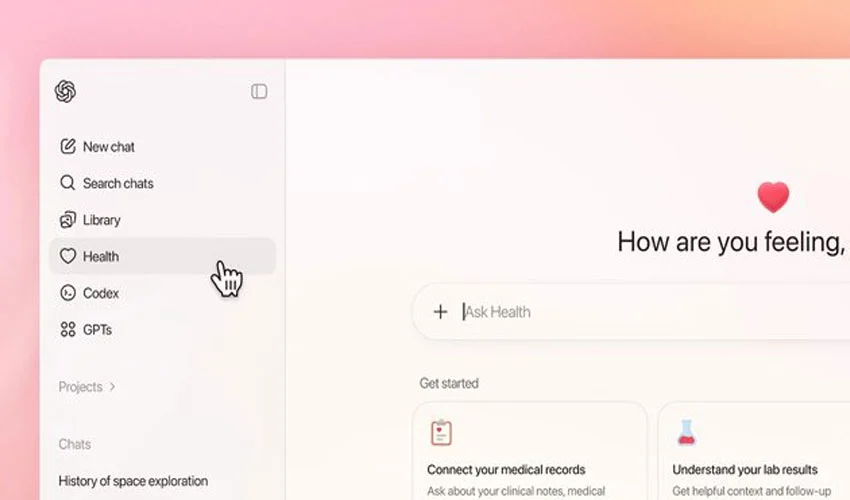
OpenAI has unveiled ChatGPT Health, a new feature aimed at formalising how users seek health and wellness information on the platform.
The move comes as the company reveals that more than 230 million users ask health-related questions every week.
ChatGPT Health is a dedicated section within ChatGPT designed specifically for conversations about health, fitness, illness, and treatment-related topics. OpenAI says the goal is to offer a more careful, structured, and medically grounded experience.
Health-related chats are separated from regular conversations so personal medical context does not surface elsewhere on the platform.
Why OpenAI created separate health space
OpenAI says people already rely heavily on ChatGPT for medical guidance, from diet plans to understanding medication side effects. By siloing these conversations, the company aims to improve privacy and reduce unintended context overlap.

If a user starts a health-related conversation outside the Health section, ChatGPT will nudge them to switch to the dedicated space.
How context and personal data are used
Within ChatGPT Health, the AI can reference relevant information from standard chats. For example, if a user previously discussed marathon training, the system may recognise them as a runner when discussing fitness goals.
The tool can also integrate with wellness and fitness apps such as Apple Health, Function, and MyFitnessPal, or allow users to upload medical records for more personalised insights.
OpenAI says conversations in the Health section will not be used to train its AI models.
OpenAI’s view on healthcare challenges
In a blog post, Fidji Simo, OpenAI’s CEO of Applications, said ChatGPT Health is a response to systemic healthcare issues, including high costs, limited access, overbooked doctors, and poor continuity of care.
She described the tool as a way to help users better navigate health information, rather than replace existing healthcare systems.
Built to support medical care
OpenAI emphasises that ChatGPT Health is not intended for diagnosis or treatment. The company’s own terms of service state that the tool should not be used as a substitute for professional medical advice.
Health-related questions are routed through a curated pipeline that relies on authoritative medical sources, uses conservative language, and applies expanded safety checks. OpenAI says it worked with more than 260 physicians to shape how the system responds to medical queries.
Users can ask the tool to help interpret blood test results, track cholesterol or blood sugar trends, prepare questions for doctor appointments, or summarise symptoms in an easy-to-share format.
The AI can also help compare insurance plans based on healthcare usage patterns and assist with fitness or diet-related planning.
Despite the safeguards, OpenAI acknowledges the broader risks of using AI in medical contexts. Large language models generate responses based on probability, not factual certainty, and can be prone to hallucinations.
This limitation remains a key reason the company continues to stress that ChatGPT Health is an assistive tool, not a medical authority.
ChatGPT Health is currently rolling out via a waitlist. Users on Free, Go, Plus, and Pro plans outside the European Economic Area, Switzerland, and the United Kingdom are eligible to apply.
OpenAI says it may expand integrations with healthcare systems, insurers, and wellness platforms in the future.