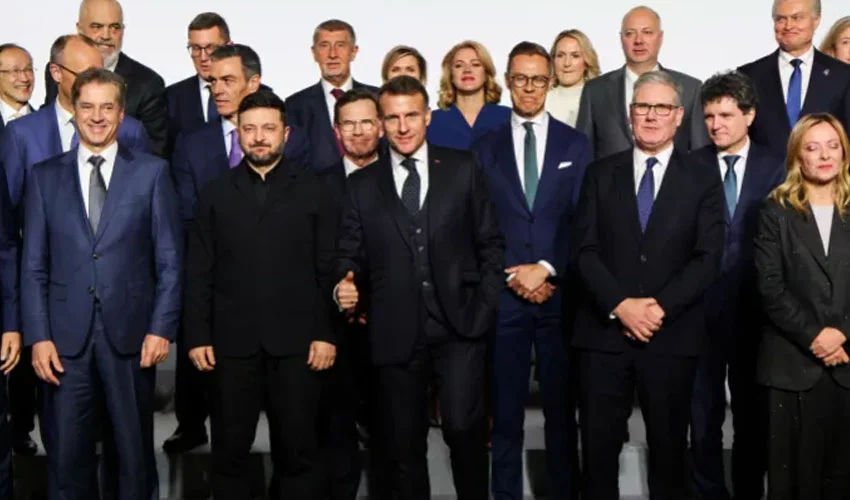
The United States has pledged support for Ukraine’s security, while France and the UK committed to deploying forces if a ceasefire is reached with Russia. The announcements came at a coalition summit aimed at securing Kyiv against future attacks.
Representatives from 35 countries, including 27 heads of state or government, gathered in Paris to finalize post-war guarantees for Ukraine.
French President Emmanuel Macron said the framework would see the U.S. lead a truce monitoring mechanism with European participation, alongside the deployment of a multinational European force.
Macron added that France could contribute “several thousand” troops to bolster Ukraine’s security.
US role in ceasefire and security
U.S. envoys Steve Witkoff and Jared Kushner, along with Europe’s top U.S. general Alexus Grynkewich, attended the talks, marking the first U.S. participation at the coalition’s summit.
Witkoff emphasized that Trump “strongly stands behind security protocols,” designed both to deter and defend against any future attacks in Ukraine.
Kushner described the Paris meeting as a “very, very big milestone,” underlining the need for Ukrainians to have robust deterrence and post-deal security guarantees.
Military hubs and monitoring mechanisms
The UK and France pledged to establish “military hubs” in Ukraine if a ceasefire is agreed upon. These would include protected facilities for weapons, equipment, and personnel to support Ukraine’s defensive needs.
The coalition also proposed a U.S.-led ceasefire monitoring system using drones, sensors, and satellites, though U.S. troops would not be directly involved in the operation.
Additionally, a US-Ukraine coalition coordination cell will be established in Paris, and support will continue for front-line forces with equipment, training, and potential air, land, and sea backup.
Ukrainian response
President Volodymyr Zelenskyy welcomed the pledges, calling them “concrete content” rather than just words. He noted that the coalition had clarified which countries would lead on security and reconstruction.
However, Zelenskyy stressed that the “territorial question”—particularly Russia’s demands for the Donbas region—remains the hardest issue to resolve.
Germany, Belgium, Croatia, and the Czech Republic expressed more cautious support, with German forces potentially stationed outside Ukraine, Belgium providing naval and air support, and Croatia and the Czech Republic declining troop deployment.
European leaders, including Macron, Starmer, Tusk, and Meloni, highlighted the renewed transatlantic coordination on Ukraine’s security.
Zelenskyy thanked the U.S. for its readiness to backstop security guarantees, monitoring, and reconstruction efforts, while noting that details on monitoring mechanisms and army support remain under discussion.
The coalition is set to continue negotiations on binding commitments and operational details in the coming days.