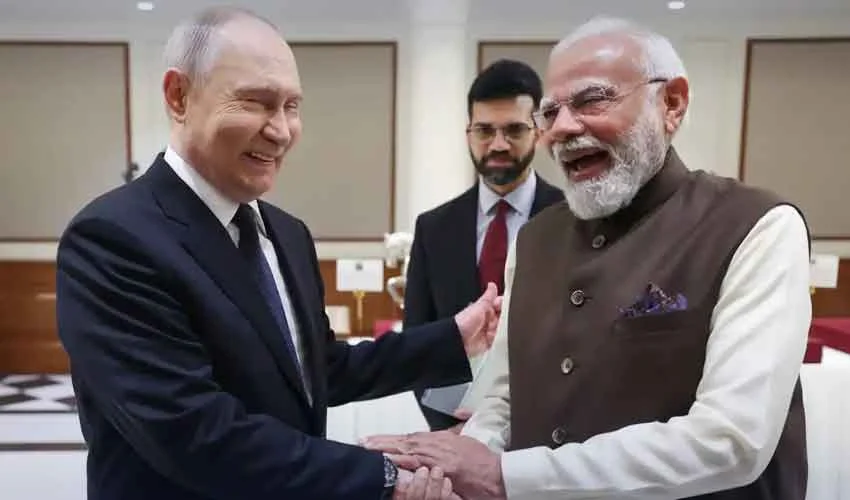
Russian President Vladimir Putin and Indian Prime Minister Narendra Modi began summit talks in New Delhi on Friday, marking Putin’s first visit to India in four years.
The meeting comes as India faces mounting US pressure over its Russian oil imports while seeking to strengthen long-standing strategic ties with Moscow.
During the opening session of their summit, Modi told Putin that India was committed to peace in Ukraine. “India is not neutral — India has a position, and that position is for peace,” Modi said. “We support every effort for peace.”
Putin thanked Modi for his “attention and efforts” to help resolve the conflict, noting he had briefed the Indian leader on ongoing discussions with partners, including the United States, about a possible settlement.
Putin added that expanding cooperation in high technology, aviation, space, artificial intelligence and military-technical fields would remain central to Russia–India ties.
Warm welcome, symbolic gestures
Putin landed in Delhi on Thursday to a rare personal welcome from Modi, who greeted him on the tarmac with a hug. The two leaders drove away in the same vehicle for a private dinner at Modi’s residence.
On Friday morning, Putin was honoured with a 21-gun salute at Rashtrapati Bhavan, underscoring the ceremonial importance India attaches to the visit.
Senior Russian ministers and a large business delegation are accompanying Putin, with major deals expected following formal talks.
Trade, defence, energy at core
Russia remains India’s top arms supplier and a key partner in energy security. The Kremlin hopes to boost trade to $100 billion by 2030, in part by importing more Indian goods to rebalance a trade relationship heavily weighted toward Russian crude exports.
Following Russia’s invasion of Ukraine, India increased purchases of discounted Russian oil but has recently scaled back under pressure from punitive US tariffs and tightening sanctions.
Despite this, Putin said in an interview with India Today that trade in crude oil and petroleum products was “running smoothly,” describing recent declines as a “minor adjustment.”
He also challenged Washington’s pressure on New Delhi: “If the US has the right to buy our [nuclear] fuel, why shouldn’t India have the same privilege?” he asked.
India argues Trump’s tariffs are unjustified and highlight that the US and EU continue importing Russian energy — from LNG to enriched uranium.
Pillar of ties
Russian Defence Minister Andrei Belousov held talks with Indian Defence Minister Rajnath Singh on Thursday. According to India’s defence ministry, Belousov said the Russian defence industry stands ready to support India’s goal of self-reliance in arms manufacturing.
Putin also emphasized Russia’s “trusting relationship” with India in military-technical cooperation.
Indian firms are expected to sign an agreement with Uralchem, Russia’s largest potash and ammonium nitrate producer, to set up a urea plant in Russia. Russian lenders Gazprombank and Alfa Bank have also sought approval to operate in India to facilitate smoother bilateral trade flows.
India–Russia trade surged from $13 billion in 2021 to nearly $69 billion in 2024–25, driven primarily by oil purchases. But bilateral trade for April–August 2025 fell to $28.25 billion due to declining crude imports.
India is now seeking new markets for goods affected by Trump’s 50% tariff, while Russia wants to diversify imports.
Trade Minister Piyush Goyal said India aims to grow exports of automobiles, electronics, heavy machinery, industrial components, textiles and foodstuffs to Russia.
India’s strategic dilemma
Foreign policy expert Michael Kugelman said New Delhi faces a “conundrum”: strengthening ties with either Moscow or Washington risks straining relations with the other.
India has refused to condemn Russia’s invasion of Ukraine, insisting that its ties with Moscow are unfairly targeted by Western countries that continue trading with Russia when convenient.
Putin’s visit comes a day after talks with Trump’s envoys on Ukraine peace efforts, which ended without a breakthrough.