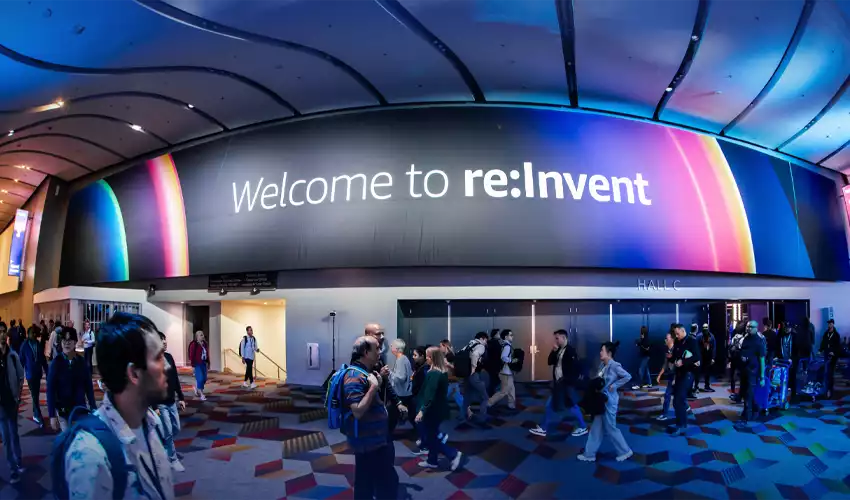
The era of the passive chatbot is evolving. At AWS re:Invent 2025, currently underway in Las Vegas, a new buzzword is dominating the conversation and promising to reshape the global workforce: Agentic AI.
Amazon has signaled a massive shift in the artificial intelligence landscape. We are moving away from simple “Generative AI”, tools that write poems or summarize emails upon request, toward “AI Agents” that autonomously plan, reason, and execute complex tasks to achieve specific goals. For businesses, the message is clear: the future isn’t about talking to AI; it’s about hiring it to perform work.

From Chatbots to Digital Workers
The distinction between the AI of 2024 and the Agentic AI of 2025 is the difference between a tool and a worker. Generative AI typically requires a user to prompt it for every step. It waits for instructions.
Agentic AI, conversely, works proactively. You give it a goal, not a prompt. For example, instead of asking ChatGPT to “write an email to a client,” a manager might tell an AI Agent to “plan and execute a lead generation campaign for Q1.” The Agent would then autonomously:
- Analyze customer data to identify targets.
- Draft personalized emails.
- Schedule the blasts.
- Monitor responses and update the CRM database.
- Book follow-up meetings with interested prospects.
It does all this across multiple software platforms without human hand-holding, stopping only to ask for clarification or approval on critical decisions.
Amazon’s Strategic Bet on “Action”
Amazon Web Services (AWS) is betting its dominance in the cloud market on this shift. During the conference, AWS executives highlighted new capabilities within Amazon Bedrock, the company’s service for building AI applications. The focus is no longer just on which Large Language Model (LLM) is the smartest, but on which system can best “use tools” and “take action.”
This resolves a major pain point for enterprises. CEOs don’t just want smarter text generators; they want efficiency. By integrating Agentic AI, AWS allows companies to build workflows where AI systems act as “digital employees,” accessing company data securely to solve problems that previously required human intervention.
The Rise of the “AI Manager”
This technological leap introduces a profound change in the Enterprise AI Trends dynamic. As 2025 unfolds, human roles will likely shift from “doing the work” to “managing the workers”—some of whom will be digital.
“Agentic workflows” allow AI to break down complex problems into smaller, manageable steps. It checks its own work, corrects errors, and iterates on solutions. For human managers, the skill set will evolve from prompt engineering (knowing what to ask) to outcome engineering (knowing what goals to set).

Why This Matters Now
The timing of this pivot is critical. While tools like OpenAI’s ChatGPT and Google’s Gemini dazzled the world with their ability to converse, businesses often struggled to find practical ROI beyond basic content creation. Agentic AI bridges that gap by turning potential into productivity.
As the presentations at AWS re:Invent 2025 continue, the industry consensus is forming rapidly: The novelty of talking to a machine is settling. In 2025, the real value lies in a machine that moves beyond conversation to deliver results.