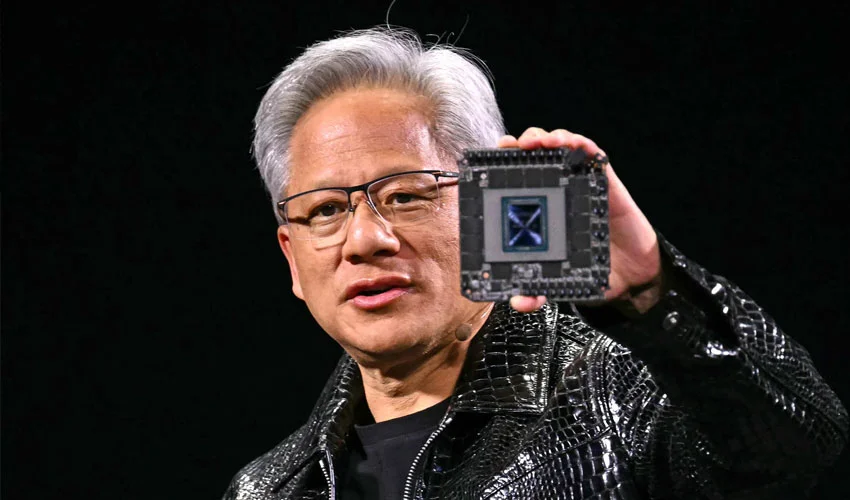
Nvidia has posted another blockbuster quarter, reporting record revenue and signalling even stronger growth ahead.
The company’s bullish earnings have quieted growing chatter about an “AI bubble,” with CEO Jensen Huang insisting the AI boom is only accelerating.
Nvidia reported $57 billion in revenue for the third quarter, marking a 62% increase from the same period last year. The company’s GAAP net income climbed to $32 billion, up 65% year-over-year, easily beating Wall Street expectations on both sales and profit.
The robust results highlight the company’s continued dominance in AI computing and data center hardware.
Data center business
Nvidia’s data center segment once again led the surge, generating a record $51.2 billion in revenue. This represents a 25% jump from the previous quarter and 66% growth over last year.
The remaining revenue came from:
Gaming: $4.2 billion
Professional visualization & automotive: combined $1.6 billion
CFO Colette Kress said the data center momentum is being driven by rapid advances in computing, powerful AI models, and the expansion of agentic AI applications.
During the quarter, Nvidia announced AI factory and infrastructure projects equivalent to an aggregate of 5 million GPUs, spanning cloud service providers, sovereign AI projects, enterprise clients, and supercomputing centers.
“These include multiple landmark build-outs across markets,” Kress added.
Blackwell GPUs lead the charge
The Blackwell Ultra GPU, unveiled in March, has become a major growth engine. Kress said demand remains “particularly strong,” with earlier versions of the Blackwell architecture also performing well.
CEO Jensen Huang described the sales trajectory in simple terms: “Blackwell sales are off the charts, and cloud GPUs are sold out.”
He added that compute demand for both AI training and inference continues to grow exponentially.
“We’ve entered the virtuous cycle of AI,” Huang said. “AI is going everywhere, doing everything, all at once.”
Despite the blockbuster quarter, Nvidia faced a setback with its H20 data center GPU — a chip designed for generative AI and high-performance computing.
The company shipped 50 million units, which Kress described as disappointing.
She said the shortfall stemmed from geopolitical tensions and export restrictions preventing Nvidia from selling more competitive products into China.
“Sizable purchase orders never materialized due to geopolitical issues and increased competition in China,” she said.
Kress added that Nvidia remains committed to engaging with both U.S. and Chinese authorities to ensure American companies can “compete around the world.”
Looking ahead, Nvidia expects $65 billion in revenue in the fourth quarter — another major jump that pushed its shares up more than 4% in after-hours trading.
For Huang, the message is clear: despite speculation, the AI market is far from overheating.
“There’s been a lot of talk about an AI bubble,” he said on the earnings call. “From our vantage point, we see something very different.”