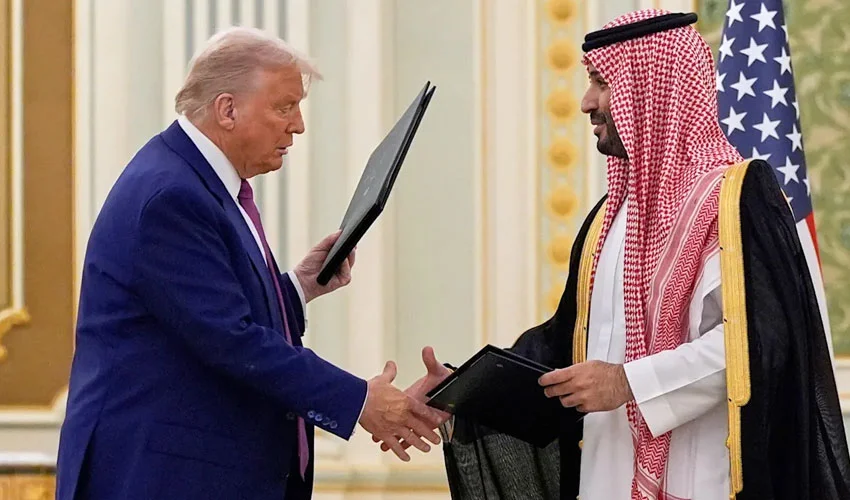
President Donald Trump announced on Monday that he intends to approve the sale of advanced F-35 fighter jets to Saudi Arabia, signaling a major shift in US policy on sophisticated weapons transfers to Arab nations.
The announcement comes just one day before Saudi Crown Prince Mohammed bin Salman visits the White House.
Speaking to reporters at the White House, Trump said, “We’ll be selling F-35s… They want to buy them. They’ve been a great ally.” The deal, if finalised, would mark Saudi Arabia as the first Arab country to join the F-35 programme.
The potential sale is seen as a diplomatic win for Riyadh, coinciding with Trump’s push for broader regional agreements, including efforts to encourage Saudi-Israel ties under the Abraham Accords.
Concerns over Israel’s qualitative military edge
The plan has sparked concerns in Israel over preserving its long-standing military superiority in the region. US law requires that Israel maintains a “qualitative military edge” over potential adversaries—a principle first introduced under President Lyndon Johnson and upheld by successive administrations.
Israeli officials, including former deputy army chief Yair Golan, warned the sale could trigger “an arms race in the Middle East” and erode Israel’s security advantage. National Security Minister Itamar Ben-Gvir stressed that Israel must maintain aerial superiority while remaining open to alliances with countries that respect its security.
Historically, Washington has mitigated such risks by either downgrading weapons sold to Arab states or supplying Israel with upgraded systems and additional equipment.
Background
Saudi Arabia has requested up to 48 F-35 fighters, a potential multibillion-dollar deal that has already cleared a Pentagon review. The jets, manufactured by Lockheed Martin, are widely regarded as the world’s most advanced fighters, featuring stealth technology that complicates enemy detection.
Trump previously approved an F-35 sale to the United Arab Emirates in 2020 after Abu Dhabi agreed to normalise relations with Israel. That deal was later halted under President Joe Biden due to congressional and security concerns.
Congress retains the authority to block arms sales, providing a potential check on any final deal with Riyadh.
Prince Mohammed’s visit comes amid ongoing instability in Gaza, with near-daily Israeli violations reported. Ahead of the trip, Saudi media reported that the Crown Prince received a handwritten letter from Iranian President Masoud Pezeshkian, though details were not disclosed.
Trump referenced US military actions in the region, including a June strike on Iran’s nuclear facilities, as evidence of America’s commitment to regional security.
Analysts say the F-35 sale could significantly alter the Middle East’s military balance and test Washington’s approach to balancing arms transfers with commitments to Israel.