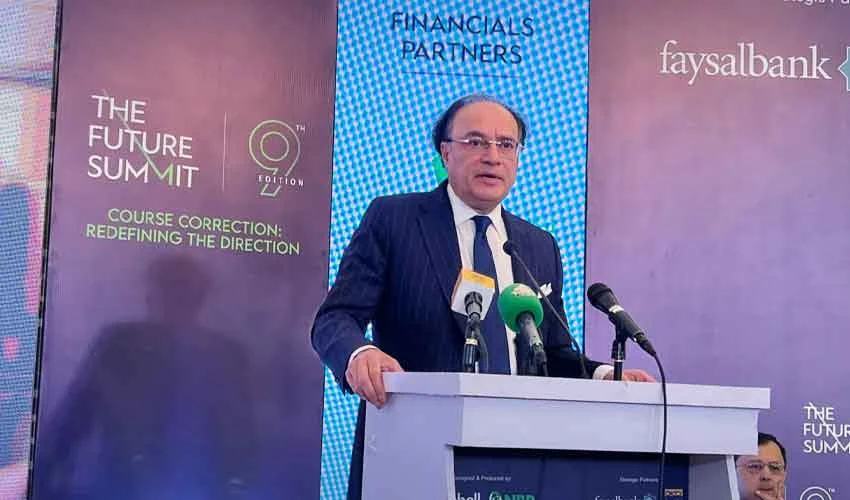
Federal Finance Minister Senator Muhammad Aurangzeb on Wednesday announced that Google will open an office in Pakistan, calling it a significant step toward transforming the country into a regional information technology hub.
Speaking to industrialists at the Karachi Chamber of Commerce, the minister said he recently met Google executives in Islamabad, who expressed a strong interest in helping Pakistan build a digital ecosystem. “They want to make Pakistan an IT hub,” Aurangzeb said, adding that the move reflects growing international confidence in Pakistan’s economy.
Aurangzeb highlighted that over the past one and a half years, the government has been actively implementing reforms in taxation, energy, state-owned enterprises (SOEs), privatization, and public finance.
He noted that the new $14.5 million investment arriving in Pakistan is particularly significant, sending a message to all stakeholders—including local and international partners—to “stay together” for sustained progress.
The finance minister underscored that population growth and climate change are two major challenges for Pakistan, urging immediate attention to the population issue.
Stable direction for Pakistan’s economy
Aurangzeb said Pakistan’s economy is now “sound” and moving in the right direction. Global rating agencies, he added, have recognized the country’s macroeconomic improvement.
He stressed that the private sector must play a pivotal role in ensuring stability and driving production-based economic development, which he called the “only sustainable path forward.”
Aurangzeb further stated that Pakistan aims to become an export hub, and digitization will help bring transparency and efficiency to the economic system. He revealed that 900,000 new tax filers have been added, showing progress in formalizing the economy.
Privatisation, AI development, structural reforms
The finance minister confirmed that PIA’s privatization will be completed within the year, and efforts are underway to rationalize the tariff regime in line with global trends.
He emphasized the need to build an ecosystem for AI-based development, saying that artificial intelligence can help curb “leakage and corruption,” particularly in sectors like cement, sugar, and tobacco.
Aurangzeb also revealed that Egypt has expressed interest in adopting “Pakistan-style economic reforms.”
He reiterated that macroeconomic stability should be viewed as “a means to investment, not an end goal.” Corporate profits, he said, have risen by 14% in 2025, and Pakistan remains viable for international investors.
Shifting toward modern economy
Aurangzeb urged that local investors must also feel confident in the system, as their trust is essential for attracting foreign investment. He called for a shift away from the traditional economy toward new sectors such as the blue economy and AI-driven industries.
“We must create digital infrastructure to support AI-based development,” he said, adding that Google’s cooperation will be instrumental in this transformation.
Leadership perspectives on growth, innovation
Federal Minister for Climate Change Senator Dr. Musadik Malik also addressed the Future Summit, stressing the importance of setting clear economic goals. “If we do not know where we are going, it is not possible to reach the destination,” he said.
Dr. Malik emphasized empowering local bodies to build “healthy neighbourhoods” and warned that smog reduces the lifespan of Punjab’s citizens by seven to eight years. He pointed out that production and innovation can only thrive in a competitive, level-playing field free from elite capture and protectionism.
Sindh CM highlights Karachi’s role
Sindh Chief Minister Murad Ali Shah described Karachi as the heartbeat of Pakistan’s economy, contributing nearly 50% of the country’s total exports.
He said the province’s youth — 60% of the population is under 30 — is its greatest asset. Highlighting development priorities, he announced that a record Rs 523.7 billion has been allocated for education in the upcoming budget.
Murad Ali Shah said e-governance is reducing bureaucracy and improving service delivery. “The era of reaction is over; now is the era of proactive governance,” he said, adding that “course correction is not a sign of failure but of courage, maturity, and accountability.”
He concluded that partnership, trust, and shared accountability will shape Pakistan’s future, asserting that while global changes cannot be stopped, their direction can always be corrected.