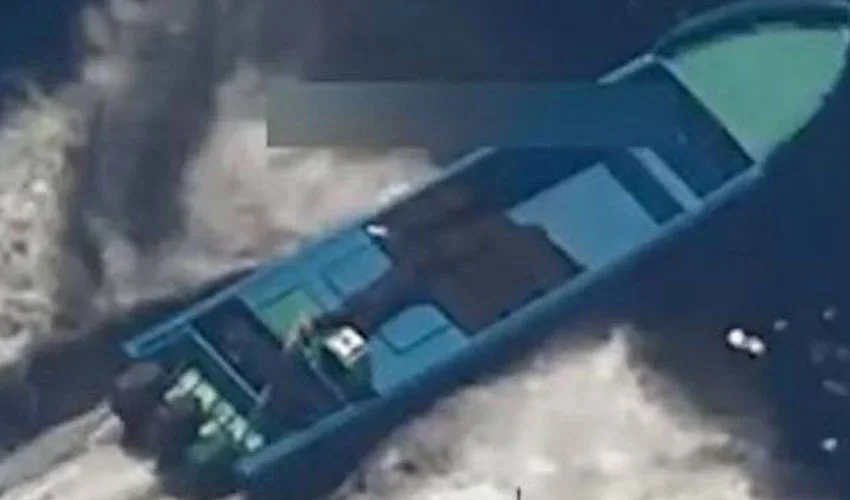
The U.S. military has carried out two deadly strikes against suspected drug-smuggling vessels in the eastern Pacific Ocean, killing five men in what officials describe as part of an intensified counter-narcotics campaign under President Donald Trump.
U.S. Defense Secretary Pete Hegseth announced on Wednesday that the military hit two vessels within 24 hours — one on Tuesday that killed two men, and another on Wednesday that killed three.
The incidents mark the first known U.S. military operations in the Pacific region since Trump launched a renewed offensive against the drug trade earlier this year.
According to Hegseth, the vessels were believed to be traveling along a known narco-trafficking route and were carrying illicit narcotics. He shared short video clips of both strikes on X (formerly Twitter), showing vessels cruising in open waters before erupting in explosions.
Part of broader US anti-narcotics campaign
The recent operations follow at least seven similar strikes in the Caribbean that have reportedly killed 32 people so far. The Trump administration, however, has provided little evidence about the amount of drugs found aboard or the intelligence used to justify these attacks.
News of the first Pacific strike was initially reported by CBS News. The Pentagon has not disclosed why it opted for lethal force rather than interdicting the vessels through the Coast Guard, which traditionally handles maritime law enforcement.
Regional backlash and political reactions
Colombian President Gustavo Petro strongly condemned the attacks, calling them “murder” and accusing Washington of violating international law. “Whether in the Caribbean or Pacific, the U.S. government strategy breaks the norms of international law,” Petro said, adding that Colombia’s Foreign Ministry has formally demanded an end to such strikes.
In contrast, Ecuadorean President Daniel Noboa — who has waged a domestic war against gangs — expressed support for Trump’s anti-narcotics drive.
When questioned by reporters in the Oval Office, Trump defended the legality of the strikes, claiming they “saved American lives.” He reiterated his willingness to extend military action to ground targets in Venezuela, saying he would “likely inform Congress” before doing so.
Military buildup and operation viper
The Pacific strikes come amid a growing U.S. military presence in the Caribbean, featuring guided missile destroyers, F-35 fighter jets, a nuclear submarine, and approximately 6,500 troops.
Meanwhile, the U.S. Coast Guard has been conducting Operation Viper, a major campaign to interdict narcotics shipments across the Pacific. As of October 15, it reported seizing over 100,000 pounds (45,000 kg) of cocaine.
The reason the latest Pacific vessel was struck rather than intercepted remains unclear.
Legal experts have questioned the expanding use of military force in what has historically been a law enforcement domain. Critics argue that the Pentagon’s involvement raises concerns about transparency, oversight, and compliance with international law.
Last week, Reuters reported that two men survived a previous U.S. strike in the Caribbean and were rescued by a Navy warship before being repatriated to Colombia and Ecuador.