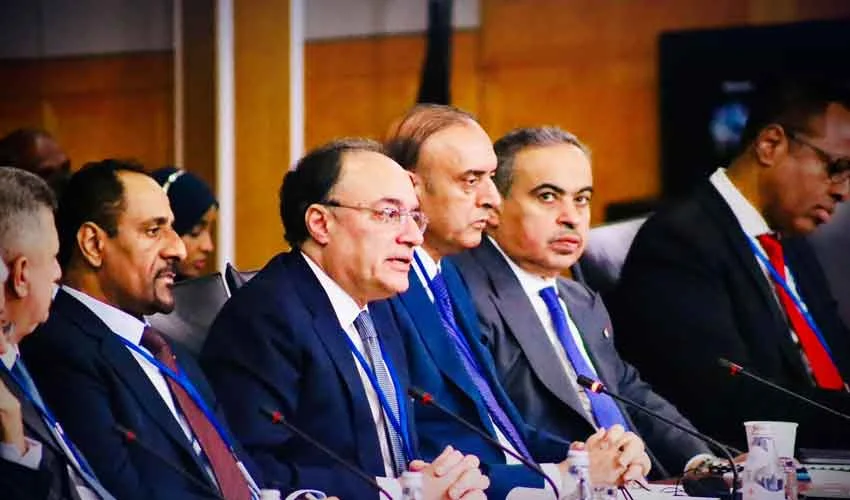
Finance Minister Muhammad Aurangzeb held a series of high-profile meetings during his ongoing visit to the United States, focusing on enhancing economic stability, attracting foreign investment, and reaffirming Pakistan’s commitment to fiscal and structural reforms.
In Washington, Aurangzeb met with IMF Managing Director Kristalina Georgieva, the Saudi Finance Minister Muhammad Abdullah Al-Jadaan, and top executives from leading global institutions, including the US International Development Finance Corporation (DFC), Standard Chartered Bank, and Multilateral Investment Guarantee Agency (MIGA).
Meeting with IMF chief Kristalina Georgieva
During his meeting with IMF Managing Director Kristalina Georgieva, Aurangzeb welcomed the recent staff-level agreement under the IMF program and reiterated Pakistan’s commitment to continuing reforms aimed at ensuring long-term economic stability.

He briefed the IMF chief on ongoing fiscal measures, progress in energy sector reforms, and Pakistan’s improved credit outlook, emphasizing the government’s resolve to sustain momentum on structural improvements. He also invited investors to invest in minerals, digital, agricultural, and pharmaceutical sectors.
Focus on investment and bilateral cooperation
In his meeting with Saudi Finance Minister Muhammad Al-Jadaan, Aurangzeb discussed ways to further strengthen investment relations between Pakistan and Saudi Arabia. He briefed his counterpart on the privatization progress of Pakistan International Airlines (PIA) and airport infrastructure projects, highlighting opportunities for Saudi participation in these ventures.

Aurangzeb also expressed Pakistan’s interest in securing Saudi support for major infrastructure projects, and both sides agreed on the importance of promoting private investment through collaboration with institutions like the International Finance Corporation (IFC) and MIGA.
Talks with US DFC, major financial institutions
The finance minister met US DFC CEO Benjamin Black to explore investment opportunities in oil and gas, minerals, agriculture, IT, and pharmaceuticals. Both sides agreed on the need to promote trade and investment ties between the two countries, with Aurangzeb reaffirming Pakistan’s openness to foreign investors.

He also held a productive session with a Standard Chartered Bank delegation, where discussions centred on the issuance of Panda Bonds, Eurobonds, and international Sukuk. Suggestions were sought for improving trade financing facilities, and Aurangzeb appreciated the bank’s longstanding partnership and support for Pakistan’s financial sector.
Meeting with MIGA, Azerbaijan’s deputy finance minister
In his meeting with MIGA Executive Vice President Hiroshi Matano, the finance minister thanked the agency for its cooperation in mediation matters and emphasized the timely implementation of trade finance facilities. He welcomed MIGA’s support for financing imports of food, fertilizers, energy, and machinery — key sectors vital to Pakistan’s economic growth.
Aurangzeb also met Azerbaijan’s Deputy Finance Minister Anar Karimov, with both sides agreeing on the importance of the Pakistan-Azerbaijan Preferential Trade and Transit Agreement in promoting bilateral trade. He congratulated Azerbaijan on successfully hosting COP 29 and underscored the need for expanding trade connectivity between the two countries.
Engagements with global forums and economic leaders
The finance minister attended the Barwars Forum Roundtable, where he highlighted the need to balance debt repayment with social investment and praised the forum’s role in promoting policy coordination and financial stability.
Aurangzeb also participated in the Coalition of Finance Ministers for Climate Action meeting and met with renowned economist Stephen Durcon and representatives from the Wall Street Journal to discuss Pakistan’s economic outlook and reform trajectory.
In a separate session with the Pakistan Bank Fund Staff Association, he reaffirmed his government’s dedication to fiscal discipline, green growth, and energy sector reforms, noting that Pakistan’s improving credit rating reflects growing global confidence in its economy.
Commitment to reform and growth
Minister Aurangzeb reiterated that Pakistan remains steadfast in its reform agenda under the IMF program. He emphasized that the government’s priority is to stabilize the economy, expand investment in key sectors like minerals, digital, agriculture, and pharmaceuticals, and build stronger partnerships with allies including Saudi Arabia, the United States, and Azerbaijan.
“There is broad consensus on promoting trade and investment in both countries,” Aurangzeb stated, reaffirming that Pakistan’s economic policy is focused on reform, resilience, and growth.