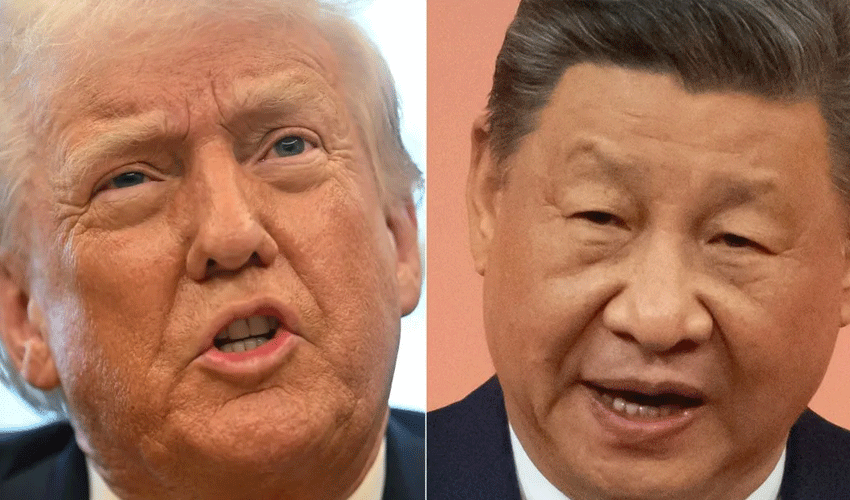
The trade rivalry between the United States and China has intensified once again after President Donald Trump announced a 100% tariff on Chinese imports and new export controls on sensitive technologies, prompting Beijing to tighten its grip on rare-earth metal exports.
In a post on social media, Trump said the tariffs and restrictions—set to take effect next month—were aimed at safeguarding U.S. economic and security interests. “Some very strange things are happening in China! They are becoming very hostile,” Trump wrote, accusing Beijing of trying to “hold the world captive.”
Markets react as Trump Threatens Xi meeting
The president’s remarks sent U.S. financial markets tumbling, with the S&P 500 closing down 2.7%, its steepest fall since April. Trump also hinted that he might cancel an upcoming meeting with Chinese President Xi Jinping, though later clarified he would still attend.
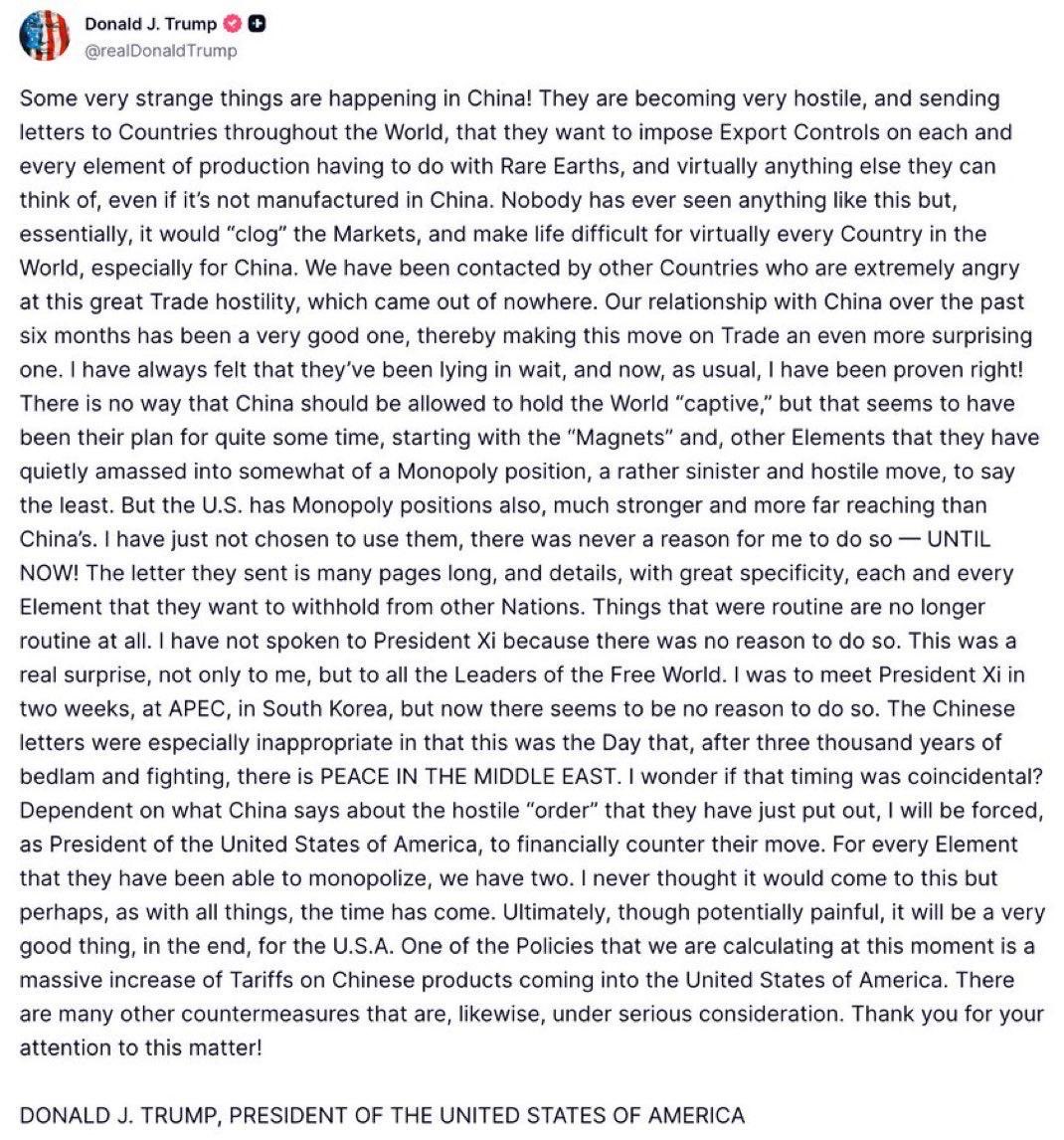
The fresh round of tariffs marks a sharp reversal from the trade détente both nations reached in May, when they agreed to drop triple-digit tariffs that had nearly frozen bilateral trade.
Rare-earth restrictions
Just hours before Trump’s announcement, China’s Ministry of Commerce issued a new directive—“announcement number 61 of 2025”—increasing export controls on five more rare-earth metals: holmium, erbium, thulium, europium, and ytterbium.
These add to the seven elements already restricted earlier this year, bringing China’s total controlled rare-earth elements to 12 out of 17. The country also placed new limits on the export of specialized refining equipment used in processing rare earths, effective from December 1.
National security and global supply risks
Beijing cited national security concerns for the move, saying foreign companies and individuals had used Chinese-origin materials for military applications without authorization.
“Rare-earth-related items have dual-use properties for both civilian and military applications. Implementing export controls on them is an international practice,” a ministry spokesperson said.
The restrictions mean that foreign companies must now seek approval from Beijing before exporting magnets or semiconductor materials containing even 0.1% heavy rare-earth content.
Why rare earths matter
Rare-earth metals are essential to modern technology—from electric cars and smartphones to jet engines and missiles. They play a critical role in U.S. defense production, including F-35 fighter jets, Tomahawk missiles, submarines, and radar systems, according to the Center for Strategic and International Studies (CSIS).
China dominates the global supply chain, mining 60% and processing 90% of the world’s rare-earth metals. Experts warn that tighter export controls could disrupt industries worldwide and give Beijing renewed leverage in its strategic standoff with Washington.
Trade war 2.0 looms
The escalating tit-for-tat moves mark a new phase in the U.S.-China trade war, threatening to destabilize markets and global supply chains once again.
Trump’s tariff announcement also comes as both sides prepare for a summit in South Korea later this month, where trade, TikTok, and semiconductor cooperation were expected to top the agenda.
For now, the latest escalation has injected fresh uncertainty into a relationship already strained by technology restrictions, security tensions, and economic rivalry.