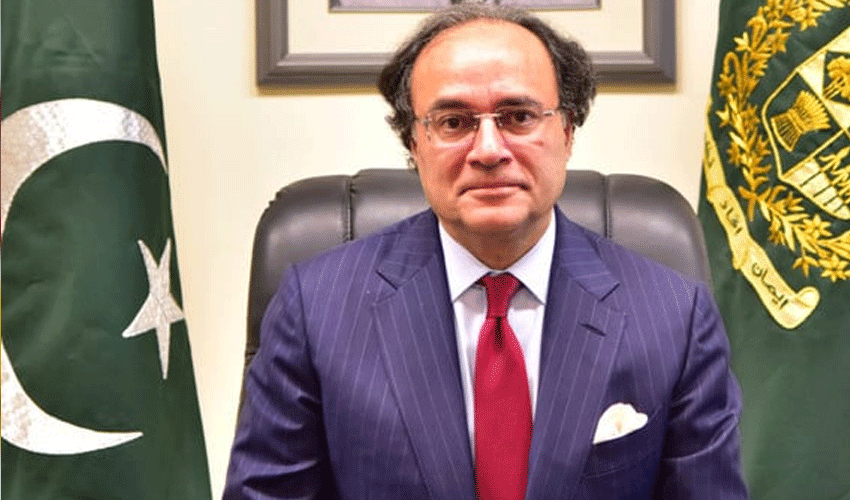
Federal Finance Minister Muhammad Aurangzeb has departed for Washington to attend the annual meetings of the International Monetary Fund (IMF) and the World Bank, where Pakistan’s crucial economic review talks are set to take place this week.
During his visit, Finance Minister Aurangzeb will meet World Bank President Ajay Banga and attend a dinner hosted by him for global finance ministers. He will also hold a one-on-one meeting with IMF Managing Director Kristalina Georgieva and address the Middle East, North Africa, Afghanistan, and Pakistan (MENAP) forum as a keynote speaker.
The minister is scheduled to participate in two significant events organized by the World Economic Forum (WEF) and meet his counterparts from China, Britain, Saudi Arabia, Turkey, and Azerbaijan.
Additionally, Aurangzeb will hold discussions with senior White House officials, meet the Chairman of the Financial Services Committee of the US Congress, and engage with leading members of the Pakistani community in the United States. He is also expected to give interviews to selected international and American media outlets.
IMF review and policy discussions
The next round of economic review talks between Pakistan and the IMF will be held in Washington alongside the annual meetings from October 13 to 18. The discussions aim to reach a staff-level agreement that could unlock the next $1.2 billion tranche under the ongoing loan programme.
Pakistan’s delegation — including the Finance Secretary and the Governor of the State Bank — will hold meetings with IMF and World Bank officials, IFC representatives, and global rating agencies.
Officials from the Finance Ministry have confirmed that the policy agenda will cover unresolved issues from the previous round of talks, focusing on fiscal discipline, governance, and economic stability.
Previous round ended without agreement
The last IMF review ended without a staff-level agreement, though both sides described the discussions as “constructive and positive.” The IMF had acknowledged Pakistan’s commitment to programme conditions but urged further reforms to maintain fiscal discipline and macroeconomic balance.
The lender also recommended maintaining a tight monetary policy, regular tariff adjustments, and advancing energy sector reforms to reduce financial losses.
Sources indicate that the IMF has emphasized tax and governance reforms, including the abolition of tax-free car import schemes and stricter implementation of baggage, gift, and residence transfer policies.
The Fund has also asked Pakistan to secure Economic Coordination Committee (ECC) approval for new policy measures later this month.
A key sticking point remains the governance and corruption report, with the IMF pushing for greater transparency and accountability. Among the proposals under review are mandatory asset declarations for civil servants in grades 17–22 and their families, alongside amendments to the Civil Servants Act, Election Act, NAB Ordinance, and FIA Act.
Despite the pending issues, officials at the Ministry of Finance remain optimistic that the upcoming review will lead to a breakthrough. If an agreement is reached, Pakistan could receive the $1.2 billion disbursement after the IMF Executive Board’s approval.