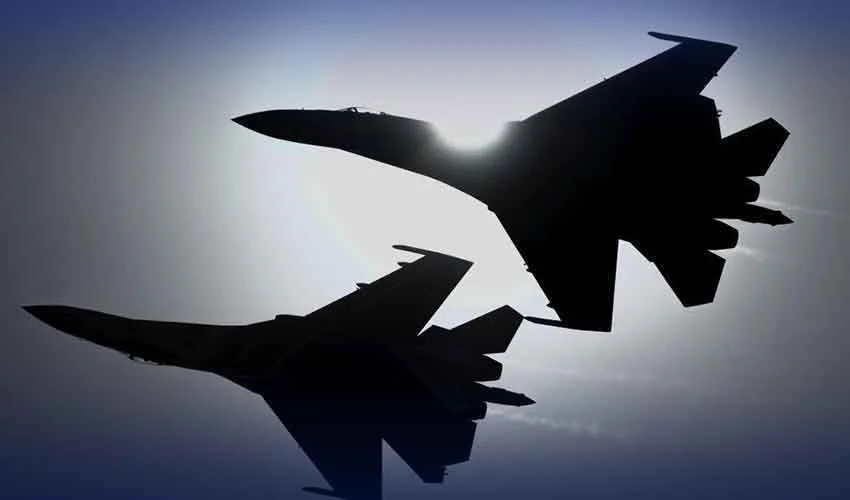
Following its 12-day war with Israel, Iran is reportedly preparing to modernize its air force by purchasing 48 Russian Su-35 fighter jets, according to a detailed report by Newsweek.
The deal, valued at over $7 billion, could significantly upgrade Iran’s aerial capabilities and deepen military cooperation between Tehran and Moscow.
The report follows the leak of classified documents online, allegedly from Rostec, Russia’s state-owned defense conglomerate. While neither Iranian nor Russian officials have confirmed or denied the agreement, analysts say the move could reshape the regional balance of power if proven true.
Hacker leak reveals details of alleged arms deal
According to Newsweek, the documents — released online by a hacker group called Black Mirror — include over 300 internal Rostec files outlining export contracts, pricing, and delivery timelines.
The leaked materials suggest that Tehran plans to acquire 48 Su-35 multirole jets equipped with advanced electronic warfare systems and avionics packages developed by KRET, a major Rostec subsidiary.
One document, labeled “Code 364”, reportedly corresponds to Iran and outlines a $686 million program with deliveries scheduled between 16 and 48 months. This means the first aircraft could arrive by 2026, with the final batch expected by 2028.
The files also mention the inclusion of Khibiny-M electronic warfare systems, designed to protect the aircraft from enemy radar and missiles.
Why deal matters
The possible Su-35 purchase comes in the aftermath of Iran’s recent 12-day conflict with Israel, during which US airstrikes targeted Iranian nuclear facilities, exposing weaknesses in Iran’s ageing air fleet.
Defense experts note that acquiring modern fourth-generation fighters like the Su-35 would vastly improve Iran’s air defense, deterrence capabilities, and ability to protect strategic infrastructure.
If verified, the deal would mark one of Russia’s largest arms exports since its invasion of Ukraine, highlighting growing defense cooperation between two heavily sanctioned nations.
Capabilities of Su-35
The Su-35 is among Russia’s most advanced fighter jets — a twin-engine, multirole aircraft designed for beyond-visual-range (BVR) combat. It features thrust-vectoring engines for superior agility, an Irbis-E radar capable of tracking multiple targets, and a payload capacity of up to 8,000 kilograms of missiles and bombs.
The aircraft competes with top Western jets like the F-15E Strike Eagle, F/A-18E/F Super Hornet, and Eurofighter Typhoon, making it a cornerstone of Russia’s export strategy.
Deepening Russia-Iran military ties
Reports of the deal come as Tehran and Moscow expand their strategic partnership. Just last month, Iran received a batch of Russian MiG-29 fighter jets, further enhancing its aerial strength.
Earlier this year, both nations signed the Iran-Russia Treaty on Comprehensive Strategic Partnership, which covers cooperation in defense, energy, and economic sectors. The treaty took effect this month, symbolizing a closer alignment between the two countries amid Western sanctions.
Algeria’s involvement in Rostec leaks
Interestingly, the leaked Rostec documents also reference “Code 012,” which appears to involve Algeria. The file lists 12 Su-57E stealth fighters and Su-34 support kits valued at $414 million.
If confirmed, Algeria would become the first African country to operate fifth-generation fighter jets, strengthening its military presence across the western Mediterranean.
Russia’s shrinking defense exports
The alleged Su-35 deal comes as Russia faces a sharp decline in global arms exports. According to the Jamestown Foundation, Russian defense shipments have dropped by 92% between 2021 and 2024, largely due to sanctions and the ongoing war in Ukraine.
As a result, major deals with nations like Iran and Algeria are increasingly critical for sustaining Russia’s defense industry and offsetting wartime production challenges.
What happens next
Neither Tehran nor Moscow has officially confirmed the existence of the deal. However, if verified, the agreement would modernize Iran’s air power, enhance its regional defense capabilities, and mark a new phase in Iran-Russia strategic cooperation.
Experts suggest the deal could alter the balance of airpower in the Middle East, posing new challenges for the United States, Israel, and Gulf allies in the region.