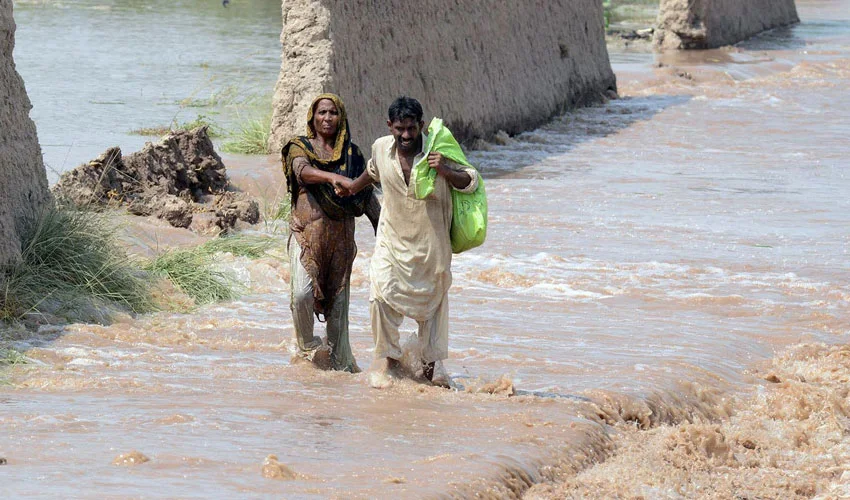
Pakistan has formally requested international assistance to accurately determine the devastation caused by recent floods, which claimed over 1,000 lives and left widespread destruction across the country.
Officials say the move aims to ensure a reliable assessment of both human and economic losses.
Pakistan reaches out to global partners
The Economic Affairs Division has written to the World Bank, Asian Development Bank (ADB), European Union, and the United Nations Development Programme (UNDP), seeking technical assistance from international experts.
According to officials, the purpose of this collaboration is to calculate precise estimates of the losses, including the damage to life, infrastructure, property, agriculture, and rural livelihoods.
Soon after, the World Bank confirmed its readiness to provide technical assistance to Pakistan in assessing flood damage. According to sources, the World Bank received Pakistan’s formal request for support and has responded positively.
World Bank officials confirmed to Samaa TV that a letter of assistance had been received, outlining the Bank’s commitment to help estimate the scale of losses caused by the floods.
Initial estimates cross Rs700bn
Sources in the Ministry of Planning revealed that the initial estimate of losses already exceeds Rs700 billion. However, authorities stress the need for independent verification to ensure credibility and accuracy before moving towards long-term recovery and reconstruction plans.
Human toll of floods
The floods have left a heavy human cost. Over 1,000 people lost their lives, while more than 1,100 were injured.
Khyber Pakhtunkhwa recorded the highest number of deaths, with over 500 fatalities. Large-scale destruction was also reported in Punjab, Gilgit-Baltistan, and Azad Kashmir, where agriculture, homes, and critical infrastructure were badly hit.
The officials said the floods caused the most damage to agriculture and rural areas in Punjab. Roads and bridges in remote areas of Gilgit-Baltistan were destroyed, they added. Infrastructure and residential areas were also damaged in Azad Kashmir.
Widespread damage across provinces
Officials confirmed that more than 12,500 houses and over 240 bridges have been damaged nationwide. Roads, schools, and hospitals were also destroyed in several areas, cutting off essential services in already hard-to-reach communities.
Agricultural fields and rural areas remain among the worst affected, threatening food security and livelihoods in the months ahead.
Punjab flood survey
Meanwhile, the largest flood survey in Punjab’s history is currently underway, according to the Provincial Disaster Management Authority (PDMA). A spokesperson for PDMA Punjab said that 1,857 survey teams are collecting data across 27 flood-affected districts. So far, details of 81,510 victims have been recorded.
The survey teams have checked crop damage from 56,207 farmers and identified 53,985 acres of flood-affected land. Data has also been collected on 24,246 houses damaged by the floods.
In addition, details from 1,057 people who lost livestock have been documented, with the survey confirming 3,945 dead animals.
Representatives from the Urban Unit, Revenue, Agriculture, Livestock departments, and the Pakistan Army are actively participating in the survey, said PDMA DG Irfan Ali.
He added that PDMA is reviewing the survey’s progress on a daily basis. Teams are also visiting affected villages using boats and collecting data by wading through floodwaters.
The DG assured that the district administration and relevant agencies are working around the clock to ensure transparency in the process. “We will not deviate even an inch from the Punjab chief minister’s vision,” Kathia emphasized.