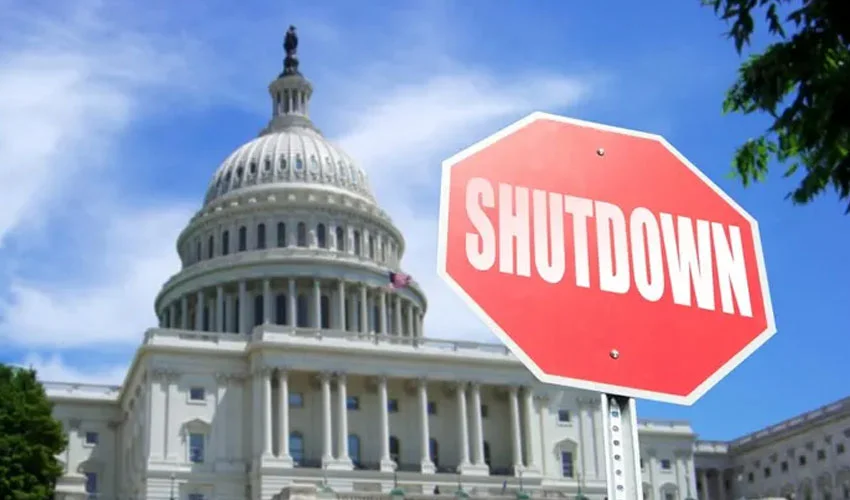
The United States government has officially entered a shutdown, its 15th since 1981, after sharp partisan divisions blocked a funding deal in Congress.
The closure, which began Wednesday, is expected to furlough 750,000 federal employees, disrupt key services, and cost the economy $400 million per day.
The deadlock will immediately halt the release of the closely watched September jobs report, slow air travel, suspend scientific research, withhold pay from U.S. troops, and freeze thousands of federal programs. Independent analysts warn the standoff could last longer than previous shutdowns, intensifying economic and social strain.
At the heart of the dispute is $1.7 trillion in funding for government agencies, representing about a quarter of Washington’s $7 trillion budget. The remaining budget covers healthcare, retirement programs, and interest payments on the ballooning $37.5 trillion national debt.
Trump’s role and warnings
Former President Donald Trump, whose campaign is focused on reshaping the federal government, has suggested the shutdown could pave the way for “irreversible” cuts, including mass layoffs and elimination of certain programs. His budget director, Russell Vought, warned last week that permanent layoffs could follow if Congress fails to act.
The crisis comes as Trump seeks to push out as many as 300,000 federal workers by December as part of his broader restructuring agenda.
Political divide over healthcare funding
The immediate trigger came when Senate Democrats rejected a short-term spending measure that would have extended funding until November 21. They opposed the bill due to the absence of healthcare subsidies for millions of Americans, which are set to expire by year’s end.
Republicans countered that the healthcare issue should be dealt with separately, accusing Democrats of stalling progress for political gain.
“This is politics. There isn’t any substantive reason why there ought to be a government shutdown,” Senate Majority Leader John Thune said, describing the rejected bill as “nonpartisan.”
Senate Democratic leader Chuck Schumer pushed back: “All they want to do is try to bully us. And they’re not going to succeed.”
Historical context
The U.S. experienced its longest government shutdown during Trump’s first term, stretching 35 days between December 2018 and January 2019 in a dispute over border wall funding.
The current shutdown, however, comes in an even more polarized environment. Political analysts note that the assassination of conservative activist Charlie Kirk and the rise of extreme factions within both parties have made bipartisan compromise increasingly difficult.
“The rules of politics are radically changing and we can’t know for sure where all of this is going to end,” said Robert Pape, a political science professor at the University of Chicago.
Adding to the controversy, Trump recently shared a deepfake video mocking Democratic leaders Chuck Schumer and Hakeem Jeffries. Schumer blasted the move as “childish” and evidence of how “unserious” the White House is about the crisis.
“It’s something that a 5-year-old would do, not a president of the United States,” Schumer told reporters.