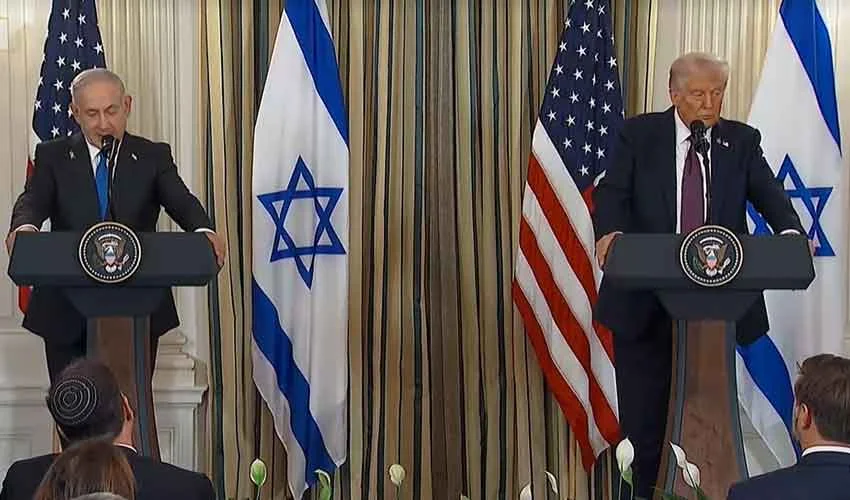
US President Donald Trump and Israeli Prime Minister Benjamin Netanyahu held a joint press conference at the White House on Monday, unveiling a 21-principle peace plan aimed at ending the nearly two-year war in Gaza.
Trump hailed the plan as “historic” and “one of the greatest days ever in civilisation,” while Netanyahu voiced full support, calling it a roadmap to lasting security for Israel and peace in the Middle East.
Trump declares peace deal ‘beyond very close’
Opening the conference, Trump said he was working closely with Netanyahu to secure “peace in the Middle East,” describing the moment as potentially historic.
“Today is a historic day for peace. This plan is extremely fair and if accepted, it will immediately end the war in Gaza,” Trump said.
The US president revealed that the proposal had been shaped with input from Arab, Muslim, and European allies, thanking leaders from Saudi Arabia, Qatar, the UAE, Egypt, Pakistan, and Jordan for their involvement. “The Pakistani prime minister and field marshal fully support my peace plan. Shehbaz Sharif and Field Marshal agreed to the 20-point peace plan,” he added.
Key features of peace plan
Trump outlined the main points of the 21-principle framework:
- Release of Hostages: All captives held by Hamas would be freed, with the bodies of deceased hostages returned.
- Ceasefire and Withdrawal: The war in Gaza would end immediately, with the Israel Defense Forces (IDF) withdrawing in phases.
- Demilitarisation of Gaza: Arab and Muslim countries pledged to dismantle Hamas tunnels, weapons facilities, and enforce demilitarisation.
- Local Security: New police forces would be trained to maintain stability.
- Oversight: A “Board of Peace,” chaired by Trump and including international leaders, would supervise implementation.
Trump also said former UK Prime Minister Tony Blair had expressed interest in joining the oversight board.
Hamas holds key
The US president stressed that Hamas was the only party yet to agree to the deal. “They have to deal with Hamas. If they don’t, Israel will have full US backing to finish the job of destroying the threat of Hamas,” Trump warned.
“So now it’s time for Hamas to accept the terms of the plan that we’ve put forward today. And again, this is a different Hamas than we were dealing with because I guess over 20,000 have been killed. Their leadership has been killed three times over. So you’re really dealing with different people than we’ve been dealing with over the last four years, five years,” he said.
He added that many Palestinians “want to live in peace” and deserved the chance to “take responsibility for their destiny.”
Netanyahu hails Trump’s leadership
Taking the podium, Prime Minister Netanyahu praised Trump as Israel’s “greatest friend ever in the White House.”
“I support your plan to end the war in Gaza. This is a critical step not just to end the conflict but to set the table for peace across the Middle East,” Netanyahu said.
He added that the deal would guarantee Israel is never again threatened by Hamas, while commending Israeli soldiers for their sacrifices in defending the country.
“Israel will retain security responsibility, including a security perimeter, for the foreseeable future,” Netanyahu said. “Gaza will have a peaceful civilian administration that is run neither by Hamas nor by the Palestinian Authority,” he said.
Trump’s plan includes the establishment of a “temporary transitional governance of a technocratic, apolitical Palestinian committee, responsible for delivering the day-to-day running of public services and municipalities for the people in Gaza, overseen by a “Board of Peace” that Trump will run. Fomer Prime Minister Tony Blair will be a member, Trump’s plan says.
Hamas has rejected the idea of foreign oversight.
“If Hamas rejects your plan, Mr. President, or if they supposedly accept it, and then then, basically do everything to counter it, then Israel will finish the job by itself. This can be done the easy way, or it can be done the hard way, but it will be done,” Netanyahu said.
Looking ahead
Trump suggested that the peace process could eventually include Iran, praising the Abraham Accords and hinting at Tehran’s possible participation in future regional agreements. “At some point, Iran will be a member of the accords. It would be a great thing for them economically,” he said.
Both leaders agreed the path to peace would be difficult but stressed that “too many lives are at stake” not to try.