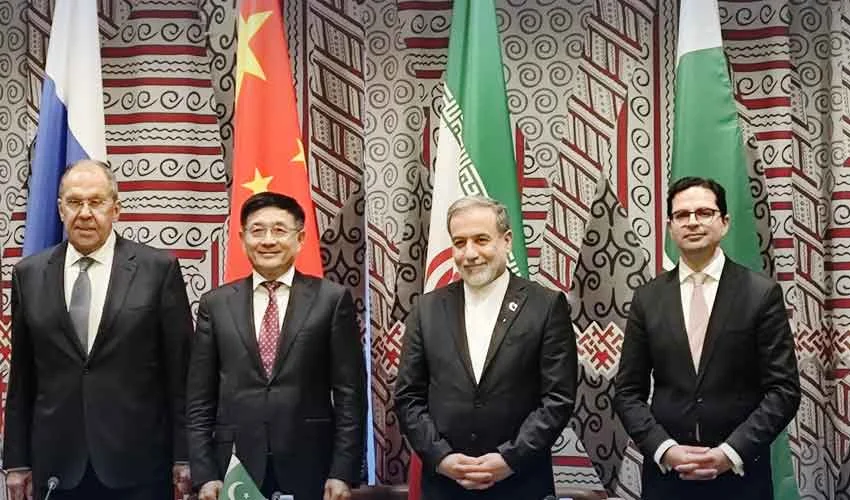
The fourth quadrilateral meeting of the foreign ministers of Pakistan, China, Iran, and Russia on Afghanistan took place in New York on Thursday, on the sidelines of the 80th United Nations General Assembly.
Hosted by the Russian Federation, the session focused on peace, stability, and the growing security challenges in Afghanistan. The four nations also vowed to continue close consultation and cooperation to resolve the Afghan issue, according to a statement by the Foreign Office of Pakistan.
Joint call for peaceful and independent Afghanistan
The four foreign ministers reaffirmed their support for Afghanistan as an independent, united, and peaceful state free from terrorism, war, and narcotics. They stressed the importance of integrating Afghanistan into regional economic cooperation and expanding trade and connectivity projects to ease the suffering of the Afghan people.
Adjusting sanctions and ensuring humanitarian aid
The ministers recognized the need to appropriately adjust the 1988 UN sanctions regime to reflect realities on the ground. They highlighted the importance of granting travel ban exemptions for designated Taliban officials to advance diplomacy and peacebuilding.
They also emphasized that humanitarian support should not be politicized. Instead, the international community must intensify aid delivery, delinked from political agendas, to address the urgent needs of Afghan citizens.
Growing threat of terrorism in Afghanistan
A major concern expressed by the four countries was the rising threat of terrorism. The joint statement specifically named ISIL, Al-Qaeda, ETIM, TTP, Jaish ul-Adl, BLA, Majeed Brigade, and other groups based in Afghanistan as posing serious threats to regional and global stability.
The ministers called on Afghan authorities to take concrete and verifiable measures to dismantle terrorist networks, prevent recruitment and fundraising, shut down training camps, and stop terrorist access to weapons. They also urged Afghanistan to prevent its territory from being used against neighbours and the wider region.
Counter-narcotics and drug trafficking measures
The ministers commended Afghan authorities for reducing opium cultivation but warned of the rise in synthetic drugs, especially methamphetamine. They called for stronger international cooperation to dismantle drug trafficking networks, cut off narcotics transit routes, and support alternative agriculture to help Afghan farmers build a society free from drug abuse.
Refugee return and international responsibility
The four sides urged Afghan authorities to create conditions that allow the safe return of Afghan refugees and prevent further migration. They appreciated Pakistan and Iran’s role in hosting millions of Afghan refugees and called on the international community to provide sustainable financial and logistical support for repatriation and reintegration programs.
Inclusive governance and rights of Afghans
The ministers stressed the importance of inclusive and broad-based governance that represents all segments of Afghan society. They highlighted that ensuring women and girls’ access to education, work, and public participation is vital for Afghanistan’s stability and prosperity.
Responsibility of NATO, western countries
In a strong statement, the four countries held NATO members responsible for Afghanistan’s current plight. They demanded the lifting of unilateral sanctions, the release of Afghanistan’s frozen assets, and the creation of opportunities for the country’s economic recovery and development.
They also opposed any plans to reestablish foreign military bases in or around Afghanistan, warning that such actions would undermine regional peace.
Support for diplomatic efforts
The ministers welcomed all diplomatic efforts for a political settlement in Afghanistan. They particularly supported initiatives under the United Nations, the Moscow Format, the Foreign Ministers’ Meeting of Afghanistan’s Neighbouring Countries, and the Shanghai Cooperation Organization.
They also welcomed the recent quadrilateral meeting of special representatives held in Dushanbe, Tajikistan, on 12 September 2025, and encouraged continuation of such consultations.