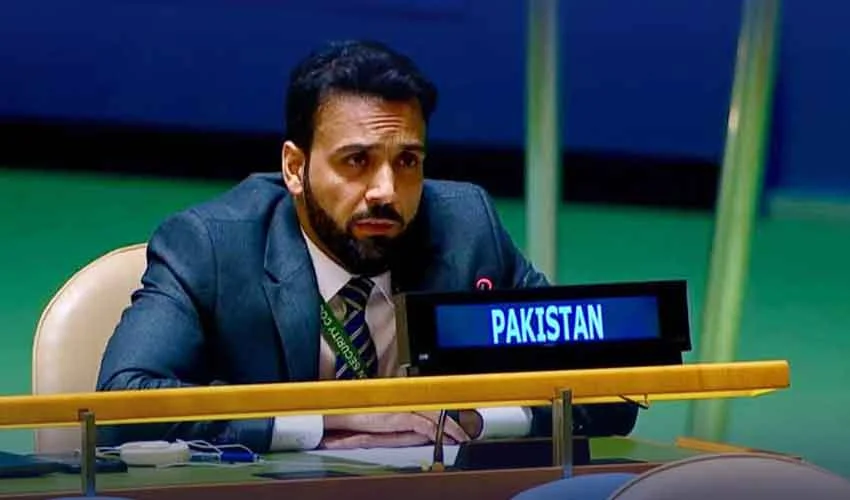
At the UN General Assembly in New York, Pakistan strongly condemned India’s use of the term “Terroristan” to distort the country’s name, calling it “utterly shameful” and petty.
The remarks were made during a heated right of reply session, marking the second sharp clash between the two neighbours in the current UNGA session.
Pakistan calls out India for mockery
Muhammad Rashid, second secretary at Pakistan’s UN Mission, told the 193-member Assembly that India’s attempt to distort Pakistan’s name was both undignified and insulting to an entire people.
“Resorting to mockery of a sovereign nation-state’s name is not just undignified, it is also a deliberate attempt to malign and insult an entire people.
“It is utterly shameful that India stoops so low as to distort the very name of a country, a member of the United Nations. This is not a local political congregation,” Rashid said. “By engaging in this kind of rhetoric, India diminishes its own credibility, showing the world that it has no substantive argument to offer — only, I am sorry to say, cheap slurs which are not worthy of serious discourse.”
India’s ‘Terroristan’ label
India’s diplomat Rentala Srinivas had accused Pakistan of promoting terrorism, declaring that “no arguments or untruths can ever whitewash the crimes of Terroristan.”
Also Read: Pakistan, China, Iran, Russia call for stronger action on terrorism in Afghanistan
Rashid hit back sharply, saying India’s use of such language reflects frustration and immaturity, exposing its “pettiness on the world stage.”
Pakistan accuses India of sponsoring terrorism
The Pakistani diplomat went further, accusing India of being “implicated in supporting and sponsoring terrorism” beyond its borders through networks run by its intelligence agencies to destabilise its neighbouring countries. These operatives, he said, have been accused of financing and directing groups engaged in sabotage and targeted killings across the world.
“Undermining regional stability and violating international law is a habit for India,” Rashid said, accusing New Delhi of fuelling terrorism rather than combating it.
Clash over Jaishankar’s UNGA remarks
Earlier, Pakistan also objected to remarks made by Indian External Affairs Minister S. Jaishankar, who accused Pakistan of sponsoring terrorism and branded the country as the “epicentre of global terrorism”.
Also Read: Trump wants American firms to start investing in Pakistan immediately: PM
Rashid dismissed the statement as factually baseless, calling India a “serial perpetrator of terrorism and a regional bully holding South Asia hostage to its hegemonic designs and radical ideology”. He said Pakistan has sacrificed over 90,000 lives in its fight against terrorism — sacrifices widely recognized by the international community.
“India’s unlawful and reckless behaviour must not be ignored by the international community,” he said.
Human rights in Kashmir
Rashid also highlighted that India is in the league of those who illegally occupy territories, oppress populations and violate fundamental human rights, as is the case in Indian-occupied Kashmir. He accused India of “state terrorism” through extrajudicial killings, arbitrary arrests, detentions, staged encounters, and collective punishment under the guise of counterterrorism.
He cited the case of Commander Kulbhushan Jadhav, a serving Indian naval officer caught spying in Pakistan, as evidence of India’s cross-border “terrorist web” and clandestine networks through its proxies, both inside Pakistan and beyond.
Pahalgam incident, cross-border aggression
Responding to Jaishankar’s “bizarre and untenable claims” about the Pahalgam incident, Rashid said India routinely blames Pakistan “without evidence, logic, or investigation.” He noted that Pakistan had condemned the attack alongside UN Security Council members and even offered an independent investigation — an offer India rejected.
“No surprise, that till this day, no evidence related to that incident has been shared by this country.”
Also Read: ‘India will always remember our response’, says PM Shehbaz
Instead, Rashid said, India used the incident as a pretext to launch aggression against Pakistan from May 7–10, which killed 54 civilians, including 15 children and 13 women.
Pakistan’s military response
Pakistan, Rashid added, exercised its right to self-defense under Article 51 of the UN Charter, targeting only military assets, delivering a befitting yet carefully calibrated response. The response resulted in the downing of multiple Indian aircraft and other significant military setbacks for India.
Pakistan reaffirms commitment to peace
Despite the sharp exchange, Rashid reaffirmed Pakistan’s commitment to dialogue, diplomacy, and regional peace.
“More than 1.9 billion people of South Asia deserve prosperity and stability,” he said. “True progress requires sincerity, mutual respect, and diplomacy—principles Pakistan upholds, and which India must embrace if it truly seeks peace.”