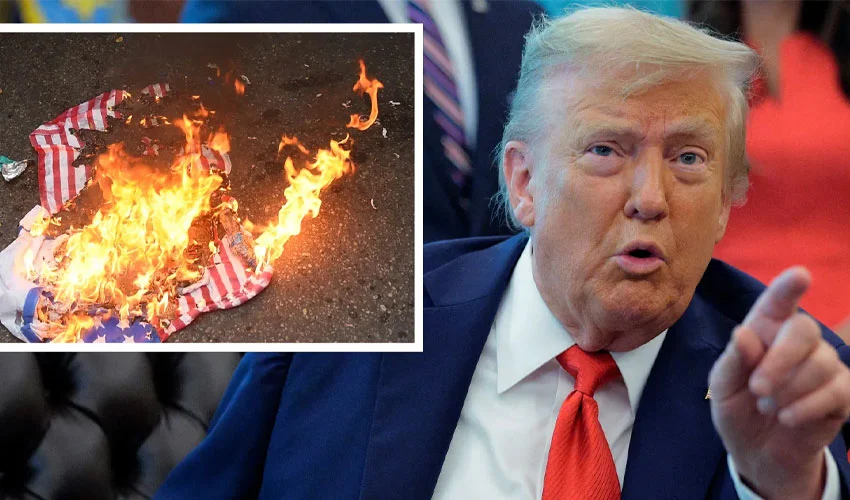
President Donald Trump signed an executive order instructing the Justice Department to prosecute individuals who burn the American flag, prescribing a mandatory one-year prison sentence.
Trump’s order mandates that Attorney General Pam Bondi pursue prosecution of anyone who burns or desecrates the U.S. flag—with no early releases or leniency—and directs prosecutors to challenge the 1989 Supreme Court ruling in Texas v. Johnson, which affirmed that flag burning is symbolic expression fully protected under the First Amendment.
Constitutional backdrop
The Supreme Court’s landmark decision in Texas v. Johnson (1989) held that flag burning is protected political speech, reaffirmed by United States v. Eichman (1990), invalidating both state and federal prohibitions on flag desecration.
Free speech advocates swiftly condemned the order. The Foundation for Individual Rights and Expression (FIRE) asserted that the president “cannot override constitutional protections by executive action.” Legal experts and commentators also warned that the order lacks evidence linking flag burning to violence, making it a “solution in search of a problem.”
Critics argue Trump is stretching executive authority in pursuit of a populist, law-and-order agenda. The directive also targets foreign nationals, threatening visa revocations and deportation for non-citizens who desecrate the flag—drawing comparisons to authoritarian symbolic-loyalty laws.
In a Washington Post commentary, analysts highlighted the irony of Trump attempting to criminalize an act defended by conservative icon Justice Antonin Scalia in the Texas v. Johnson ruling—an act that underscores his departure from traditional constitutional originalism.