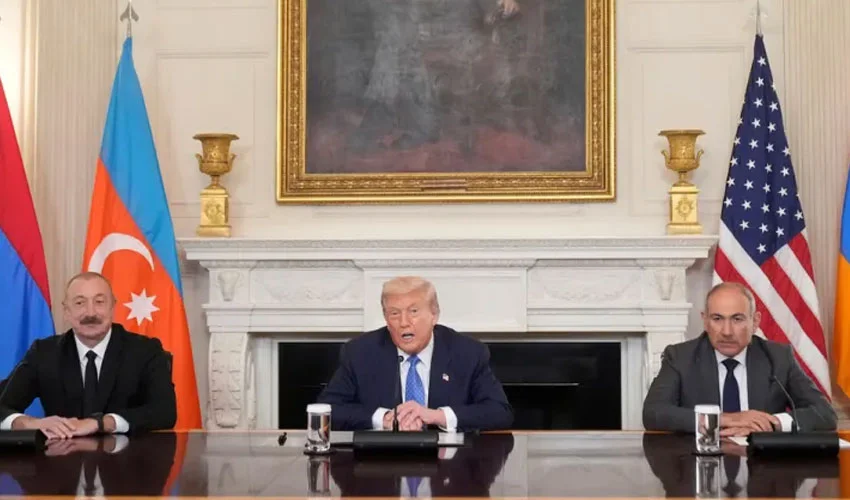
Azerbaijan and Armenia have signed a landmark accord brokered by former US President Donald Trump at the White House, aiming to end decades of hostility.
The deal promises a new transport corridor and economic cooperation, but human rights concerns and historical grievances remain unresolved.
Trump hailed the agreement as a “momentous joint declaration,” praising Armenian Prime Minister Nikol Pashinyan and Azerbaijani President Ilham Aliyev for their willingness to engage.
“This is a historic day for peace and prosperity in the Caucasus,” Trump said, adding that the transport route would be dubbed the “Trump Route for International Peace and Prosperity.” The US will hold exclusive development rights for the corridor, which is expected to attract significant American investment.
Transport corridor and economic promise
The accord establishes a transportation link between the two countries, aiming to boost trade and regional connectivity. American companies are expected to spearhead infrastructure projects, with plans for cooperation in energy, trade, and emerging technologies such as artificial intelligence.
Aliyev welcomed the lifting of long-standing US restrictions on security coordination with Azerbaijan, in place since 1992. “If any of us had in mind to step back, we wouldn’t have come here,” he said, calling the deal the beginning of “eternal peace in the Caucasus.”
Unresolved wounds from Nagorno-Karabakh conflict
Despite optimism, deep mistrust persists. The two nations have fought multiple wars over Nagorno-Karabakh, a territory within Azerbaijan but historically populated by ethnic Armenians.
Azerbaijan’s 2023 military campaign to reclaim the enclave forced tens of thousands of Armenians to flee, with rights groups accusing Baku of using starvation as a weapon of war. Critics, including the Armenian National Committee of America, say the current deal was reached “at gunpoint” and does not address the displacement crisis.
While the accord signals a potential economic boom and reduced hostilities, experts warn that without reconciliation and accountability, peace could be fragile. The coming months will test whether the agreement can translate into genuine stability for the Caucasus.